1. Laboratory of Molecular Imaging and Nanomedicine (LOMIN), National Institute of Biomedical Imaging and Bioengineering (NIBIB), National Institutes of Health (NIH), Bethesda, Maryland.
Theranostics. 2011;1:251-62. doi: 10.7150/thno/v01p0251. Epub 2011 Apr 19.
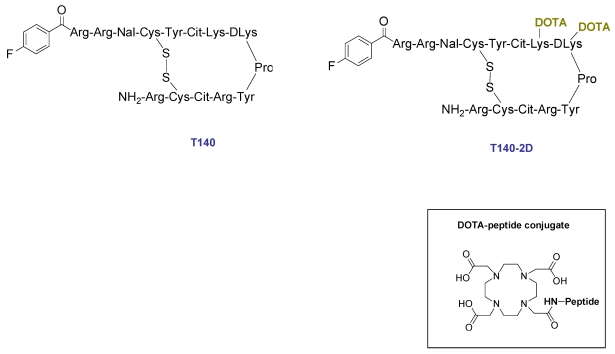
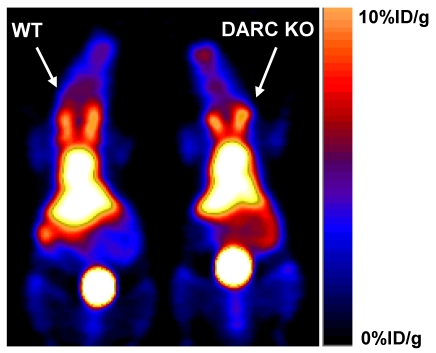
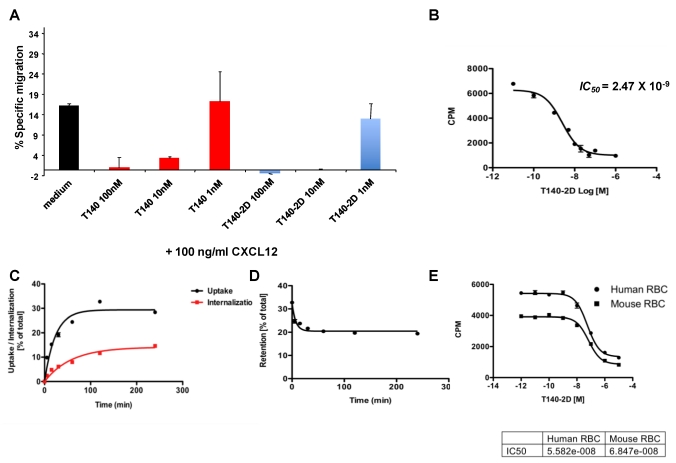
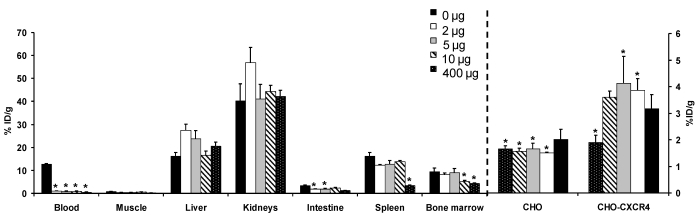
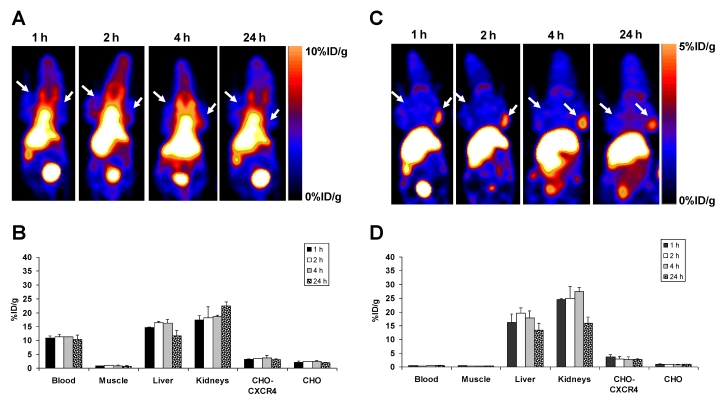
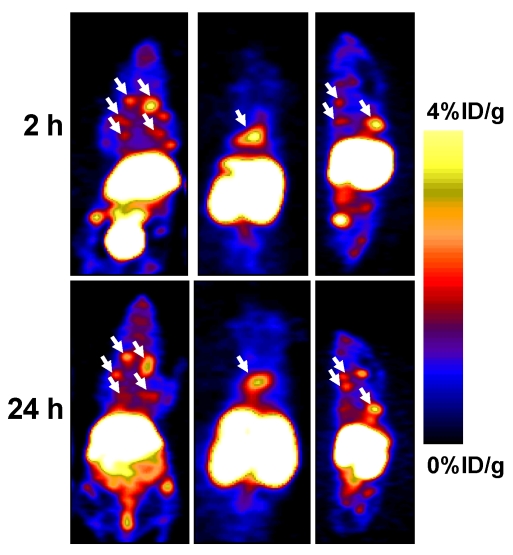
Expression of CXCR4 in cancer has been found to correlate with poor prognosis and resistance to chemotherapy. In this study we developed a derivative of the CXCR4 peptide antagonist, T140-2D, that can be labeled easily with the PET isotope copper-64, and thereby enable in vivo visualization of CXCR4 in tumors. T140 was conjugated to 1,4,7,10-tetraazacyclododecane-1,4,7,10-tetraacetic acid mono (N-hydroxysuccinimide ester) (DOTA-NHS) to give T140-2D, which contains a DOTA molecule on each of the two lysine residues. (64)Cu-T140-2D was evaluated in vitro by migration and binding experiments, and in vivo by microPET imaging and biodistribution, in mice bearing CXCR4-positive and CXCR4-negative tumor xenografts. T140-2D was labeled with copper-64 to give (64)Cu-T140-2D in a high radiochemical yield of 86 ± 3% (not decay-corrected) and a specific activity of 0.28 - 0.30 mCi/µg (10.36 - 11.1 MBq/µg). (64)Cu-T140-2D had antagonistic and binding characteristics to CXCR4 that were similar to those of T140. In vivo, (64)Cu-T140-2D tended to bind to red blood cells and had to be used in a low specific activity form. In this new form (64)Cu-T140-2D enabled specific imaging of CXCR4-positive, but not CXCR4-negative tumors. Undesirably, however, (64)Cu-T140-2D also displayed high accumulation in the liver and kidneys. In conclusion, (64)Cu-T140-2D was easily labeled and, in its low activity form, enabled imaging of CXCR4 in tumors. It had high uptake, however, in metabolic organs. Further research with imaging tracers targeting CXCR4 is required.
CXCR4 在癌症中的表达已被发现与预后不良和对化疗的耐药性相关。在这项研究中,我们开发了 CXCR4 肽拮抗剂 T140-2D 的衍生物,该衍生物可以很容易地用正电子发射断层扫描(PET)同位素铜-64 标记,从而能够在体内可视化肿瘤中的 CXCR4。T140 与 1,4,7,10-四氮杂环十二烷-1,4,7,10-四乙酸单(N-羟基琥珀酰亚胺酯)(DOTA-NHS)缀合得到 T140-2D,其中每个赖氨酸上都有一个 DOTA 分子。(64)Cu-T140-2D 通过迁移和结合实验进行了体外评估,并通过微 PET 成像和生物分布在携带 CXCR4 阳性和 CXCR4 阴性肿瘤异种移植物的小鼠中进行了体内评估。T140-2D 用铜-64 标记得到(64)Cu-T140-2D,放射化学产率为 86±3%(未经衰变校正),比活度为 0.28-0.30 mCi/μg(10.36-11.1 MBq/μg)。(64)Cu-T140-2D 对 CXCR4 的拮抗作用和结合特性与 T140 相似。体内,(64)Cu-T140-2D 倾向于与红细胞结合,因此必须以低比活度形式使用。在这种新形式中,(64)Cu-T140-2D 能够特异性地成像 CXCR4 阳性肿瘤,但不能成像 CXCR4 阴性肿瘤。然而,不理想的是,(64)Cu-T140-2D 还在肝脏和肾脏中表现出高积聚。总之,(64)Cu-T140-2D 很容易标记,在低比活度形式下,能够在肿瘤中成像 CXCR4。然而,它在代谢器官中有很高的摄取。需要进一步研究针对 CXCR4 的成像示踪剂。