Division of Medicinal Chemistry, Leiden/Amsterdam Center for Drug Research, Leiden University, PO Box 9502, 2300 RA, Leiden, The Netherlands.
Purinergic Signal. 2011 Jun;7(2):171-92. doi: 10.1007/s11302-011-9232-0. Epub 2011 May 5.
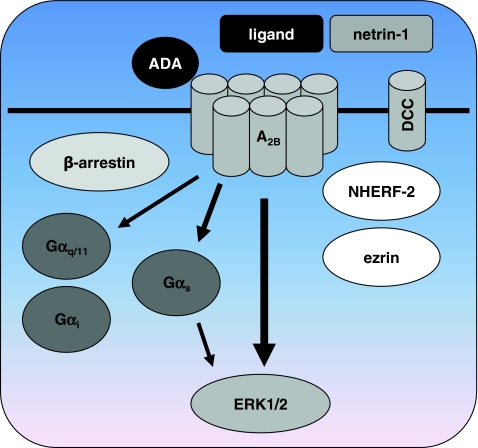
Adenosine receptors are plasma membrane proteins that transduce an extracellular signal into the interior of the cell. Basically every mammalian cell expresses at least one of the four adenosine receptor subtypes. Recent insight in signal transduction cascades teaches us that the current classification of receptor ligands into agonists, antagonists, and inverse agonists relies very much on the experimental setup that was used. Upon activation of the receptors by the ubiquitous endogenous ligand adenosine they engage classical G protein-mediated pathways, resulting in production of second messengers and activation of kinases. Besides this well-described G protein-mediated signaling pathway, adenosine receptors activate scaffold proteins such as β-arrestins. Using innovative and sensitive experimental tools, it has been possible to detect ligands that preferentially stimulate the β-arrestin pathway over the G protein-mediated signal transduction route, or vice versa. This phenomenon is referred to as functional selectivity or biased signaling and implies that an antagonist for one pathway may be a full agonist for the other signaling route. Functional selectivity makes it necessary to redefine the functional properties of currently used adenosine receptor ligands and opens possibilities for new and more selective ligands. This review focuses on the current knowledge of functionally selective adenosine receptor ligands and on G protein-independent signaling of adenosine receptors through scaffold proteins.
腺苷受体是一种位于细胞膜上的蛋白,能够将细胞外的信号转导至细胞内。基本上,每一种哺乳动物细胞都至少表达四种腺苷受体亚型中的一种。最近对信号转导级联的深入了解告诉我们,目前对受体配体的分类,包括激动剂、拮抗剂和反向激动剂,在很大程度上取决于所使用的实验设置。当这些受体被无处不在的内源性配体腺苷激活后,它们会与经典的 G 蛋白偶联途径结合,导致第二信使的产生和激酶的激活。除了这种描述明确的 G 蛋白介导的信号转导途径之外,腺苷受体还可以激活支架蛋白,如β-arrestin。利用创新和敏感的实验工具,已经有可能检测到那些优先刺激β-arrestin 途径而不是 G 蛋白介导的信号转导途径的配体,或者反之亦然。这种现象被称为功能选择性或偏向性信号传递,意味着一种途径的拮抗剂可能是另一种信号通路的完全激动剂。功能选择性使得有必要重新定义当前使用的腺苷受体配体的功能特性,并为新的和更具选择性的配体提供了可能性。本文综述了目前关于功能选择性腺苷受体配体的知识,以及通过支架蛋白进行的 G 蛋白非依赖性腺苷受体信号转导。