1. Department of Nuclear Medicine, Klinikum rechts der Isar, Technische Universität München, Munich, Germany.
Theranostics. 2011 Jan 17;1:48-57. doi: 10.7150/thno/v01p0048.
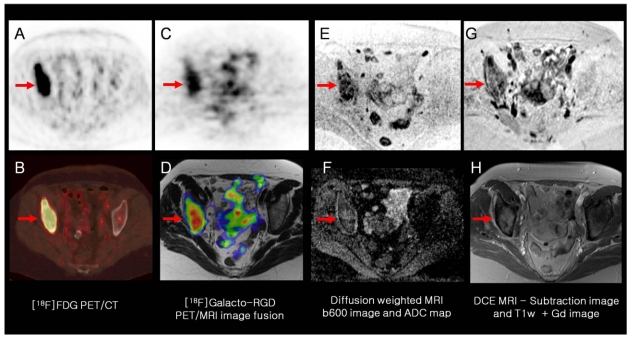
PET imaging of integrin αvβ3 expression has been studied intensely by the academia and recently also by the industry. Imaging of integrin αvβ3 expression is of great potential value, as the integrin αvβ3 is a key player in tumor metastasis and angiogenesis. Therefore PET imaging of this target might be a suitable in-vivo biomarker of angiogenesis and metastatic potential of tumors. In this manuscript, the various strategies for PET imaging of the integrin αvβ3 will be summarized, including monomeric and multimeric radiolabelled RGD peptides and nanoparticles. While most experiments have been performed using preclinical tumor models, more and more clinical results on PET imaging of αvβ3 expression are available and will be discussed in detail. However, while a multitude of radiotracer strategies have been successfully evaluated for PET imaging of αvβ3, the ultimate clinical value of this new imaging biomarker still has to be evaluated in large clinical trials.
正电子发射断层扫描(PET)成像技术对整合素 αvβ3 表达的研究受到学术界和工业界的广泛关注。整合素 αvβ3 表达的成像具有巨大的潜在价值,因为整合素 αvβ3 是肿瘤转移和血管生成的关键参与者。因此,该靶点的 PET 成像可能是血管生成和肿瘤转移潜力的合适的体内生物标志物。在本文中,将总结整合素 αvβ3 的各种 PET 成像策略,包括单体和多聚体放射性标记的 RGD 肽和纳米颗粒。虽然大多数实验都是使用临床前肿瘤模型进行的,但越来越多的关于 αvβ3 表达的 PET 成像的临床结果已经可用,并将详细讨论。然而,尽管已经成功地评估了多种放射性示踪剂策略用于 αvβ3 的 PET 成像,但这种新的成像生物标志物的最终临床价值仍需要在大规模临床试验中进行评估。