
使用骨-髌腱-骨移植物进行前交叉韧带重建时股骨隧道干涉螺钉的发散:两种技术的比较。
Femoral tunnel-interference screw divergence in anterior cruciate ligament reconstruction using bone-patellar tendon-bone graft: A comparison of two techniques.
作者信息
Pandey Vivek, Acharya Kiran, Rao Sharath, Rao Sripathi
机构信息
Department of Orthopaedics, Kasturba Medical College, Manipal, Karnataka, India.
出版信息
Indian J Orthop. 2011 May;45(3):255-60. doi: 10.4103/0019-5413.80045.
BACKGROUND
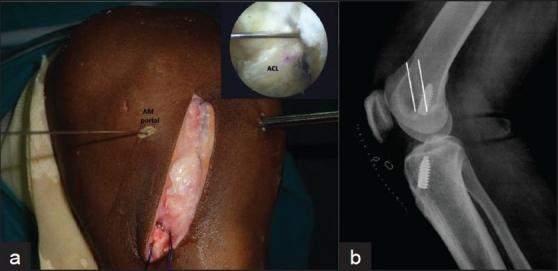
Interference screw is a popular fixation device used to rigidly fix bone-patellar tendon-bone (B-PT-B) graft both in femoral and tibial tunnels in anterior cruciate ligament (ACL) reconstruction. Parallel placement of screw is difficult in transtibially drilled femoral tunnel but always desired as it affects pullout strength of the graft. Commonly, interference screw into the femoral tunnel is inserted through the anteromedial (AM) or accessory AM portal. These portals are not-in-line with the transtibially drilled femoral tunnel. Furthermore, these portals increase the divergence of the interference screw in the femoral tunnel. We hypothesized that interference screw placement through patellar tendon (PT) portal (through donor defect) in transtibially drilled femoral tunnel can be less divergent. We report the prospective randomized study to investigate the difference of divergence of interference screw placed through PT portal and AM portal and its clinical relevance.
MATERIALS AND METHODS
Forty-one patients underwent femoral tunnel B-PT-B graft fixation through AM portal (group 1) and other 41 (group 2) through PT portal. Femoral tunnel-interference screw divergence was measured on postoperative digital lateral X-rays. Ha's method was used to grade divergence. The clinical outcome was assessed by postoperative intervention knee documentation committee grading (IKDC) and Lysholm score at 2 years followup.
RESULTS
Mean tunnel-screw divergence in sagittal plane through AM portal was 13.38° (95% CI: 12.34-14.41) and through PT portal was 7.20° (95% CI: 6.25-8.16) (P<0.0001). In AM portal group, 82.9% patients had divergence in either grade 3 or 4 category, whereas in PT portal group, 82.9% patients were in grade 1 or 2 category (P<0.0001). Mean Lysholm score were 92.8 and 94.5 at two-year follow-up in both groups which were statistically not significant. The International knee documentation committee grades of patients in both groups were similar and had no statistical significance.
CONCLUSION
Femoral interference screw placement through the PT portal leads to significantly less screw divergence as compared with screw placement through the AM portal. However, this difference in divergence is not reflected in clinical outcome.
背景
在交叉韧带(ACL)重建术中,挤压螺钉是一种常用的固定装置,用于在股骨和胫骨隧道中牢固固定骨-髌腱-骨(B-PT-B)移植物。在经胫骨钻孔的股骨隧道中,平行放置螺钉很困难,但由于其会影响移植物的拔出强度,所以一直是人们所期望的。通常,进入股骨隧道的挤压螺钉是通过前内侧(AM)或辅助AM通道插入的。这些通道与经胫骨钻孔的股骨隧道不在一条直线上。此外,这些通道会增加挤压螺钉在股骨隧道中的发散度。我们假设,通过髌腱(PT)通道(穿过供体缺损处)在经胫骨钻孔的股骨隧道中放置挤压螺钉,其发散度可能会更小。我们报告了一项前瞻性随机研究,以调查通过PT通道和AM通道放置挤压螺钉的发散度差异及其临床相关性。
材料与方法
41例患者通过AM通道(第1组)进行股骨隧道B-PT-B移植物固定,另外41例(第2组)通过PT通道进行固定。术后通过数字化侧位X线片测量股骨隧道-挤压螺钉的发散度。采用哈氏方法对发散度进行分级。在2年随访时,通过术后干预膝关节记录委员会分级(IKDC)和Lysholm评分评估临床结果。
结果
通过AM通道在矢状面的平均隧道-螺钉发散度为13.38°(95%CI:12.34-14.41),通过PT通道为7.20°(95%CI:6.25-8.16)(P<0.0001)。在AM通道组中,82.9%的患者发散度为3级或4级,而在PT通道组中,82.9%的患者为1级或2级(P<0.0001)。两组在两年随访时的平均Lysholm评分分别为92.8和94.5,差异无统计学意义。两组患者的国际膝关节记录委员会分级相似,无统计学意义。
结论
与通过AM通道放置螺钉相比,通过PT通道放置股骨挤压螺钉导致的螺钉发散度明显更小。然而,这种发散度的差异并未反映在临床结果中。

 Zotero 插件