Barbara Davis Center for Childhood Diabetes, University of Colorado Denver, Aurora, Colorado, USA.
Diabetes Care. 2011 Jun;34(6):1397-9. doi: 10.2337/dc10-2088. Epub 2011 May 11.
We evaluated predictors of progression to diabetes in children with high-risk HLA genotypes and persistent islet autoantibodies.
The Diabetes Autoimmunity Study in the Young (DAISY) followed 2,542 children with autoantibodies measured to GAD, IA-2, and insulin.
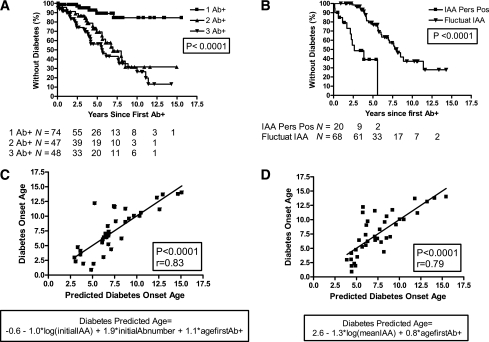
Persistent islet autoantibodies developed in 169 subjects, and 55 of those progressed to diabetes. Children expressing three autoantibodies showed a linear progression to diabetes with 74% cumulative incidence by the 10-year follow-up compared with 70% with two antibodies and 15% with one antibody (P < 0.0001). Both age of appearance of first autoantibody and insulin autoantibody (IAA) levels, but not GAD or IA-2 autoantibodies, were major determinants of the age of diabetes diagnosis (r = 0.79, P < 0.0001).
In the DAISY cohort, 89% of children who progressed to diabetes expressed two or more autoantibodies. Age of diagnosis of diabetes is strongly correlated with age of appearance of first autoantibody and IAA levels.
我们评估了高危 HLA 基因型和持续胰岛自身抗体患儿发生糖尿病进展的预测因素。
糖尿病自身抗体研究中的年轻人(DAISY)随访了 2542 名自身抗体水平可测至 GAD、IA-2 和胰岛素的儿童。
169 名受试者出现持续的胰岛自身抗体,其中 55 名进展为糖尿病。表达三种自身抗体的儿童呈线性进展至糖尿病,10 年随访时累积发病率为 74%,而两种抗体为 70%,一种抗体为 15%(P<0.0001)。首次自身抗体和胰岛素自身抗体(IAA)水平的出现年龄均为糖尿病诊断年龄的主要决定因素(r=0.79,P<0.0001),但 GAD 或 IA-2 自身抗体则不然。
在 DAISY 队列中,89%进展为糖尿病的儿童表达了两种或更多种自身抗体。糖尿病的诊断年龄与首次自身抗体和 IAA 水平出现的年龄密切相关。