Howard Hughes Medical Institute and Department of Cell Biology, Harvard Medical School, 240 Longwood Avenue, Boston, Massachusetts 02115, USA.
Nature. 2011 May 12;473(7346):239-42. doi: 10.1038/nature10014.
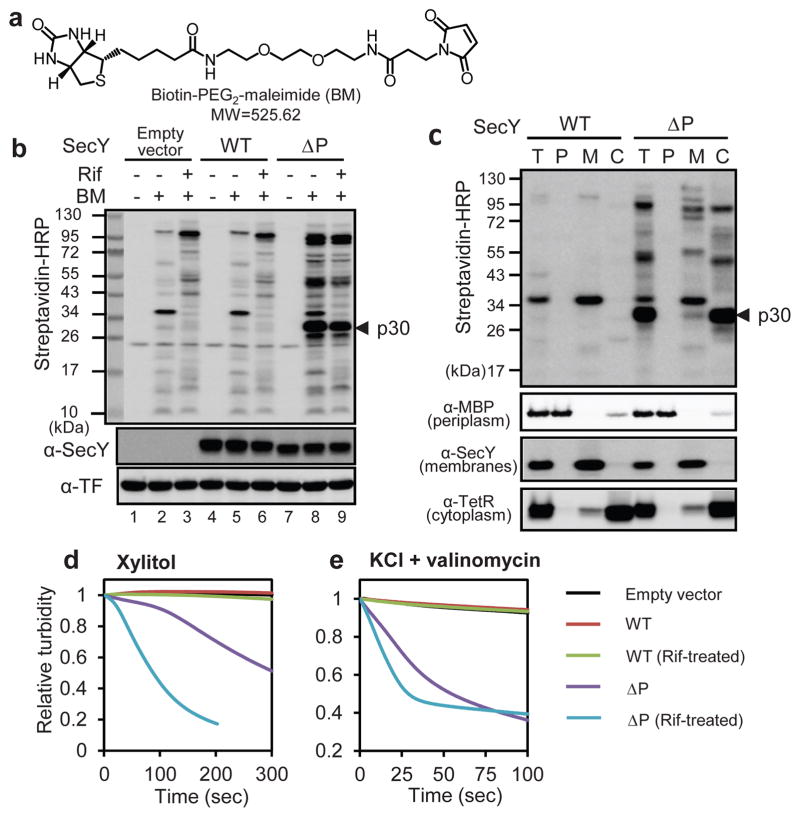
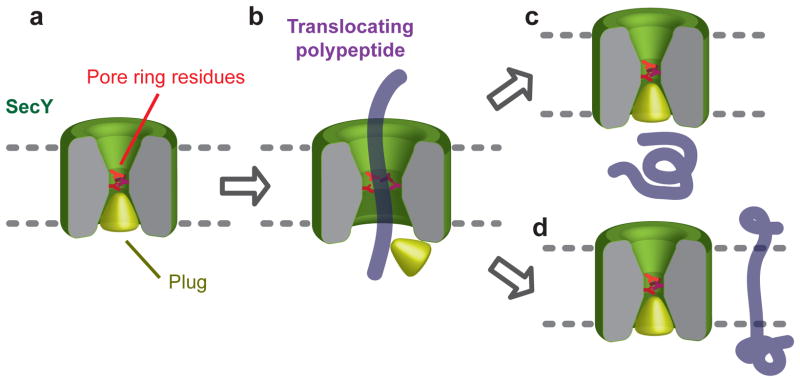
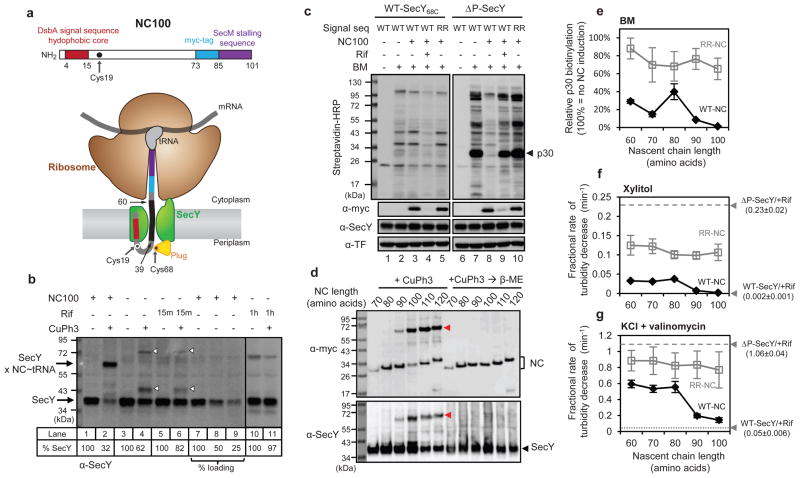
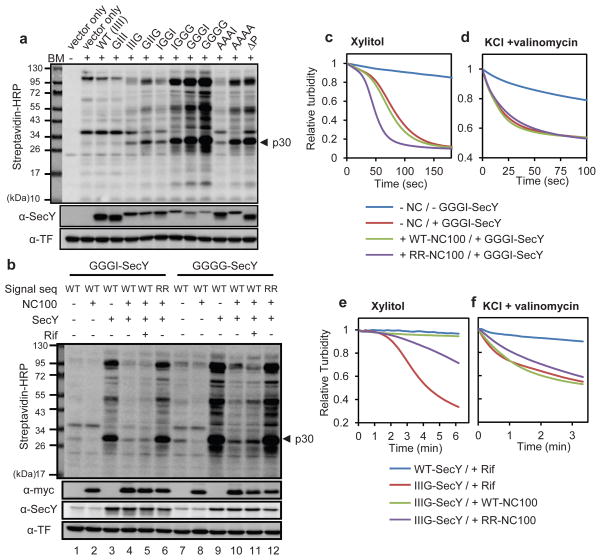
Many proteins are translocated through the SecY channel in bacteria and archaea and through the related Sec61 channel in eukaryotes. The channel has an hourglass shape with a narrow constriction approximately halfway across the membrane, formed by a pore ring of amino acids. While the cytoplasmic cavity of the channel is empty, the extracellular cavity is filled with a short helix called the plug, which moves out of the way during protein translocation. The mechanism by which the channel transports large polypeptides and yet prevents the passage of small molecules, such as ions or metabolites, has been controversial. Here, we have addressed this issue in intact Escherichia coli cells by testing the permeation of small molecules through wild-type and mutant SecY channels, which are either in the resting state or contain a defined translocating polypeptide chain. We show that in the resting state, the channel is sealed by both the pore ring and the plug domain. During translocation, the pore ring forms a 'gasket-like' seal around the polypeptide chain, preventing the permeation of small molecules. The structural conservation of the channel in all organisms indicates that this may be a universal mechanism by which the membrane barrier is maintained during protein translocation.
许多蛋白质通过细菌和古菌中的 SecY 通道以及真核生物中的相关 Sec61 通道进行易位。该通道呈沙漏形,膜中间的狭窄部分由一个氨基酸组成的孔环形成。当通道的细胞质腔为空时,细胞外腔充满了一个短的螺旋,称为塞子,在蛋白质易位时会移开。该通道如何运输大的多肽,同时防止小分子(如离子或代谢物)通过,一直存在争议。在这里,我们通过测试野生型和突变 SecY 通道(处于静止状态或包含定义的易位多肽链)中小分子的渗透性,在完整的大肠杆菌细胞中解决了这个问题。我们表明,在静止状态下,通道由孔环和塞子结构域封闭。在易位过程中,孔环围绕多肽链形成一个“垫圈状”密封,防止小分子渗透。通道在所有生物中的结构保守性表明,这可能是一种普遍的机制,用于在蛋白质易位过程中维持膜屏障。