Hasenboehler Erik A, Stahel Philip F, Williams Allison, Smith Wade R, Newman Justin T, Symonds David L, Morgan Steven J
Department of Orthopaedic Surgery, Denver Health Medical Center, University of Colorado Denver, School of Medicine, 777 Bannock Street, Denver, CO 80204, USA.
Patient Saf Surg. 2011 May 10;5(1):8. doi: 10.1186/1754-9493-5-8.
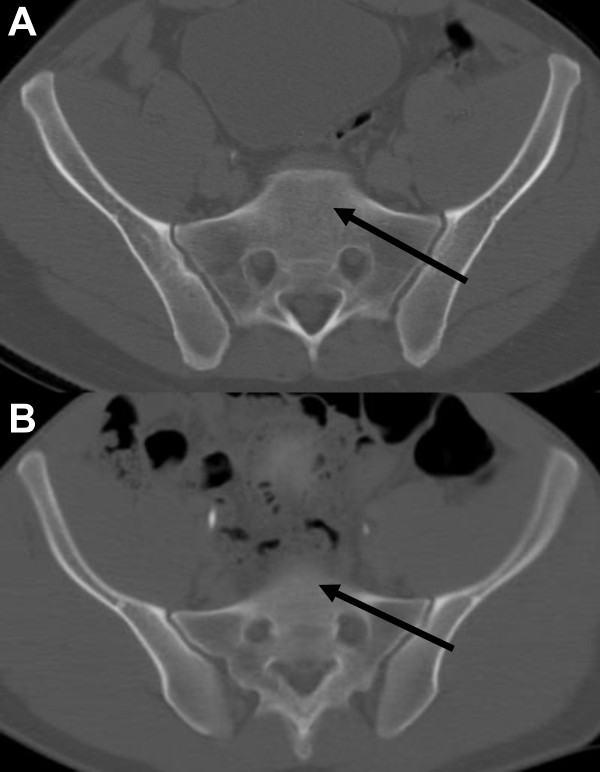
Percutaneous sacro-iliac (SI) screw fixation represents a widely used technique in the management of unstable posterior pelvic ring injuries and sacral fractures. The misplacement of SI-screws under fluoroscopic guidance represents a critical complication for these patients. This study was designed to determine the prevalence of sacral dysmorphia and the radiographic anatomy of surgical S1 and S2 corridors in a representative trauma population.
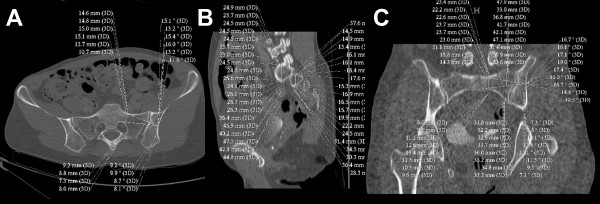
Prospective observational cohort study on a consecutive series of 344 skeletally mature trauma patients of both genders enrolled between January 1, 2007, to September 30, 2007, at a single academic level 1 trauma center. Inclusion criteria included a pelvic CT scan as part of the initial diagnostic trauma work-up. The prevalence of sacral dysmorphia was determined by plain radiographic pelvic films and CT scan analysis. The anatomy of sacral corridors was analyzed on 3 mm reconstruction sections derived from multislice CT scan, in the axial, coronal, and sagittal plane. "Safe" potential surgical corridors at S1 and S2 were calculated based on these measurements.
Radiographic evidence of sacral dysmorphia was detected in 49 patients (14.5%). The prevalence of sacral dysmorphia was not significantly different between male and female patients (12.2% vs. 19.2%; P = 0.069). In contrast, significant gender-related differences were detected with regard to radiographic analysis of surgical corridors for SI-screw placement, with female trauma patients (n = 99) having significantly narrower corridors at S1 and S2 in all evaluated planes (axial, coronal, sagittal), compared to male counterparts (n = 245; P < 0.01). In addition, the mean S2 body height was higher in dysmorphic compared to normal sacra, albeit without statistical significance (P = 0.06), implying S2 as a safe surgical corridor of choice in patients with sacral dysmorphia.
These findings emphasize a high prevalence of sacral dysmorphia in a representative trauma population and imply a higher risk of SI-screw misplacement in female patients. Preoperative planning for percutaneous SI-screw fixation for unstable pelvic and sacral fractures must include a detailed CT scan analysis to determine the safety of surgical corridors.
经皮骶髂螺钉固定术是治疗不稳定型骨盆后环损伤和骶骨骨折的一种广泛应用的技术。在透视引导下骶髂螺钉误置是这些患者的一种严重并发症。本研究旨在确定在一个具有代表性的创伤人群中骶骨形态异常的发生率以及手术S1和S2通道的影像学解剖结构。
对2007年1月1日至2007年9月30日在一家一级学术创伤中心连续纳入的344例骨骼成熟的创伤患者进行前瞻性观察队列研究。纳入标准包括骨盆CT扫描作为初始诊断创伤检查的一部分。通过X线骨盆平片和CT扫描分析确定骶骨形态异常的发生率。在多层CT扫描获得的3mm重建图像上,在轴位、冠状位和矢状位分析骶骨通道的解剖结构。根据这些测量结果计算S1和S2的“安全”潜在手术通道。
49例患者(14.5%)有骶骨形态异常的影像学证据。男性和女性患者骶骨形态异常的发生率无显著差异(12.2%对19.2%;P = 0.069)。相比之下,在骶髂螺钉置入手术通道的影像学分析方面发现了显著的性别差异,与男性创伤患者(n = 245)相比,女性创伤患者(n = 99)在所有评估平面(轴位、冠状位、矢状位)的S1和S2通道明显更窄(P < 0.01)。此外,形态异常的骶骨与正常骶骨相比,S2椎体平均高度更高,尽管无统计学意义(P = 0.06),这意味着S2是骶骨形态异常患者安全的手术通道选择。
这些发现强调了在一个具有代表性的创伤人群中骶骨形态异常的高发生率,并表明女性患者骶髂螺钉误置的风险更高。对于不稳定骨盆和骶骨骨折的经皮骶髂螺钉固定术,术前规划必须包括详细的CT扫描分析,以确定手术通道的安全性。