Department of Radiation Oncology, Radboud University, Nijmegen Medical Centre, The Netherlands.
BMC Cancer. 2011 May 12;11:167. doi: 10.1186/1471-2407-11-167.
The cellular response of malignant tumors to hypoxia is diverse. Several important endogenous metabolic markers are upregulated under hypoxic conditions. We examined the staining patterns and co-expression of HIF-1α, CAIX, LDH-5, GLUT-1, MCT1 and MCT4 with the exogenous hypoxic cell marker pimonidazole and the association of marker expression with clinicopathological characteristics.
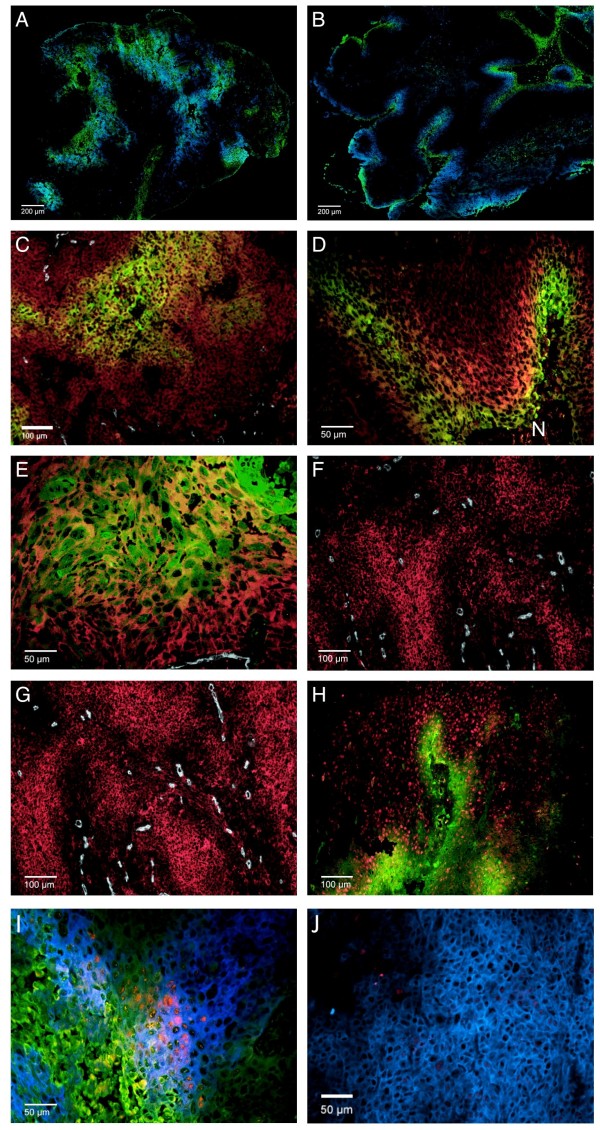
20 biopsies of advanced head and neck carcinomas were immunohistochemically stained and analyzed. All patients were given the hypoxia marker pimonidazole intravenously 2 h prior to biopsy taking. The tumor area positive for each marker, the colocalization of the different markers and the distribution of the markers in relation to the blood vessels were assessed by semiautomatic quantitative analysis.
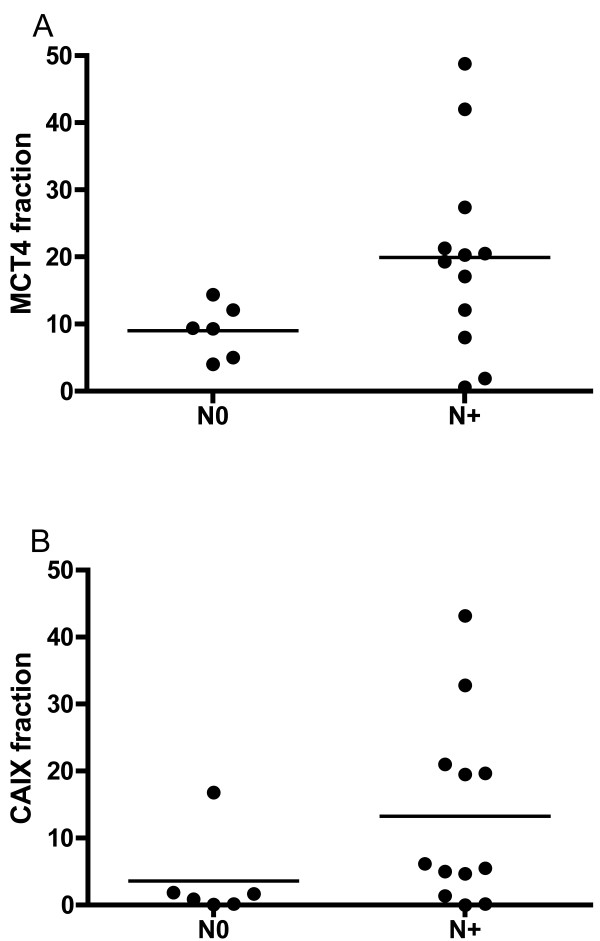
MCT1 staining was present in hypoxic (pimonidazole stained) as well as non-hypoxic areas in almost equal amounts. MCT1 expression showed a significant overall correlation (r = 0.75, p < 0.001) and strong spatial relationship with CAIX. LDH-5 showed the strongest correlation with pimonidazole (r = 0.66, p = 0.002). MCT4 and GLUT-1 demonstrated a typical diffusion-limited hypoxic pattern and showed a high degree of colocalization. Both MCT4 and CAIX showed a higher expression in the primary tumor in node positive patients (p = 0.09 both).
Colocalization and staining patterns of metabolic and hypoxia-related proteins provides valuable additional information over single protein analyses and can improve the understanding of their functions and environmental influences.
恶性肿瘤对缺氧的细胞反应是多样的。在缺氧条件下,几种重要的内源性代谢标志物上调。我们检查了 HIF-1α、CAIX、LDH-5、GLUT-1、MCT1 和 MCT4 的染色模式和共表达情况,与外源性缺氧细胞标志物 pimonidazole 以及标志物表达与临床病理特征的相关性。
对 20 例晚期头颈部癌活检进行免疫组织化学染色和分析。所有患者在活检前 2 小时静脉注射缺氧标志物 pimonidazole。通过半自动定量分析评估每个标志物的肿瘤区域阳性率、不同标志物的共定位以及标志物在血管周围的分布。
MCT1 染色在缺氧(pimonidazole 染色)和非缺氧区域中几乎等量存在。MCT1 表达与 CAIX 呈显著的整体相关性(r = 0.75,p < 0.001)和强烈的空间关系。LDH-5 与 pimonidazole 相关性最强(r = 0.66,p = 0.002)。MCT4 和 GLUT-1 表现出典型的扩散受限缺氧模式,并具有高度的共定位。MCT4 和 CAIX 在淋巴结阳性患者的原发性肿瘤中表达更高(p = 0.09)。
代谢和缺氧相关蛋白的共定位和染色模式提供了比单一蛋白分析更有价值的附加信息,并可以提高对其功能和环境影响的理解。