Ming Xue, Brimacombe Michael, Malek Joanne H, Jani Nisha, Wagner George C
Departments of Neurosciences and Pediatrics, UMDNJ-New Jersey Medical School, Newark, NJ.
Environ Health Insights. 2008 Aug 20;2:55-9. doi: 10.4137/ehi.s830.
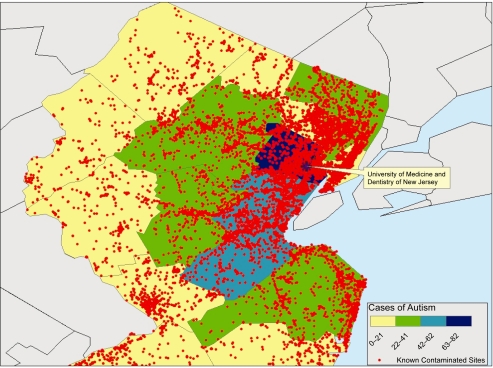
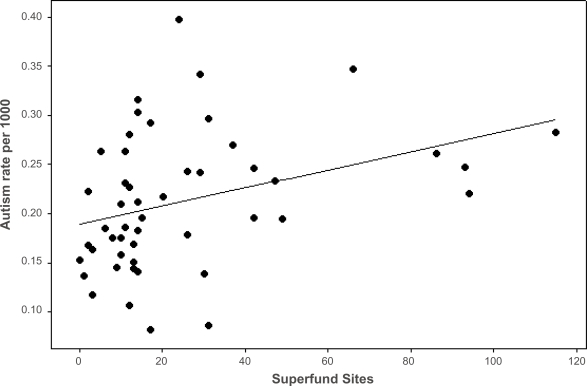
It is believed that gene by environmental interactions contribute to the pathogenesis of autism spectrum disorders (ASD). We hypothesize that ASD are associated with early and repeated exposures to any of a number of toxicants or mixtures of toxicants. It is the cumulative effects of these repeated exposures acting upon genetically susceptible individuals that lead to the phenotypes of ASD. We report our initial observations of a considerable overlap of identified toxic landfills in the State of New Jersey and the residence of an ASD cohort, and a correlation between the identified toxic Superfund sites on each U.S. state and the total number of diagnosed cases of ASD in those states. The residence of 495 ASD patients in New Jersey by zip code and the toxic landfill sites were plotted on a map of Northern New Jersey. The area of highest ASD cases coincides with the highest density of toxic landfill sites while the area with lowest ASD cases has the lowest density of toxic landfill sites. Furthermore, the number of toxic Superfund sites and autism rate across 49 of the 50 states shows a statistically significant correlation (i.e. the number of identified superfund sites correlates with the rate of autism per 1000 residents in 49 of the states (p = 0.015; excluding the state of Oregon). These significant observations call for further organized studies to elucidate possible role(s) of environmental toxicants contributing to the pathogenesis of ASD.
人们认为基因与环境的相互作用会导致自闭症谱系障碍(ASD)的发病机制。我们假设ASD与早期反复接触多种有毒物质或有毒物质混合物有关。正是这些反复接触对基因易感个体产生的累积效应导致了ASD的表型。我们报告了我们的初步观察结果:新泽西州已识别的有毒垃圾填埋场与一个ASD队列的居住地有相当大的重叠,并且美国每个州已识别的有毒超级基金场地与这些州ASD诊断病例总数之间存在相关性。按邮政编码绘制了新泽西州495名ASD患者的居住地和有毒垃圾填埋场位置的地图,该地图位于新泽西州北部。ASD病例数最高的区域与有毒垃圾填埋场密度最高的区域重合,而ASD病例数最低的区域有毒垃圾填埋场密度最低。此外,50个州中的49个州的有毒超级基金场地数量与自闭症发病率显示出统计学上的显著相关性(即已识别的超级基金场地数量与49个州每1000名居民中的自闭症发病率相关(p = 0.015;不包括俄勒冈州)。这些重要观察结果需要进一步开展有组织的研究,以阐明环境有毒物质在ASD发病机制中可能发挥的作用。