State University of New York at Buffalo, Department of Biological Sciences and Graduate Program of Ecology, Evolution and Behavior, Buffalo, New York, United States of America.
PLoS One. 2011 May 10;6(5):e19438. doi: 10.1371/journal.pone.0019438.
Sex ratios are important empirical data in predicting sex allocation strategy and selection in populations. Therefore, they should be sampled at crucial developmental steps before and after parental investment. In parasites with free-living (off-host) developmental stages the timing and method of sampling is not trivial, because ecological niches are frequently poorly known. Consequently, information is scarce for sex ratios of these parasites between conception and sexual maturity. Often, only data from adult parasites are available, which usually were collected from the parasite's hosts. Generally, these ratios are assumed to represent operational sex ratios.
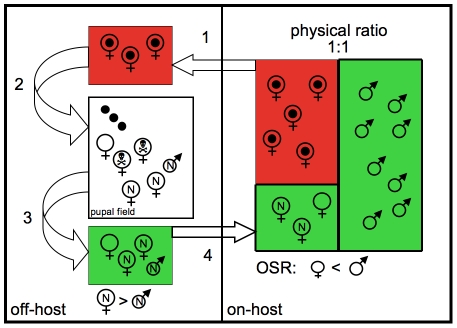
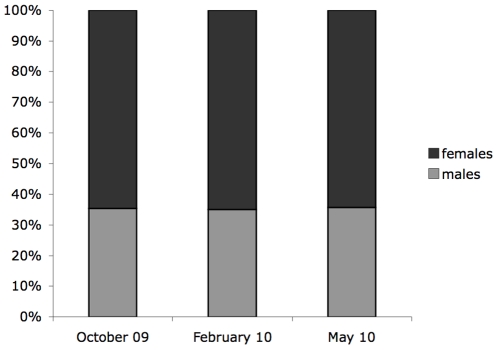
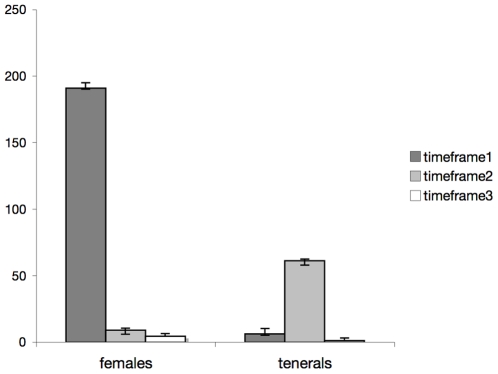
METHODOLOGY/PRINCIPAL FINDINGS: We here report three years of empirical data on population sex differentials from a bat ectoparasite (Trichobius frequens) with off-host developmental stages. At emergence these parasites exhibit a significant and seasonally stable female biased sex ratio. This bias is lost in the adult population on the roosting host, which shows sex ratios at equality. This is best explained by a behaviorally driven, sex-dependent mortality differential. Because consistently only subsets of females are available to mate, the operational sex ratio in the population is likely male biased. Host capture experiments throughout the day show a statistically significant, but temporary male excess in bat flies on foraging bats. This phenomenon is partly driven by the diurnal rhythms of female larviposition, and partly due to parasites remaining in the bat roost during foraging. Because most previous research in bat flies is based only on foraging bats, female contributions to physical sex ratios have been underestimated.
CONCLUSION/SIGNIFICANCE: Our results highlight the importance of detailed natural history observations, and emphasize that ignoring the spatial and temporal heterogeneity of reproduction in any organism will lead to significant empirical sampling errors of sex ratios, and may obscure operational sex ratios.
性别比例是预测种群中性分配策略和选择的重要经验数据。因此,它们应该在亲代投资前后的关键发育阶段进行采样。在具有自由生活(离宿主)发育阶段的寄生虫中,采样的时间和方法并不简单,因为生态位通常知之甚少。因此,关于这些寄生虫在受孕和性成熟之间的性别比例的信息很少。通常,只有来自成年寄生虫的数据可用,这些数据通常是从寄生虫的宿主中收集的。一般来说,这些比例被认为代表操作性别比例。
方法/主要发现:我们在这里报告了三年来对一种具有离宿主发育阶段的蝙蝠外寄生虫(Trichobius frequens)的种群性别差异的实证数据。这些寄生虫在出现时表现出显著的、季节性稳定的雌性偏性性别比例。这种偏差在栖息在宿主身上的成年群体中消失了,成年群体中性别比例均等。这最好通过行为驱动的、性别相关的死亡率差异来解释。由于始终只有部分雌性寄生虫可供交配,因此种群中的操作性别比例可能偏向雄性。全天的宿主捕获实验表明,在觅食蝙蝠上的蝙蝠蝇中存在统计学上显著但暂时的雄性过剩现象。这种现象部分是由雌性产卵的昼夜节律驱动的,部分是由于寄生虫在觅食期间留在蝙蝠栖息地。由于之前大多数蝙蝠蝇的研究仅基于觅食蝙蝠,因此女性对物理性别比例的贡献被低估了。
结论/意义:我们的研究结果强调了详细的自然历史观察的重要性,并强调忽略任何生物体繁殖的时空异质性将导致性别比例的显著经验采样误差,并可能掩盖操作性别比例。