Division of Nephrology and Dialysis, San Raffaele Scientific Institute, Università Vita-Salute San Raffaele Hospital, Milan, Italy.
PLoS One. 2011 May 9;6(5):e19620. doi: 10.1371/journal.pone.0019620.
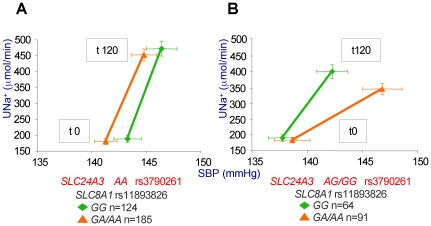
The importance of excess salt intake in the pathogenesis of hypertension is widely recognized. Blood pressure is controlled primarily by salt and water balance because of the infinite gain property of the kidney to rapidly eliminate excess fluid and salt. Up to fifty percent of patients with essential hypertension are salt-sensitive, as manifested by a rise in blood pressure with salt loading. We conducted a two-stage genetic analysis in hypertensive patients very accurately phenotyped for their salt-sensitivity. All newly discovered never treated before, essential hypertensives underwent an acute salt load to monitor the simultaneous changes in blood pressure and renal sodium excretion. The first stage consisted in an association analysis of genotyping data derived from genome-wide array on 329 subjects. Principal Component Analysis demonstrated that this population was homogenous. Among the strongest results, we detected a cluster of SNPs located in the first introns of PRKG1 gene (rs7897633, p = 2.34E-05) associated with variation in diastolic blood pressure after acute salt load. We further focused on two genetic loci, SLC24A3 and SLC8A1 (plasma membrane sodium/calcium exchange proteins, NCKX3 and NCX1, respectively) with a functional relationship with the previous gene and associated to variations in systolic blood pressure (the imputed rs3790261, p = 4.55E-06; and rs434082, p = 4.7E-03). In stage 2, we characterized 159 more patients for the SNPs in PRKG1, SLC24A3 and SLC8A1. Combined analysis showed an epistatic interaction of SNPs in SLC24A3 and SLC8A1 on the pressure-natriuresis (p interaction = 1.55E-04, p model = 3.35E-05), supporting their pathophysiological link in cellular calcium homeostasis. In conclusions, these findings point to a clear association between body sodium-blood pressure relations and molecules modulating the contractile state of vascular cells through an increase in cytoplasmic calcium concentration.
摄入过多盐分对高血压发病机制的重要性已得到广泛认可。由于肾脏具有快速消除多余液体和盐分的无限增益特性,血压主要通过盐分和水分平衡来控制。多达 50%的原发性高血压患者对盐敏感,表现为盐负荷时血压升高。我们对经过严格表型分析的原发性高血压患者进行了两阶段遗传分析。所有新发现的未经治疗的原发性高血压患者均接受了急性盐负荷,以监测血压和肾钠排泄的同时变化。第一阶段包括对 329 名受试者进行全基因组芯片基因分型数据的关联分析。主成分分析表明,该人群具有同质性。在最强的结果中,我们检测到位于 PRKG1 基因第一内含子中的 SNP 簇(rs7897633,p = 2.34E-05)与急性盐负荷后舒张压的变化有关。我们进一步关注两个遗传位点,SLC24A3 和 SLC8A1(分别为质膜钠/钙交换蛋白,NCKX3 和 NCX1),它们与之前的基因具有功能关系,并与收缩压的变化相关(rs3790261,p = 4.55E-06;rs434082,p = 4.7E-03)。在第二阶段,我们对 159 名更多的患者进行了 PRKG1、SLC24A3 和 SLC8A1 的 SNP 特征分析。联合分析显示,SLC24A3 和 SLC8A1 的 SNP 存在上位性相互作用,对压力-排钠作用有影响(p 相互作用=1.55E-04,p 模型=3.35E-05),支持它们在细胞钙稳态方面的病理生理联系。总之,这些发现表明,体内钠-血压关系与调节血管细胞收缩状态的分子之间存在明显关联,这种关联通过增加细胞质钙浓度来实现。