Institute of Medical Genetics, Children's Hospital of Shanghai, Shanghai Jiao Tong University, Shanghai, P.R. China.
BMC Med Genet. 2011 May 17;12:68. doi: 10.1186/1471-2350-12-68.
Chromosome abnormalities, especially trisomy of chromosome 21, 13, or 18 as well as sex chromosome aneuploidy, are a well-established cause of pregnancy loss. Cultured cell karyotype analysis and FISH have been considered reliable detectors of fetal abnormality. However, results are usually not available for 3-4 days or more. Multiplex ligation-dependent probe amplification (MLPA) has emerged as an alternative rapid technique for detection of chromosome aneuploidies. However, conventional MLPA does not allow for relative quantification of more than 50 different target sequences in one reaction and does not detect mosaic trisomy. A multiplexed MLPA with more sensitive detection would be useful for fetal genetic screening.
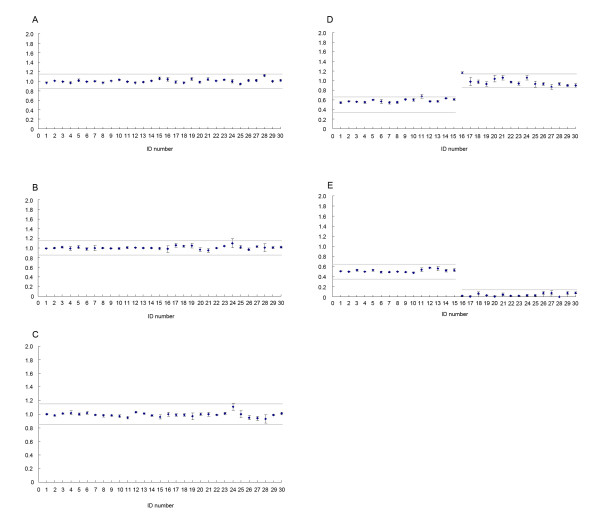
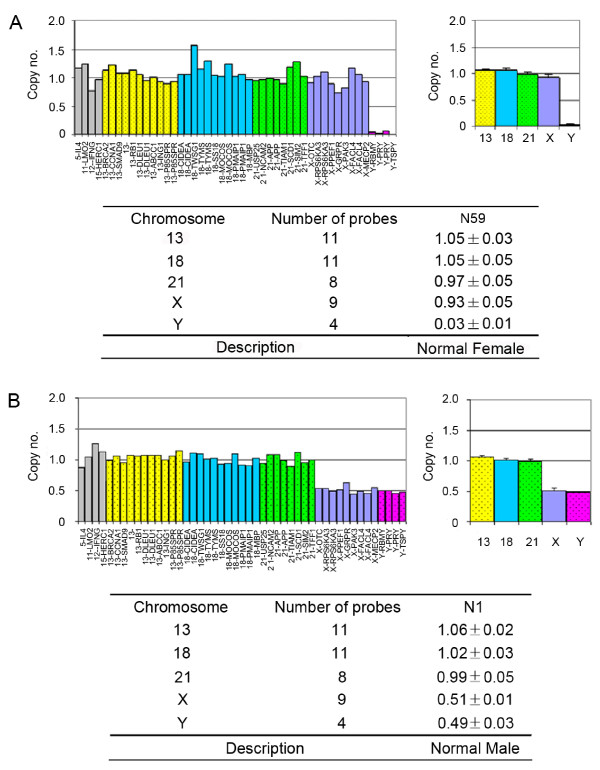
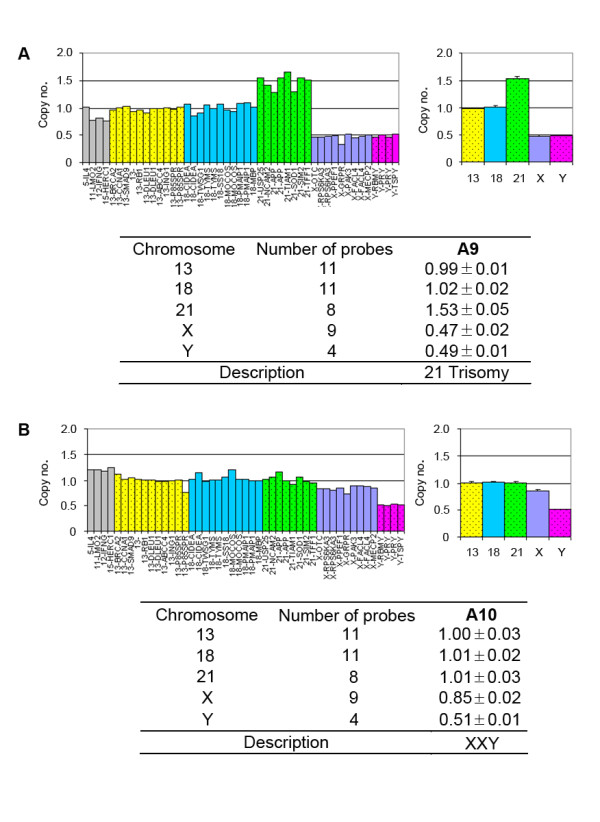
We developed a method of array-based MLPA to rapidly screen for common aneuploidies. We designed 116 universal tag-probes covering chromosomes 13, 18, 21, X, and Y, and 8 control autosomal genes. We performed MLPA and hybridized the products on a 4-well flow-through microarray system. We determined chromosome copy numbers by analyzing the relative signals of the chromosome-specific probes.
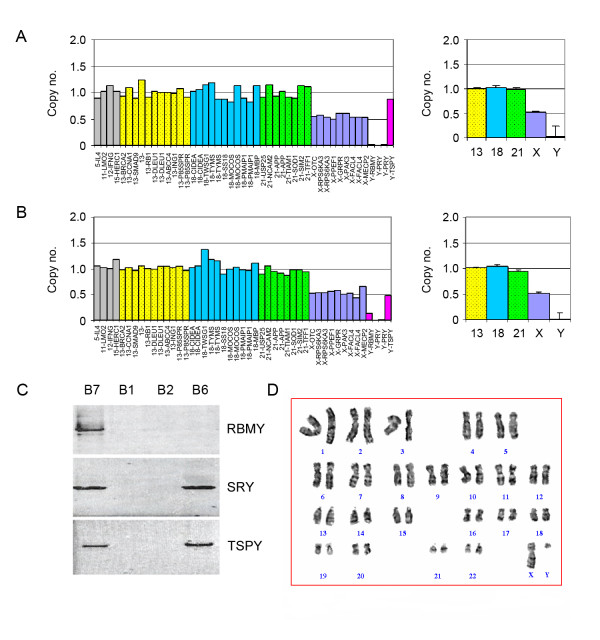
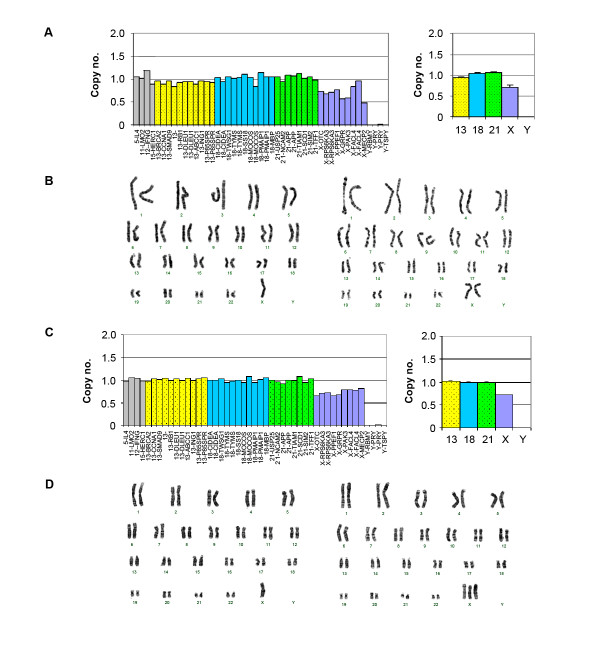
In a blind study of 161 peripheral blood and 12 amniotic fluid samples previously karyotyped, 169 of 173 (97.7%) including all the amniotic fluid samples were correctly identified by array-MLPA. Furthermore, we detected two chromosome X monosomy mosaic cases in which the mosaism rates estimated by array-MLPA were basically consistent with the results from karyotyping. Additionally, we identified five Y chromosome abnormalities in which G-banding could not distinguish their origins for four of the five cases.
Our study demonstrates the successful application and strong potential of array-MLPA in clinical diagnosis and prenatal testing for rapid and sensitive chromosomal aneuploidy screening. Furthermore, we have developed a simple and rapid procedure for screening copy numbers on chromosomes 13, 18, 21, X, and Y using array-MLPA.
染色体异常,尤其是 21、13 或 18 号染色体三体及性染色体非整倍体,是妊娠丢失的一个明确病因。培养细胞核型分析和荧光原位杂交(FISH)已被认为是检测胎儿异常的可靠手段。然而,结果通常需要 3-4 天或更长时间才能得到。多重连接依赖性探针扩增(MLPA)已成为一种用于检测染色体非整倍体的替代快速技术。然而,传统的 MLPA 不能在一个反应中对 50 个以上的不同靶序列进行相对定量,也不能检测嵌合体三体。一种具有更敏感检测能力的多重 MLPA 对于胎儿遗传筛查将是有用的。
我们开发了一种基于阵列的 MLPA 方法,用于快速筛查常见的非整倍体。我们设计了 116 个通用的标签探针,覆盖了染色体 13、18、21、X 和 Y 以及 8 个控制常染色体基因。我们进行了 MLPA 并将产物杂交到 4 孔流式微阵列系统上。我们通过分析染色体特异性探针的相对信号来确定染色体拷贝数。
在对 161 个外周血和 12 个羊水样本进行的一项盲法研究中,173 个样本中的 169 个(97.7%),包括所有羊水样本,均通过阵列-MLPA 正确识别。此外,我们检测到了两个性染色体 X 单体性嵌合体病例,其中通过阵列-MLPA 估计的嵌合体率与核型分析的结果基本一致。此外,我们还发现了五个 Y 染色体异常,其中五个病例中的四个无法通过 G 带区分其来源。
我们的研究证明了阵列-MLPA 在临床诊断和产前检测中的成功应用和强大潜力,用于快速和敏感的染色体非整倍体筛查。此外,我们已经开发了一种简单快速的程序,用于使用阵列-MLPA 筛选染色体 13、18、21、X 和 Y 的拷贝数。