Saha A K, Mukhopadhyay N K, Dowling J N, Ficht T A, Adams L G, Glew R H
Department of Microbiology, Biochemistry and Molecular Biology, University of Pittsburgh School of Medicine, Pennsylvania 15261.
Infect Immun. 1990 May;58(5):1153-8. doi: 10.1128/iai.58.5.1153-1158.1990.
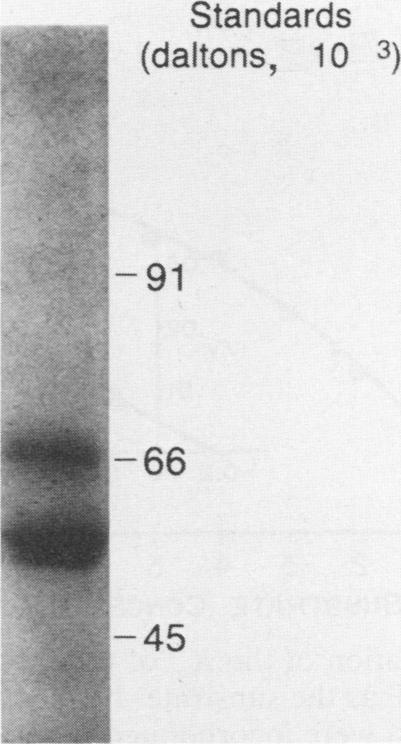
Brucellae are facultative intracellular bacterial pathogens that reside primarily in cells of the reticuloendothelial system. The high-speed supernatant obtained after centrifuging a suspension of Brucella abortus that had been frozen-thawed and sonicated contained abundant phosphomonoesterase activity, determined by using 4-methylumbelliferylphosphate as the substrate; this enzyme was purified 2,900-fold (yield, 570%) by chromatography on DE-52 cellulose and hydroxylapatite columns and high-performance liquid chromatography-gel filtration. The native enzyme had a molecular mass of 120,000 daltons (+/- 10,000 daltons), as determined by gel filtration chromatography, and resolved into two bands (60,000 and 66,000 daltons) when subjected to polyacrylamide gel electrophoresis in the presence of sodium dodecyl sulfate. The B. abortus phosphomonoesterase had the following properties: pH optimum, 6.0 to 6.5; isoelectric point, 3.0; substrate specificity, 5'-AMP greater than 3'-AMP greater than 3'-GMP greater than 5'-GDP greater than 5'-CDP greater than 5'-CTP greater than 5'-UPT greater than phosphotyrosine greater than phosphoserine greater than phosphothreonine. The Km for 5'-AMP was 0.37 mM. Phosphatidylinositol 4,5-bisphosphate and myo-inositol 1,3,4-trisphosphate were poor substrates for the B. abortus enzyme. The phosphomonoesterase did not inhibit superoxide anion production by human neutrophils stimulated with formyl-methionyl-leucyl-phenylalanine. The phosphomonoesterase may be one of the bacterial enzymes in the pathway leading to the production of adenine, which is secreted by B. abortus and blocks the activation of neutrophils.
布鲁氏菌是兼性胞内细菌病原体,主要寄居于网状内皮系统的细胞中。将经冻融和超声处理的流产布鲁氏菌悬浮液离心后得到的高速上清液含有丰富的磷酸单酯酶活性,该活性通过使用4-甲基伞形酮基磷酸酯作为底物来测定;通过在DE-52纤维素柱和羟基磷灰石柱上进行色谱分离以及高效液相色谱-凝胶过滤,该酶被纯化了2900倍(产率为570%)。通过凝胶过滤色谱法测定,天然酶的分子量为120,000道尔顿(±10,000道尔顿),在十二烷基硫酸钠存在下进行聚丙烯酰胺凝胶电泳时,该酶可分离为两条带(60,000和66,000道尔顿)。流产布鲁氏菌磷酸单酯酶具有以下特性:最适pH为6.0至6.5;等电点为3.0;底物特异性为5'-AMP>3'-AMP>3'-GMP>5'-GDP>5'-CDP>5'-CTP>5'-UPT>磷酸酪氨酸>磷酸丝氨酸>磷酸苏氨酸。5'-AMP的Km值为0.37 mM。磷脂酰肌醇4,5-二磷酸和肌醇1,3,4-三磷酸是流产布鲁氏菌该酶的不良底物。该磷酸单酯酶不抑制由甲酰甲硫氨酰亮氨酰苯丙氨酸刺激的人中性粒细胞产生超氧阴离子。该磷酸单酯酶可能是流产布鲁氏菌分泌的、导致腺嘌呤产生并阻断中性粒细胞活化的途径中的细菌酶之一。