Division of Geriatrics and Nutritional Sciences, Department of Medicine, Washington University School of Medicine, Saint Louis, Missouri, United States of America.
PLoS One. 2011 May 12;6(5):e19739. doi: 10.1371/journal.pone.0019739.
It has been proposed that muscle insulin resistance in type 2 diabetes is due to a selective decrease in the components of the mitochondrial electron transport chain and results from accumulation of toxic products of incomplete fat oxidation. The purpose of the present study was to test this hypothesis.
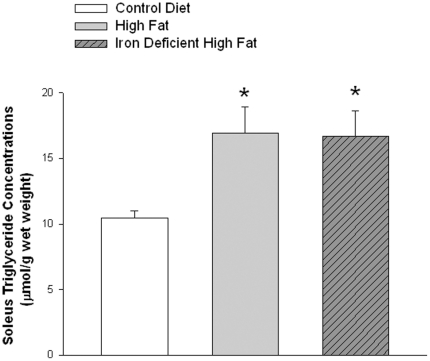
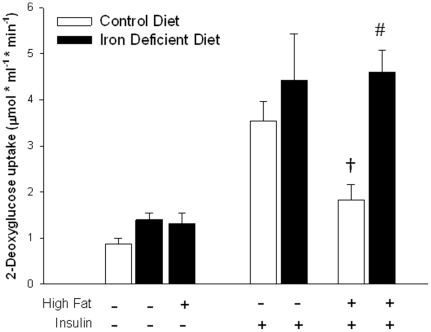
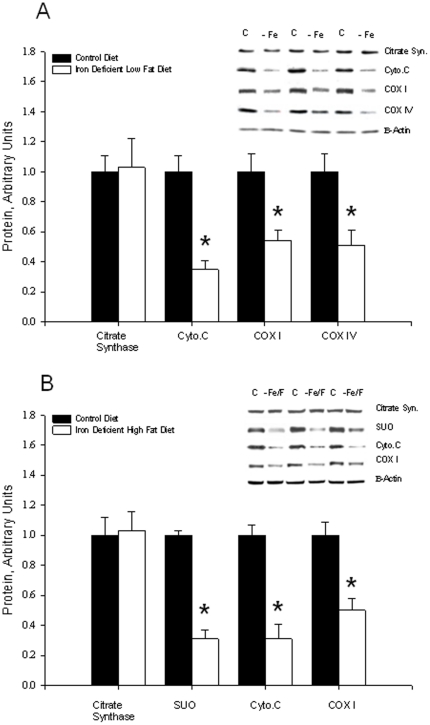
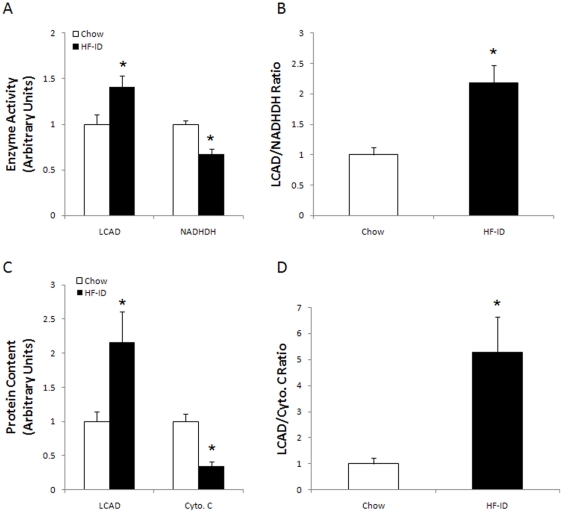
METHODOLOGY/PRINCIPAL FINDINGS: Rats were made severely iron deficient, by means of an iron-deficient diet. Iron deficiency results in decreases of the iron containing mitochondrial respiratory chain proteins without affecting the enzymes of the fatty acid oxidation pathway. Insulin resistance was induced by feeding iron-deficient and control rats a high fat diet. Skeletal muscle insulin resistance was evaluated by measuring glucose transport activity in soleus muscle strips. Mitochondrial proteins were measured by Western blot. Iron deficiency resulted in a decrease in expression of iron containing proteins of the mitochondrial respiratory chain in muscle. Citrate synthase, a non-iron containing citrate cycle enzyme, and long chain acyl-CoA dehydrogenase (LCAD), used as a marker for the fatty acid oxidation pathway, were unaffected by the iron deficiency. Oleate oxidation by muscle homogenates was increased by high fat feeding and decreased by iron deficiency despite high fat feeding. The high fat diet caused severe insulin resistance of muscle glucose transport. Iron deficiency completely protected against the high fat diet-induced muscle insulin resistance.
CONCLUSIONS/SIGNIFICANCE: The results of the study argue against the hypothesis that a deficiency of the electron transport chain (ETC), and imbalance between the ETC and β-oxidation pathways, causes muscle insulin resistance.
有人提出,2 型糖尿病患者的肌肉胰岛素抵抗是由于线粒体电子传递链的组成部分选择性减少所致,并且是由于不完全脂肪氧化的有毒产物积累所致。本研究的目的是检验这一假设。
方法/主要发现:通过缺铁饮食使大鼠严重缺铁。缺铁会导致含铁的线粒体呼吸链蛋白减少,而不影响脂肪酸氧化途径的酶。通过给缺铁和对照组大鼠喂食高脂肪饮食来诱导胰岛素抵抗。通过测量比目鱼肌条的葡萄糖转运活性来评估骨骼肌胰岛素抵抗。通过 Western blot 测定线粒体蛋白。缺铁导致肌肉中线粒体呼吸链含铁蛋白的表达减少。柠檬酸合酶(一种不含铁的柠檬酸循环酶)和长链酰基辅酶 A 脱氢酶(LCAD),用作脂肪酸氧化途径的标志物,不受缺铁的影响。肌肉匀浆的油酸盐氧化在高脂肪喂养时增加,而在高脂肪喂养时减少,但缺铁。高脂肪饮食导致肌肉葡萄糖转运严重胰岛素抵抗。缺铁完全防止了高脂肪饮食引起的肌肉胰岛素抵抗。
结论/意义:研究结果反对电子传递链(ETC)缺乏以及 ETC 和β-氧化途径之间失衡导致肌肉胰岛素抵抗的假设。