Department of Pathology & Anatomical Sciences, Center for Translational Neuroscience, University of Missouri-Columbia School of Medicine, Columbia, MO, USA.
Mol Neurodegener. 2011 May 19;6:34. doi: 10.1186/1750-1326-6-34.
Accumulation of aberrant proteins to form Lewy bodies (LBs) is a hallmark of Parkinson's disease (PD). Ubiquitination-mediated degradation of aberrant, misfolded proteins is critical for maintaining normal cell function. Emerging evidence suggests that oxidative/nitrosative stress compromises the precisely-regulated network of ubiquitination in PD, particularly affecting parkin E3 ligase activity, and contributes to the accumulation of toxic proteins and neuronal cell death.
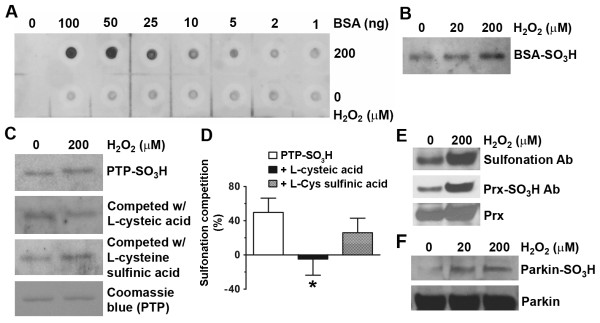
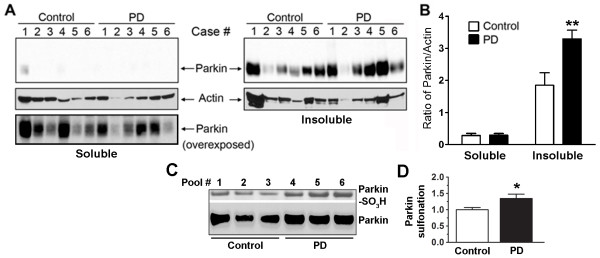
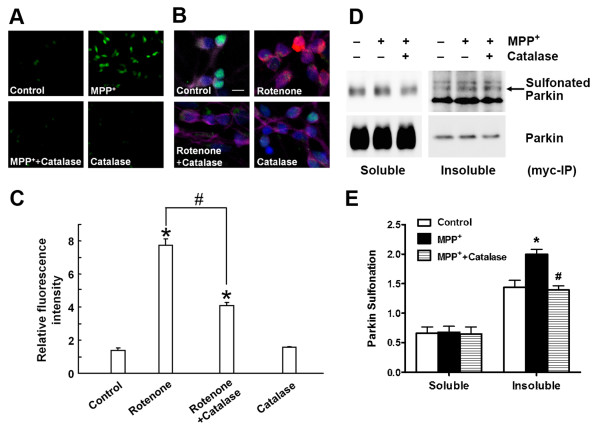
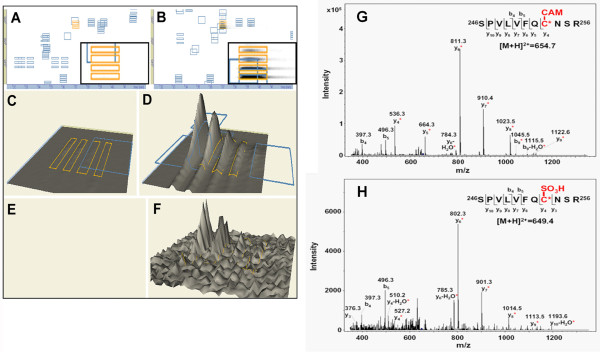
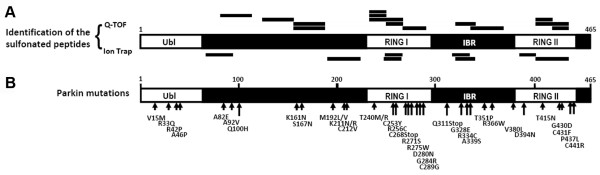
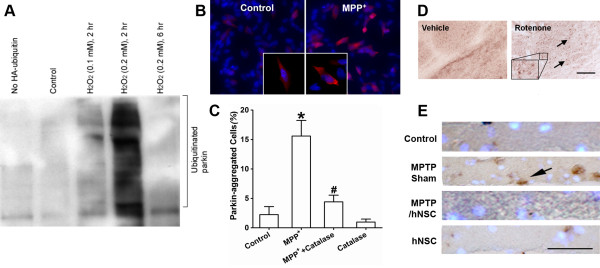
To gain insight into the mechanism whereby cell stress alters parkin-mediated ubiquitination and LB formation, we investigated the effect of oxidative stress. We found significant increases in oxidation (sulfonation) and subsequent aggregation of parkin in SH-SY5Y cells exposed to the mitochondrial complex I inhibitor 1-methyl-4-phenlypyridinium (MPP+), representing an in vitro cell-based PD model. Exposure of these cells to direct oxidation via pathological doses of H2O2 induced a vicious cycle of increased followed by decreased parkin E3 ligase activity, similar to that previously reported following S-nitrosylation of parkin. Pre-incubation with catalase attenuated H2O2 accumulation, parkin sulfonation, and parkin aggregation. Mass spectrometry (MS) analysis revealed that H2O2 reacted with specific cysteine residues of parkin, resulting in sulfination/sulfonation in regions of the protein similar to those affected by parkin mutations in hereditary forms of PD. Immunohistochemistry or gel electrophoresis revealed an increase in aggregated parkin in rats and primates exposed to mitochondrial complex I inhibitors, as well as in postmortem human brain from patients with PD with LBs.
These findings show that oxidative stress alters parkin E3 ligase activity, leading to dysfunction of the ubiquitin-proteasome system and potentially contributing to LB formation.
异常蛋白的积累形成路易体(LB)是帕金森病(PD)的一个标志。泛素化介导的异常、错误折叠蛋白的降解对于维持正常细胞功能至关重要。新出现的证据表明,氧化/硝化应激破坏了 PD 中精确调节的泛素化网络,特别是影响 parkin E3 连接酶的活性,并导致毒性蛋白的积累和神经元细胞死亡。
为了深入了解细胞应激改变 parkin 介导的泛素化和 LB 形成的机制,我们研究了氧化应激的影响。我们发现,暴露于线粒体复合物 I 抑制剂 1-甲基-4-苯基吡啶(MPP+)的 SH-SY5Y 细胞中,parkin 的氧化(磺化)和随后的聚集显著增加,这代表了一种体外基于细胞的 PD 模型。这些细胞通过病理剂量的 H2O2 直接氧化暴露,导致 parkin E3 连接酶活性的增加随后减少的恶性循环,类似于先前报道的 parkin 的 S-亚硝基化后。预先用过氧化氢酶孵育可减轻 H2O2 的积累、parkin 的磺化和 parkin 的聚集。质谱(MS)分析表明,H2O2 与 parkin 的特定半胱氨酸残基反应,导致蛋白区域的磺化/亚磺化,类似于遗传性 PD 中 parkin 突变所影响的区域。免疫组织化学或凝胶电泳显示,暴露于线粒体复合物 I 抑制剂的大鼠和灵长类动物中,以及具有 LB 的 PD 患者死后人脑的 parkin 聚集增加。
这些发现表明,氧化应激改变了 parkin E3 连接酶的活性,导致了泛素-蛋白酶体系统的功能障碍,并可能导致 LB 的形成。