Institute of Biological and Environmental Sciences, College of Life Sciences and Medicine, University of Aberdeen, UK.
Biochem J. 2011 Sep 1;438(2):369-78. doi: 10.1042/BJ20110373.
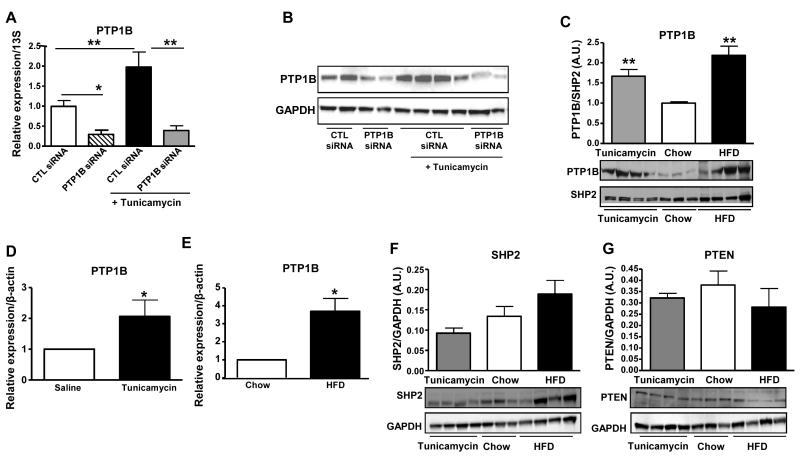
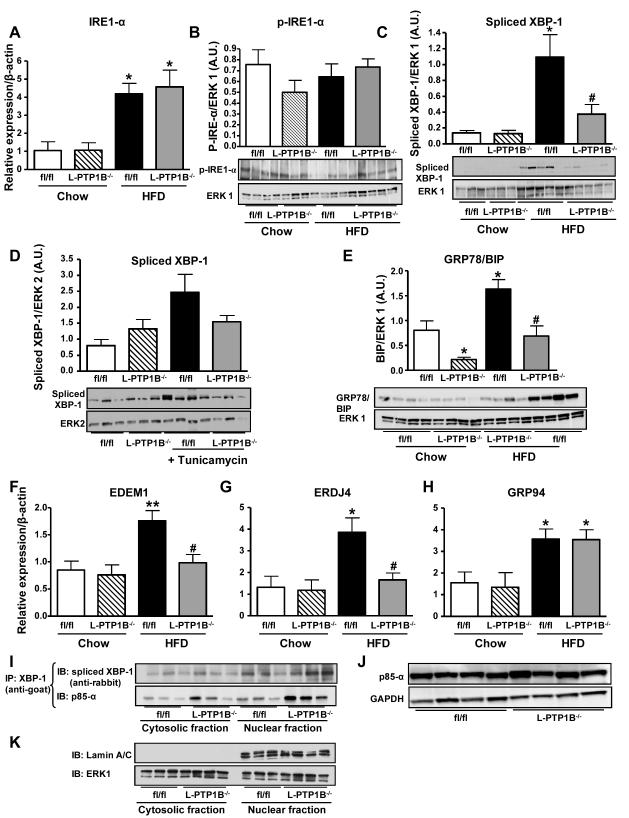
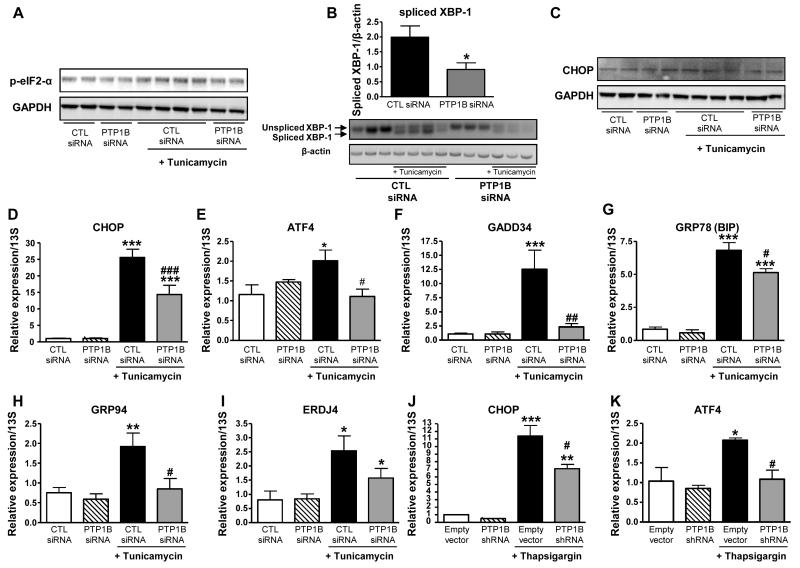
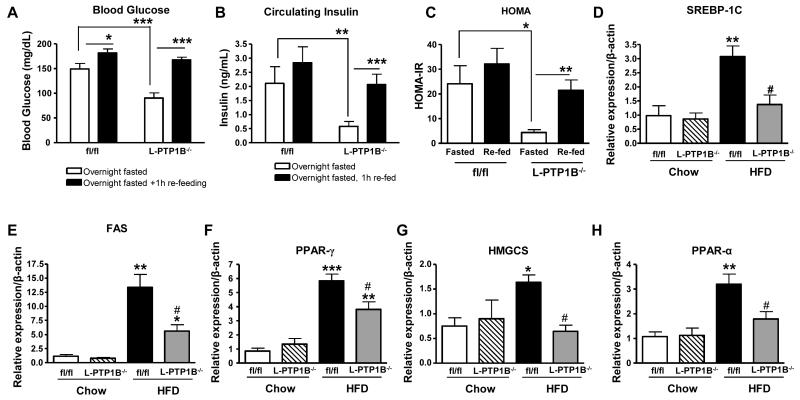
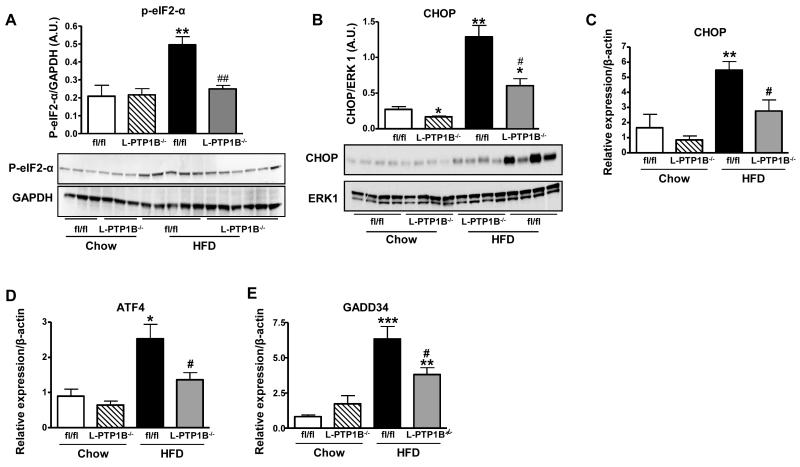
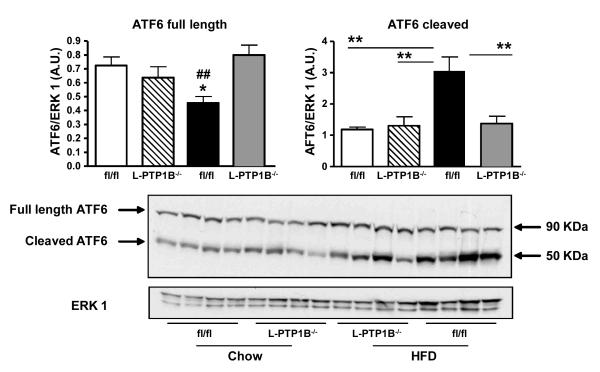
Obesity is associated with induction of the ER (endoplasmic reticulum)-stress response signalling and insulin resistance. PTP1B (protein tyrosine phosphatase 1B) is a major regulator of adiposity and insulin sensitivity. The aim of the present study was to investigate the role of L-PTP1B (liver-specific PTP1B) in chronically HFD (high-fat diet) and pharmacologically induced (tunicamycin and thapsigargin) ER-stress response signalling in vitro and in vivo. We assessed the effects of ER-stress response induction on hepatic PTP1B expression, and consequences of hepatic-PTP1B deficiency, in cells and mouse liver, on components of ER-stress response signalling. We found that PTP1B protein and mRNA expression levels were up-regulated in response to acute and/or chronic ER stress, in vitro and in vivo. Silencing PTP1B in hepatic cell lines or mouse liver (L-PTP1B(-/-)) protected against induction of pharmacologically induced and/or obesity-induced ER stress. The HFD-induced increase in CHOP (CCAAT/enhancer-binding protein homologous protein) and BIP (binding immunoglobulin protein) mRNA levels were partially inhibited, whereas ATF4 (activated transcription factor 4), GADD34 (growth-arrest and DNA-damage-inducible protein 34), GRP94 (glucose-regulated protein 94), ERDJ4 (ER-localized DnaJ homologue) mRNAs and ATF6 protein cleavage were completely suppressed in L-PTP1B(-/-) mice relative to control littermates. L-PTP1B(-/-) mice also had increased nuclear translocation of spliced XBP-1 (X box-binding protein-1) via increased p85α binding. We demonstrate that the ER-stress response and L-PTP1B expression are interlinked in obesity- and pharmacologically induced ER stress and this may be one of the mechanisms behind improved insulin sensitivity and lower lipid accumulation in L-PTP1B(-/-) mice.
肥胖与内质网(endoplasmic reticulum)应激反应信号的诱导和胰岛素抵抗有关。PTP1B(蛋白酪氨酸磷酸酶 1B)是调节肥胖和胰岛素敏感性的主要调节因子。本研究旨在探讨 L-PTP1B(肝脏特异性 PTP1B)在慢性高脂肪饮食(high-fat diet)和药理学诱导的内质网应激反应信号中的作用,包括在体外和体内。我们评估了内质网应激反应诱导对肝 PTP1B 表达的影响,以及肝 PTP1B 缺失对细胞和小鼠肝脏内质网应激反应信号成分的影响。我们发现,PTP1B 蛋白和 mRNA 表达水平在体外和体内均受到急性和/或慢性内质网应激的上调。在肝细胞系或小鼠肝脏(L-PTP1B(-/-))中沉默 PTP1B 可防止药理学诱导和/或肥胖诱导的内质网应激的发生。HFD 诱导的 CHOP(CCAAT/enhancer-binding protein homologous protein)和 BIP(binding immunoglobulin protein)mRNA 水平的增加部分受到抑制,而 ATF4(activated transcription factor 4)、GADD34(growth-arrest and DNA-damage-inducible protein 34)、GRP94(glucose-regulated protein 94)、ERDJ4(ER-localized DnaJ homologue)mRNA 和 ATF6 蛋白切割在 L-PTP1B(-/-) 小鼠中完全被抑制,而与对照同窝仔鼠相比。L-PTP1B(-/-) 小鼠还通过增加 p85α 结合增加了剪接 XBP-1(X 盒结合蛋白-1)的核易位。我们证明,内质网应激反应和 L-PTP1B 表达在肥胖和药理学诱导的内质网应激中相互关联,这可能是 L-PTP1B(-/-) 小鼠胰岛素敏感性提高和脂质积累降低的机制之一。