Cell Biology, Woolcock Institute of Medical Research, Sydney, New South Wales, Australia.
PLoS One. 2011;6(5):e20000. doi: 10.1371/journal.pone.0020000. Epub 2011 May 17.
Asthma is associated with airway narrowing in response to bronchoconstricting stimuli and increased airway smooth muscle (ASM) mass. In addition, some studies have suggested impaired β-agonist induced ASM relaxation in asthmatics, but the mechanism is not known.
To characterize the potential defect in β-agonist induced cAMP in ASM derived from asthmatic in comparison to non-asthmatic subjects and to investigate its mechanism.
We examined β(2)-adrenergic (β(2)AR) receptor expression and basal β-agonist and forskolin (direct activator of adenylyl cyclase) stimulated cAMP production in asthmatic cultured ASM (n = 15) and non-asthmatic ASM (n = 22). Based on these results, PDE activity, PDE4D expression and cell proliferation were determined.
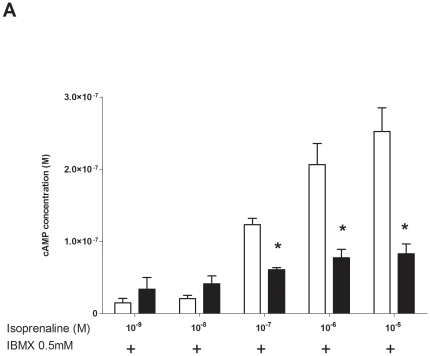
In the presence of IBMX, a pan PDE inhibitor, asthmatic ASM had ∼50% lower cAMP production in response to isoproterenol, albuterol, formoterol, and forskolin compared to non-asthmatic ASM. However when PDE4 was specifically inhibited, cAMP production by the agonists and forskolin was normalized in asthmatic ASM. We then measured the amount and activity of PDE4, and found ∼2-fold greater expression and activity in asthmatic ASM compared to non-asthmatic ASM. Furthermore, inhibition of PDE4 reduced asthmatic ASM proliferation but not that of non-asthmatic ASM.
Decreased β-agonist induced cAMP in ASM from asthmatics results from enhanced degradation due to increased PDE4D expression. Clinical manifestations of this dysregulation would be suboptimal β-agonist-mediated bronchodilation and possibly reduced control over increasing ASM mass. These phenotypes appear to be "hard-wired" into ASM from asthmatics, as they do not require an inflammatory environment in culture to be observed.
哮喘与气道对缩血管刺激的收缩反应以及气道平滑肌(ASM)质量增加有关。此外,一些研究表明哮喘患者的β-激动剂诱导的 ASM 松弛受损,但机制尚不清楚。
与非哮喘患者相比,表征哮喘患者 ASM 中β-激动剂诱导的 cAMP 潜在缺陷,并研究其机制。
我们检查了哮喘患者培养的 ASM(n=15)和非哮喘患者 ASM(n=22)中的β(2)-肾上腺素能(β(2)AR)受体表达以及基础β-激动剂和福司可林(腺苷酸环化酶的直接激活剂)刺激的 cAMP 产生。基于这些结果,测定了 PDE 活性、PDE4D 表达和细胞增殖。
在 IBMX(一种泛 PDE 抑制剂)存在的情况下,哮喘患者的 ASM 对异丙肾上腺素、沙丁胺醇、福莫特罗和福司可林的反应中 cAMP 产生减少了约 50%,而与非哮喘患者的 ASM 相比。然而,当特异性抑制 PDE4 时,激动剂和福司可林引起的 cAMP 产生在哮喘患者的 ASM 中得到了正常化。然后,我们测量了 PDE4 的量和活性,发现哮喘患者的 ASM 中表达和活性增加了约 2 倍。此外,抑制 PDE4 减少了哮喘患者的 ASM 增殖,但不减少非哮喘患者的 ASM 增殖。
哮喘患者的 ASM 中β-激动剂诱导的 cAMP 减少是由于 PDE4D 表达增加导致的降解增强所致。这种失调的临床表现将是β-激动剂介导的支气管扩张效果不理想,并且可能导致 ASM 质量增加的控制降低。这些表型似乎是哮喘患者的 ASM 中的“固有”现象,因为它们在培养中不需要炎症环境即可观察到。