Department of Molecular and Human Genetics, Program in Developmental Biology, Baylor College of Medicine, Houston, TX 77030, USA.
Hum Mol Genet. 2011 Sep 1;20(17):3366-75. doi: 10.1093/hmg/ddr243. Epub 2011 May 30.
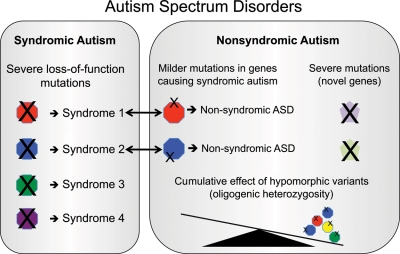
Autism spectrum disorders (ASDs) are a heterogeneous group of neuro-developmental disorders. While significant progress has been made in the identification of genes and copy number variants associated with syndromic autism, little is known to date about the etiology of idiopathic non-syndromic autism. Sanger sequencing of 21 known autism susceptibility genes in 339 individuals with high-functioning, idiopathic ASD revealed de novo mutations in at least one of these genes in 6 of 339 probands (1.8%). Additionally, multiple events of oligogenic heterozygosity were seen, affecting 23 of 339 probands (6.8%). Screening of a control population for novel coding variants in CACNA1C, CDKL5, HOXA1, SHANK3, TSC1, TSC2 and UBE3A by the same sequencing technology revealed that controls were carriers of oligogenic heterozygous events at significantly (P < 0.01) lower rate, suggesting oligogenic heterozygosity as a new potential mechanism in the pathogenesis of ASDs.
自闭症谱系障碍(ASD)是一组异质性的神经发育障碍。虽然在与综合征性自闭症相关的基因和拷贝数变异的鉴定方面已经取得了重大进展,但目前对于特发性非综合征性自闭症的病因知之甚少。对 339 名高功能、特发性自闭症患者的 21 个已知自闭症易感基因进行 Sanger 测序,结果显示在 339 名先证者中有 6 名(1.8%)至少存在一个基因的新生突变。此外,还观察到多种寡基因杂合性事件,影响了 339 名先证者中的 23 名(6.8%)。通过相同的测序技术对 CACNA1C、CDKL5、HOXA1、SHANK3、TSC1、TSC2 和 UBE3A 中的新编码变异进行对照人群筛查,结果显示对照者的寡基因杂合事件发生率显著(P < 0.01)降低,提示寡基因杂合性是 ASD 发病机制中的一个新的潜在机制。