Department of Clinical Neuroscience, Psychiatry Section, Karolinska Institutet, Stockholm 171 76, Sweden.
Psychopharmacology (Berl). 2011 Dec;218(3):579-87. doi: 10.1007/s00213-011-2343-z. Epub 2011 May 28.
Cariprazine is a novel antipsychotic drug candidate that exhibits high selectivity and affinity to dopamine D(3) and D(2) receptors and moderate affinity to serotonin 5-HT(1A) receptors. Targeting receptors other than D(2) may provide a therapeutic benefit for both positive and negative symptoms associated with schizophrenia. Positron emission tomography (PET) can be used as a tool in drug development to assess the in vivo distribution and pharmacological properties of a drug.
The objective of this study was to determine dopamine D(2)/D(3) and serotonin 5-HT(1A) receptor occupancy in monkey brain after the administration of cariprazine.
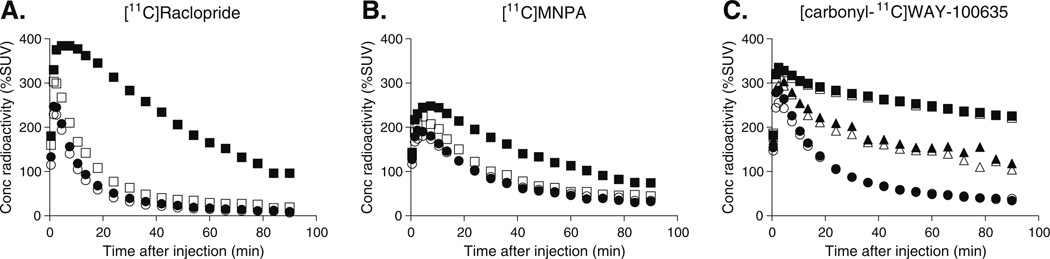
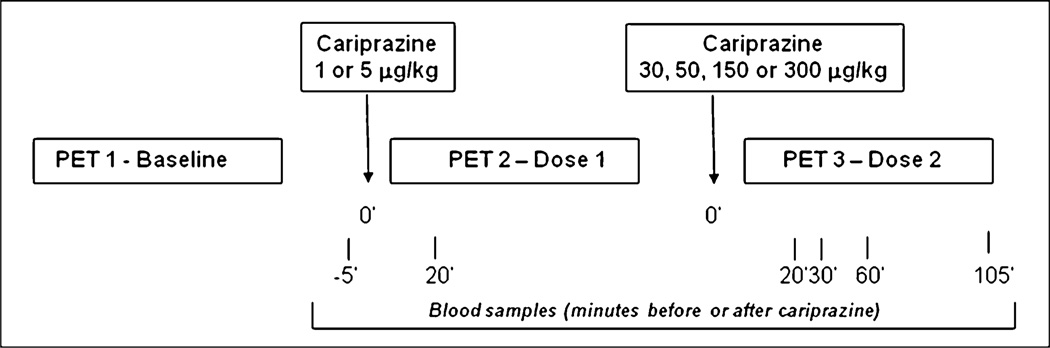
We examined three monkeys using the following PET radioligands: [(11)C]MNPA (an agonist at D(2) and D(3) receptors), [(11)C]raclopride (an antagonist at D(2) and D(3) receptors), and [(11)C]WAY-100635 (an antagonist at 5-HT(1A) receptors). During each experimental day, the first PET measurement was a baseline study, the second after a low dose of cariprazine, and the third after the administration of a high dose.
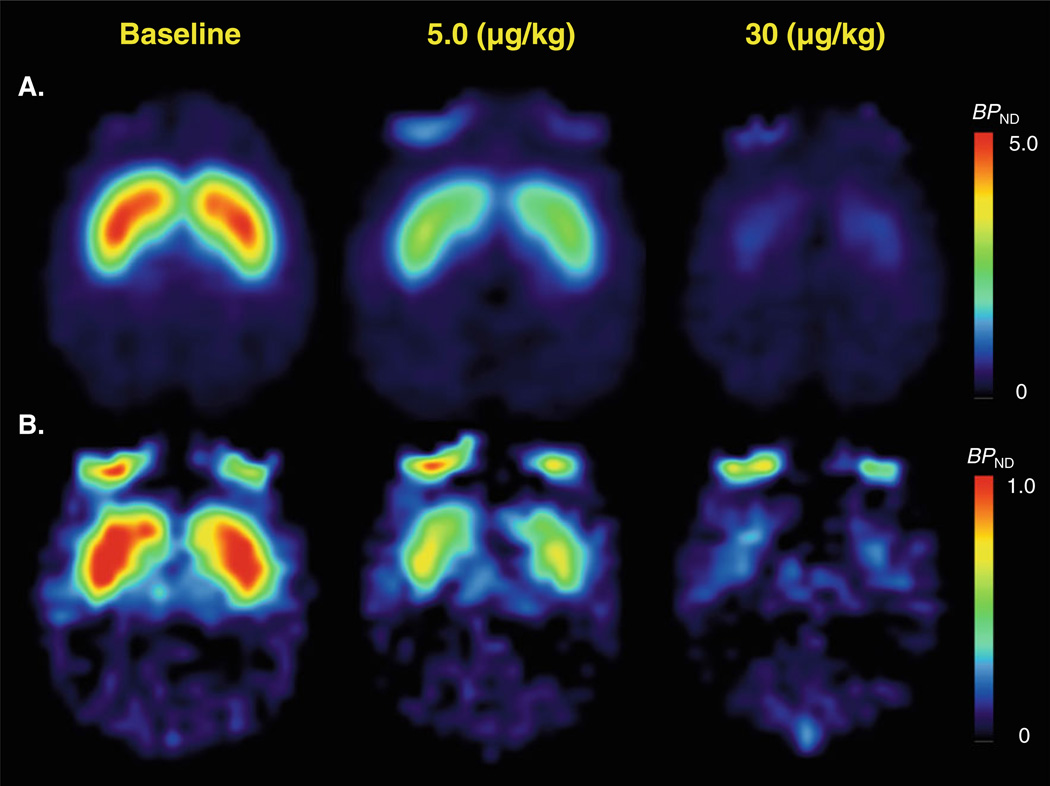
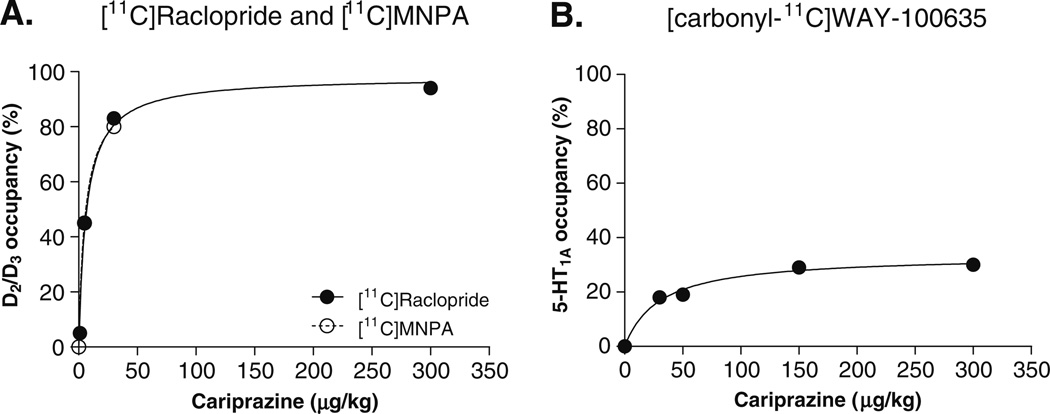
We found that cariprazine occupied D(2)/D(3) receptors in a dose-dependent and saturable manner, with the lowest dose occupying ~5% of receptors and the highest dose showing more than 90% occupancy. 5-HT(1A) receptor occupancy was considerably lower compared with D(2)/D(3) occupancy at the same doses, with a maximal value of ~30% for the raphe nuclei.
We conclude that cariprazine binds preferentially to dopamine D(2)/D(3) rather than to serotonin 5-HT(1A) receptors in monkey brain. These findings can be used to guide the selection of cariprazine dosing in humans.
卡利拉嗪是一种新型抗精神病候选药物,对多巴胺 D(3) 和 D(2) 受体具有高选择性和亲和力,对 5-羟色胺 5-HT(1A) 受体具有中等亲和力。针对除 D(2) 以外的受体可能为精神分裂症的阳性和阴性症状提供治疗益处。正电子发射断层扫描 (PET) 可作为药物开发中的一种工具,用于评估药物的体内分布和药理学特性。
本研究的目的是确定卡利拉嗪给药后猴脑中多巴胺 D(2)/D(3) 和 5-羟色胺 5-HT(1A) 受体占有率。
我们使用以下 PET 放射性配体检查了三只猴子:[(11)C]MNPA(D(2) 和 D(3) 受体激动剂)、[(11)C]raclopride(D(2) 和 D(3) 受体拮抗剂)和 [(11)C]WAY-100635(5-HT(1A) 受体拮抗剂)。在每个实验日,第一次 PET 测量为基线研究,第二次为低剂量卡利拉嗪给药后,第三次为高剂量给药后。
我们发现卡利拉嗪以剂量依赖性和饱和方式占据 D(2)/D(3) 受体,最低剂量占据约 5%的受体,最高剂量显示超过 90%的占有率。与同一剂量的 D(2)/D(3) 占有率相比,5-HT(1A) 受体占有率明显较低,在中缝核的最大值约为 30%。
我们得出结论,卡利拉嗪在猴脑中优先结合多巴胺 D(2)/D(3) 受体,而不是 5-羟色胺 5-HT(1A) 受体。这些发现可用于指导卡利拉嗪在人类中的剂量选择。