Centro de Genômica e Fitomelhoramento, Faculdade de Agronomia Eliseu Maciel, Universidade Federal de Pelotas, Pelotas, RS Brazil.
Genet Mol Biol. 2009 Oct;32(4):822-33. doi: 10.1590/S1415-47572009005000091. Epub 2009 Dec 1.
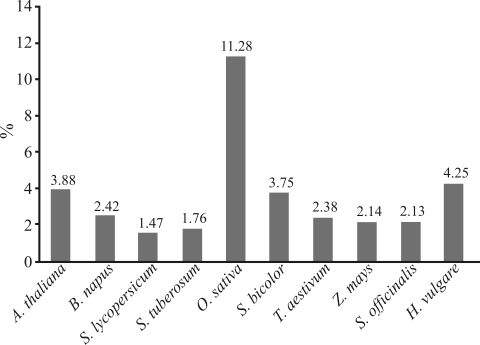
Tandem repeats (microsatellites or SSRs) are molecular markers with great potential for plant genetic studies. Modern strategies include the transfer of these markers among widely studied and orphan species. In silico analyses allow for studying distribution patterns of microsatellites and predicting which motifs would be more amenable to interspecies transfer. Transcribed sequences (Unigene) from ten species of three plant families were surveyed for the occurrence of micro and minisatellites. Transcripts from different species displayed different rates of tandem repeat occurrence, ranging from 1.47% to 11.28%. Both similar and different patterns were found within and among plant families. The results also indicate a lack of association between genome size and tandem repeat fractions in expressed regions. The conservation of motifs among species and its implication on genome evolution and dynamics are discussed.
串联重复(微卫星或 SSR)是具有巨大潜力的植物遗传研究的分子标记。现代策略包括在广泛研究的和被忽视的物种之间转移这些标记。通过计算机分析可以研究微卫星的分布模式,并预测哪些基序更适合种间转移。对三个植物科的十个物种的转录序列(基因)进行了微卫星和小卫星的发生情况调查。不同物种的转录本显示出不同的串联重复发生频率,范围从 1.47%到 11.28%。在植物科内和科间都发现了相似和不同的模式。结果还表明,表达区域中基因组大小和串联重复分数之间没有关联。讨论了物种间基序的保守性及其对基因组进化和动态的影响。