Laboratory of Anatomy and Embryology, Faculté de Médecine, Université Libre de Bruxelles, Brussels Belgium.
Genet Mol Biol. 2009 Apr;32(2):399-404. doi: 10.1590/S1415-47572009005000041. Epub 2009 May 1.
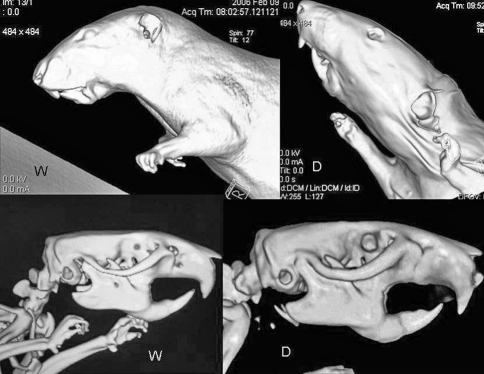
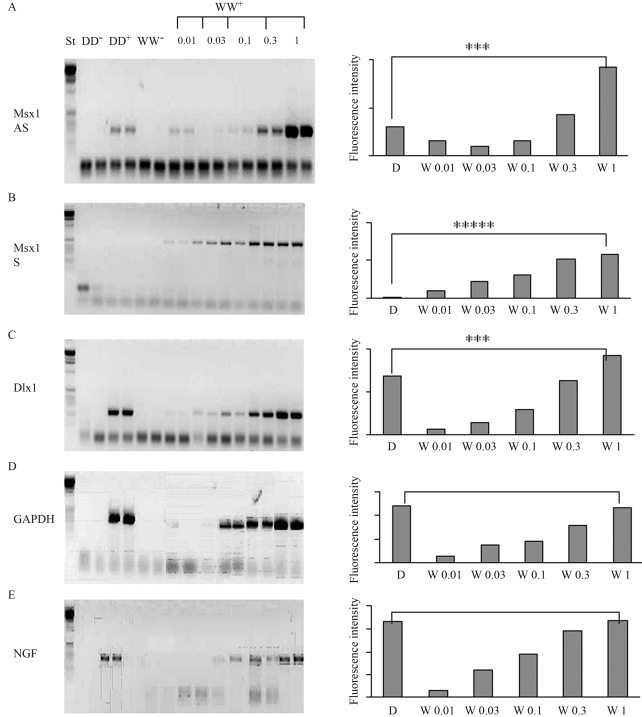
The Dumbo rat possesses some characteristics that evoke several human syndromes, such as Treacher-Collins: shortness of the maxillary, zygomatic and mandibular bones, and low position of the ears. Knowing that many homeobox genes are candidates in craniofacial development, we investigated the involvement of the Msx1 and Dlx1 genes in the Dumbo phenotype with the aim of understanding their possible role in abnormal craniofacial morphogenesis and examining the possibility of using Dumbo rat as an experimental model for understanding abnormal craniofacial development. We studied the expression of these genes during craniofacial morphogenesis by RT-PCR method. We used Dumbo embryos at E12 and E14 and included the Wistar strain as a control. Semi-quantitative PCR analysis demonstrated that Msx1 and Dlx1 are expressed differently between Dumbo and Wistar rats, indicating that their low expression may underly the Dumbo phenotype.
大耳鼠具有一些特征,使人联想到几种人类综合征,如特雷彻-柯林斯综合征:上颌骨、颧骨和下颌骨短小,耳朵位置低。由于许多同源盒基因是颅面发育的候选基因,我们研究了 Msx1 和 Dlx1 基因在 Dumbo 表型中的参与,目的是了解它们在异常颅面形态发生中的可能作用,并研究是否可以使用 Dumbo 大鼠作为实验模型来理解异常颅面发育。我们通过 RT-PCR 方法研究了这些基因在颅面形态发生过程中的表达。我们使用了 E12 和 E14 期的 Dumbo 胚胎,并将 Wistar 品系作为对照。半定量 PCR 分析表明,Msx1 和 Dlx1 在 Dumbo 和 Wistar 大鼠之间的表达不同,这表明它们的低表达可能是 Dumbo 表型的基础。