Fajer P G, Fajer E A, Thomas D D
Department of Biochemistry, University of Minnesota Medical School, Minneapolis 55455.
Proc Natl Acad Sci U S A. 1990 Jul;87(14):5538-42. doi: 10.1073/pnas.87.14.5538.
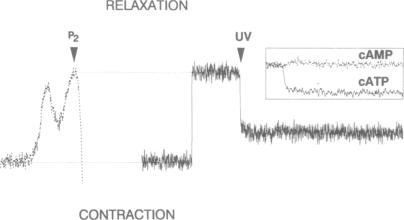
To study the orientation of spin-labeled myosin heads in the first few seconds after the production of saturating ATP, we have used a laser flash to photolyze caged ATP during EPR data acquisition. Rabbit psoas muscle fibers were labeled with maleimide spin label, modifying 60% of the myosin heads without impairing muscle fiber biochemical and physiological activity (ATPase and force). The muscle bundles were incubated for 30 min with 5 mM caged ATP prior to the UV flash. The flash, from an excimer laser, liberated 2-3 mM ATP, generating maximum force in the presence of Ca2+ and relaxing fully in the absence of Ca2+. Control experiments, using fibers decorated with labeled myosin subfragment, showed that the flash liberates sufficient ATP to saturate myosin active sites in all regions of the muscle bundles. To increase the time resolution, and to minimize the time of the contraction, we followed in time the intensity at a single spectral position (P2), which is associated with the high degree of orientational order in rigor. ATP liberation produced a rapid decrease of P2 with liberation of ATP, indicating a large decrease in orientational order in both relaxation and contraction. This transient was absent when caged AMP was used, ruling out nonspecific effects of the UV flash and subsequent photochemistry. The steady-state level of P2 during contraction was almost as low as that reached in relaxation, although the duration of the steady state was much more brief in contraction. Upon depletion of ATP in contraction, the P2 intensity reverted to the original rigor level, accompanied by development of rigor tension. The steady-state results obtained in the brief contractions induced by caged ATP are quantitatively consistent with those obtained in longer contractions by continuously perfusing fibers with ATP. In isometric contraction, most (88% +/- 4%) of the heads are in a population characterized by a high degree of axial disorder, comparable to that observed for all heads in relaxation. Since the stiffness of these fibers in contraction is 80% of the stiffness in rigor, it is likely that most of the heads in this highly disoriented population are attached to actin in contraction and that most actin-attached heads in contraction are in this disoriented population.
为了研究在产生饱和ATP后的最初几秒内自旋标记肌球蛋白头部的取向,我们在电子顺磁共振(EPR)数据采集期间使用激光闪光光解笼形ATP。兔腰大肌纤维用马来酰亚胺自旋标记进行标记,修饰60%的肌球蛋白头部,而不损害肌纤维的生化和生理活性(ATP酶和力量)。在紫外闪光之前,将肌束与5 mM笼形ATP孵育30分钟。来自准分子激光的闪光释放出2 - 3 mM ATP,在Ca2+存在下产生最大力量,在没有Ca2+时完全松弛。使用用标记的肌球蛋白亚片段装饰的纤维进行的对照实验表明,闪光释放出足够的ATP以使肌束所有区域的肌球蛋白活性位点饱和。为了提高时间分辨率并最小化收缩时间,我们及时跟踪与僵直中高度取向有序相关的单个光谱位置(P2)处的强度。ATP释放导致P2随着ATP的释放而迅速下降,表明在松弛和收缩过程中取向有序度大幅降低。当使用笼形AMP时,这种瞬变不存在,排除了紫外闪光和随后光化学的非特异性影响。收缩期间P2的稳态水平几乎与松弛时达到的水平一样低,尽管收缩中稳态的持续时间要短得多。在收缩过程中ATP耗尽时,P2强度恢复到原来的僵直水平,同时伴随着僵直张力的发展。由笼形ATP诱导的短暂收缩中获得的稳态结果与通过用ATP连续灌注纤维进行的较长收缩中获得的结果在数量上是一致的。在等长收缩中,大多数(88%±4%)头部处于以高度轴向无序为特征的群体中,这与在松弛时所有头部观察到的情况相当。由于这些纤维在收缩时的刚度是僵直时刚度的80%,很可能这个高度无序群体中的大多数头部在收缩时附着于肌动蛋白,并且收缩时大多数附着于肌动蛋白的头部处于这个无序群体中。