Institute for Molecular Biology, Centre for Medical Biotechnology (ZMB), University Duisburg-Essen, Essen, Germany.
PLoS One. 2011;6(5):e18253. doi: 10.1371/journal.pone.0018253. Epub 2011 May 25.
Threonine Aspartase 1 (Taspase1) mediates cleavage of the mixed lineage leukemia (MLL) protein and leukemia provoking MLL-fusions. In contrast to other proteases, the understanding of Taspase1's (patho)biological relevance and function is limited, since neither small molecule inhibitors nor cell based functional assays for Taspase1 are currently available.
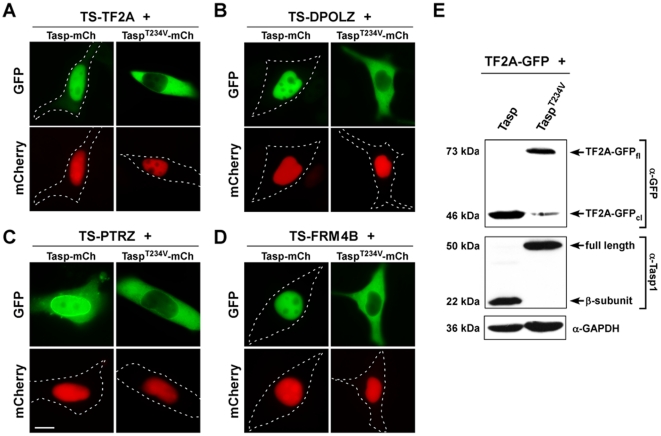
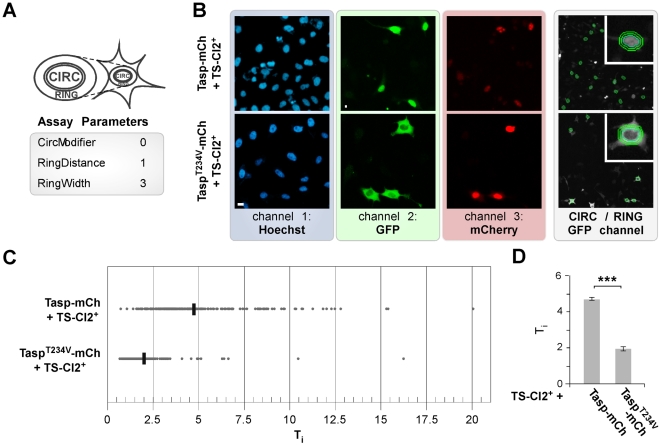
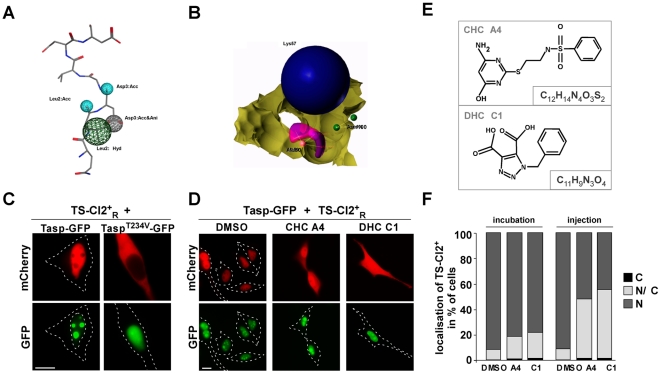
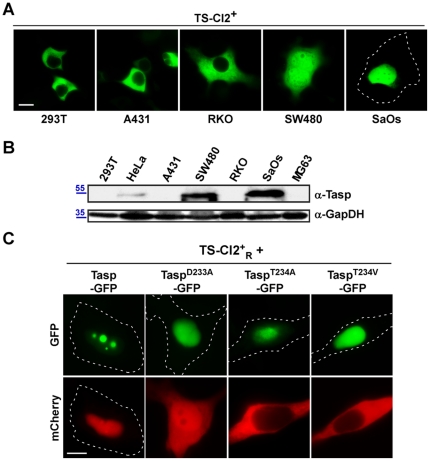
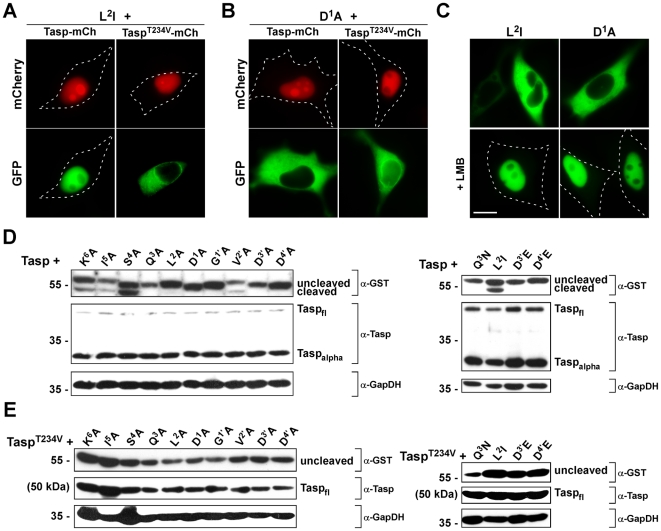
METHODOLOGY/FINDINGS: Efficient cell-based assays to probe Taspase1 function in vivo are presented here. These are composed of glutathione S-transferase, autofluorescent protein variants, Taspase1 cleavage sites and rational combinations of nuclear import and export signals. The biosensors localize predominantly to the cytoplasm, whereas expression of biologically active Taspase1 but not of inactive Taspase1 mutants or of the protease Caspase3 triggers their proteolytic cleavage and nuclear accumulation. Compared to in vitro assays using recombinant components the in vivo assay was highly efficient. Employing an optimized nuclear translocation algorithm, the triple-color assay could be adapted to a high-throughput microscopy platform (Z'factor = 0.63). Automated high-content data analysis was used to screen a focused compound library, selected by an in silico pharmacophor screening approach, as well as a collection of fungal extracts. Screening identified two compounds, N-[2-[(4-amino-6-oxo-3H-pyrimidin-2-yl)sulfanyl]ethyl]benzenesulfonamide and 2-benzyltriazole-4,5-dicarboxylic acid, which partially inhibited Taspase1 cleavage in living cells. Additionally, the assay was exploited to probe endogenous Taspase1 in solid tumor cell models and to identify an improved consensus sequence for efficient Taspase1 cleavage. This allowed the in silico identification of novel putative Taspase1 targets. Those include the FERM Domain-Containing Protein 4B, the Tyrosine-Protein Phosphatase Zeta, and DNA Polymerase Zeta. Cleavage site recognition and proteolytic processing of these substrates were verified in the context of the biosensor.
The assay not only allows to genetically probe Taspase1 structure function in vivo, but is also applicable for high-content screening to identify Taspase1 inhibitors. Such tools will provide novel insights into Taspase1's function and its potential therapeutic relevance.
苏氨酸天冬氨酸蛋白酶 1(Taspase1)介导混合谱系白血病(MLL)蛋白和引起白血病的 MLL 融合蛋白的切割。与其他蛋白酶不同,由于目前尚无 Taspase1 的小分子抑制剂或基于细胞的功能测定,因此对 Taspase1 的(病理)生物学相关性和功能的了解有限。
方法/发现:本文介绍了用于体内探测 Taspase1 功能的有效基于细胞的测定方法。这些测定方法由谷胱甘肽 S-转移酶、自发荧光蛋白变体、Taspase1 切割位点和核输入和输出信号的合理组合组成。生物传感器主要定位于细胞质,而表达有生物活性的 Taspase1,但不是无活性的 Taspase1 突变体或蛋白酶 Caspase3 触发它们的蛋白水解切割和核积累。与使用重组成分的体外测定相比,体内测定效率更高。采用优化的核易位算法,三色彩色测定法可适应高通量显微镜平台(Z'因子=0.63)。自动化高内涵数据分析用于筛选经计算机药物筛选方法选择的聚焦化合物文库,以及一系列真菌提取物。筛选鉴定了两种化合物,N-[2-[(4-氨基-6-氧代-3H-嘧啶-2-基)硫基]乙基]苯磺酰胺和 2-苄基三唑-4,5-二羧酸,它们可部分抑制活细胞中的 Taspase1 切割。此外,该测定法还用于探测实体瘤细胞模型中的内源性 Taspase1,并确定用于有效 Taspase1 切割的改进共识序列。这使得能够在计算机上鉴定新的潜在 Taspase1 靶标。这些靶标包括 FERM 结构域包含蛋白 4B、酪氨酸蛋白磷酸酶 Zeta 和 DNA 聚合酶 Zeta。在生物传感器的背景下验证了这些底物的切割位点识别和蛋白水解加工。
该测定法不仅允许在体内遗传探测 Taspase1 的结构功能,还可用于高通量筛选以鉴定 Taspase1 抑制剂。此类工具将为 Taspase1 的功能及其潜在治疗相关性提供新的见解。