
联合基因组和表型筛选揭示分泌因子丝氨酸蛋白酶抑制剂 Kazal 型 1(SPINK1)是与乳腺癌患者预后相关的侵袭和存活因子。
Combined genomic and phenotype screening reveals secretory factor SPINK1 as an invasion and survival factor associated with patient prognosis in breast cancer.
机构信息
Cancer Biology and Pharmacology, Genome Institute of Singapore.
出版信息
EMBO Mol Med. 2011 Aug;3(8):451-64. doi: 10.1002/emmm.201100150. Epub 2011 Jun 8.
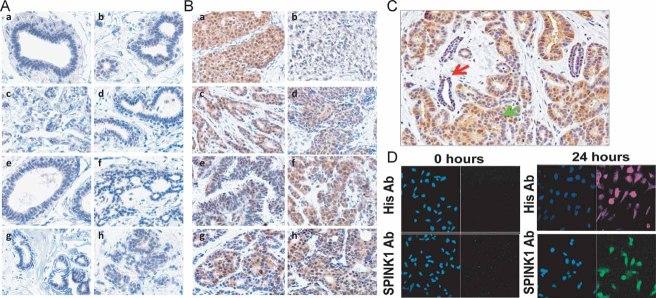
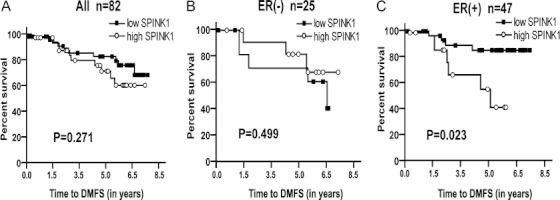
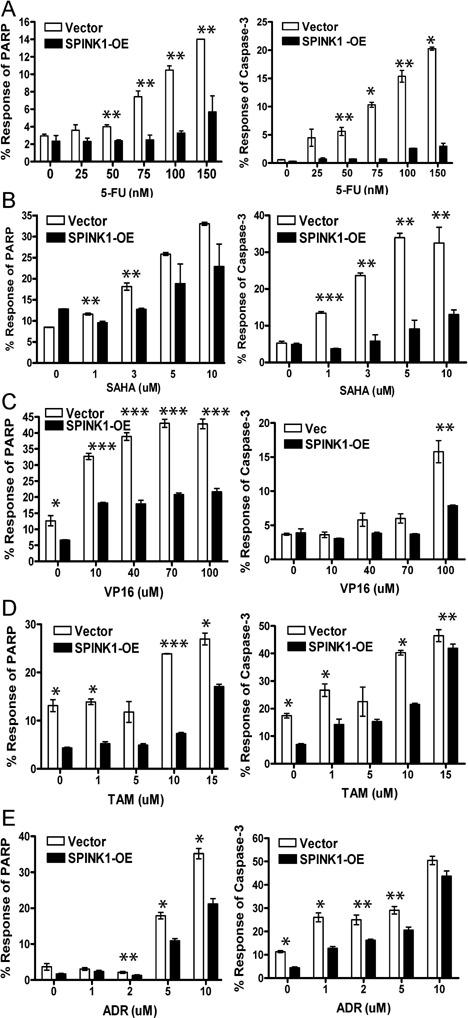
Secretory factors that drive cancer progression are attractive immunotherapeutic targets. We used a whole-genome data-mining approach on multiple cohorts of breast tumours annotated for clinical outcomes to discover such factors. We identified Serine protease inhibitor Kazal-type 1 (SPINK1) to be associated with poor survival in estrogen receptor-positive (ER+) cases. Immunohistochemistry showed that SPINK1 was absent in normal breast, present in early and advanced tumours, and its expression correlated with poor survival in ER+ tumours. In ER- cases, the prognostic effect did not reach statistical significance. Forced expression and/or exposure to recombinant SPINK1 induced invasiveness without affecting cell proliferation. However, down-regulation of SPINK1 resulted in cell death. Further, SPINK1 overexpressing cells were resistant to drug-induced apoptosis due to reduced caspase-3 levels and high expression of Bcl2 and phospho-Bcl2 proteins. Intriguingly, these anti-apoptotic effects of SPINK1 were abrogated by mutations of its protease inhibition domain. Thus, SPINK1 affects multiple aggressive properties in breast cancer: survival, invasiveness and chemoresistance. Because SPINK1 effects are abrogated by neutralizing antibodies, we suggest that SPINK1 is a viable potential therapeutic target in breast cancer.
促进癌症进展的分泌因子是有吸引力的免疫治疗靶点。我们使用全基因组数据挖掘方法对多个注释了临床结局的乳腺癌队列进行分析,以发现此类因子。我们发现丝氨酸蛋白酶抑制剂 Kazal 型 1(SPINK1)与雌激素受体阳性(ER+)病例的不良生存相关。免疫组化显示 SPINK1 在正常乳腺中不存在,在早期和晚期肿瘤中存在,其表达与 ER+肿瘤的不良生存相关。在 ER-病例中,预后效果未达到统计学意义。强制表达和/或暴露于重组 SPINK1 诱导侵袭性而不影响细胞增殖。然而,下调 SPINK1 导致细胞死亡。此外,由于 caspase-3 水平降低和 Bcl2 和磷酸化 Bcl2 蛋白的高表达,过表达 SPINK1 的细胞对药物诱导的细胞凋亡具有抗性。有趣的是,其蛋白酶抑制结构域的突变会消除 SPINK1 的这些抗凋亡作用。因此,SPINK1 影响乳腺癌的多种侵袭性特征:生存、侵袭性和化疗耐药性。由于中和抗体可消除 SPINK1 的作用,我们认为 SPINK1 是乳腺癌潜在的可行治疗靶点。






 Zotero 插件