U,O, Oncologia Medica 2 Universitaria, Azienda Ospedaliero-Universitaria Pisana, Istituto Toscano Tumori and Dipartimento di Oncologia, dei Trapianti e delle Nuove Tecnologie in Medicina, Università di Pisa, Italy.
BMC Cancer. 2011 Jun 14;11:247. doi: 10.1186/1471-2407-11-247.
Molecular predictors of bevacizumab efficacy in colorectal cancer have not been identified yet. Specific VEGF polymorphisms may affect gene transcription and therefore indirectly influence the efficacy of bevacizumab.
Genomic DNA of 111 consecutive metastatic colorectal cancer patients treated with first-line FOLFIRI plus bevacizumab was obtained from blood samples. VEGF -2578 C/A, -1498 C/T, + 405 C/G, + 936 C/T polymorphisms were analyzed by means of PCR-RFLP. DNA samples from 107 patients treated with FOLFIRI alone served as historical control group. The relation of VEGF polymorphisms with PFS, evaluated through Kaplan-Meier method and log-rank test, was the primary end-point. An interaction test with a Cox model has been performed in order to demonstrate the heterogeneity of the effect of VEGF -1498 C/T polymorphism between bevacizumab-and control group.
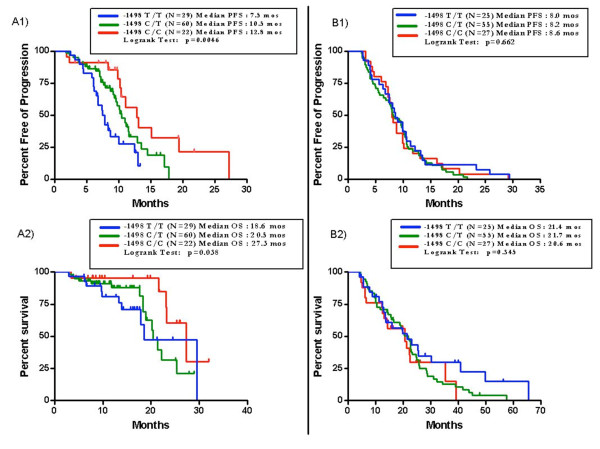
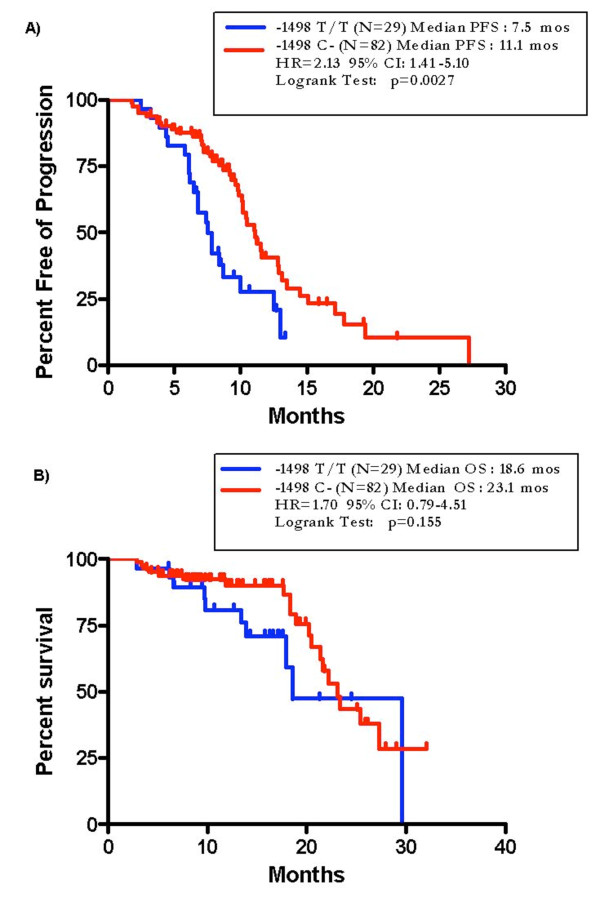
In the bevacizumab-group median PFS and OS of patients carrying VEGF -1498 C/C, C/T and T/T allelic variants were, respectively, 12.8, 10.5, 7.5 months (p = 0.0046, log-rank test) and 27.3, 20.5, 18.6 months (p = 0.038, log-rank test). VEGF -1498 T/T genotype was associated with shorter PFS (HR = 2.13, [1.41-5.10], p = 0.0027). In the control group no significant association of VEGF -1498 C/T allelic variants and PFS or OS was found. Interaction between VEGF -1498 C/T variants and treatment effect suggested that the relation of VEGF -1498 T/T genotype with shorter PFS was caused by the effect of bevacizumab (p = 0.011). Other investigated polymorphisms did not affect the outcome.
These data suggest a possible role for VEGF -1498 C/T variants in predicting the efficacy of bevacizumab in the up-front treatment of metastatic colorectal cancer patients. A molecular tool for selecting subjects candidate to benefit from the anti-VEGF could be important for clinical practice. The retrospective and exploratory design of the present study, coupled with the non-randomized nature of the comparison between treated and untreated patients, imply that these results should be considered as hypothesis generators. A prospective validating trial is currently ongoing.
目前尚未发现贝伐单抗治疗结直肠癌疗效的分子预测因子。特定的 VEGF 多态性可能会影响基因转录,从而间接影响贝伐单抗的疗效。
从 111 例接受一线 FOLFIRI 联合贝伐单抗治疗的转移性结直肠癌患者的血样中获得基因组 DNA。采用 PCR-RFLP 法分析 VEGF-2578 C/A、-1498 C/T、+405 C/G、+936 C/T 多态性。107 例接受单纯 FOLFIRI 治疗的患者的 DNA 样本作为历史对照组。通过 Kaplan-Meier 法和对数秩检验评估 VEGF 多态性与 PFS 的关系,这是主要终点。为了证明 VEGF-1498 C/T 多态性在贝伐单抗组和对照组之间的作用存在异质性,我们进行了 Cox 模型的交互检验。
在贝伐单抗组中,携带 VEGF-1498 C/C、C/T 和 T/T 等位基因变异的患者中位 PFS 和 OS 分别为 12.8、10.5、7.5 个月(p=0.0046,对数秩检验)和 27.3、20.5、18.6 个月(p=0.038,对数秩检验)。VEGF-1498 T/T 基因型与较短的 PFS 相关(HR=2.13,[1.41-5.10],p=0.0027)。在对照组中,未发现 VEGF-1498 C/T 等位基因变异与 PFS 或 OS 之间存在显著关联。VEGF-1498 C/T 变异与治疗效果之间的相互作用表明,VEGF-1498 T/T 基因型与较短 PFS 之间的关系是由贝伐单抗的作用引起的(p=0.011)。其他研究的多态性未影响结果。
这些数据表明,VEGF-1498 C/T 变异可能在预测转移性结直肠癌患者一线治疗中贝伐单抗疗效方面发挥作用。用于选择可能从抗 VEGF 中获益的受试者的分子工具对于临床实践可能很重要。本研究的回顾性和探索性设计,加上治疗组和未治疗组之间比较的非随机性,意味着这些结果应被视为假设生成。目前正在进行一项前瞻性验证试验。