Department of Immunology, Mayo Clinic College of Medicine, Mayo Clinic Arizona, Scottsdale, AZ 85259, USA.
J Exp Med. 2011 Jul 4;208(7):1485-99. doi: 10.1084/jem.20100730. Epub 2011 Jun 13.
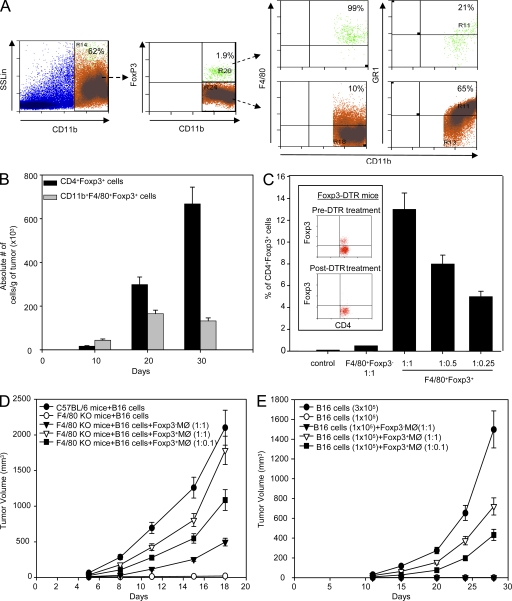
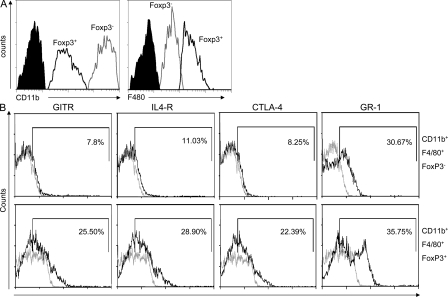
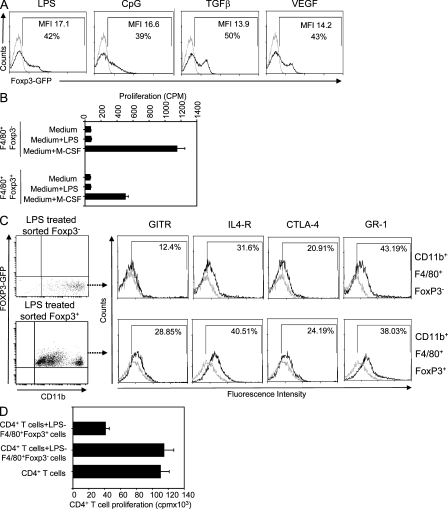
Regulatory T cells (T reg cells) are characterized by the expression of the forkhead lineage-specific transcription factor Foxp3, and their main function is to suppress T cells. While evaluating T reg cells, we identified a population of Foxp3-positive cells that were CD11b(+)F4/80(+)CD68(+), indicating macrophage origin. These cells were observed in spleen, lymph nodes, bone marrow, thymus, liver, and other tissues of naive animals. To characterize this subpopulation of macrophages, we devised a strategy to purify CD11b(+)F4/80(+)Foxp3(+) macrophages using Foxp3-GFP mice. Analysis of CD11b(+)F4/80(+)Foxp3(+) macrophage function indicated that these cells inhibited the proliferation of T cells, whereas Foxp3(-) macrophages did not. Suppression of T cell proliferation was mediated through soluble factors. Foxp3(-) macrophages acquired Foxp3 expression after activation, which conferred inhibitory properties that were indistinguishable from natural Foxp3(+) macrophages. The cytokine and transcriptional profiles of Foxp3(+) macrophages were distinct from those of Foxp3(-) macrophages, indicating that these cells have different biological functions. Functional in vivo analyses indicated that CD11b(+)F4/80(+)Foxp3(+) macrophages are important in tumor promotion and the induction of T reg cell conversion. For the first time, these studies demonstrate the existence of a distinct subpopulation of naturally occurring macrophage regulatory cells in which expression of Foxp3 correlates with suppressive function.
调节性 T 细胞(Treg 细胞)的特征是表达叉头框谱系特异性转录因子 Foxp3,其主要功能是抑制 T 细胞。在评估 Treg 细胞时,我们鉴定出一群 Foxp3 阳性细胞,这些细胞为 CD11b(+)F4/80(+)CD68(+),表明其来源于巨噬细胞。这些细胞存在于未成熟动物的脾脏、淋巴结、骨髓、胸腺、肝脏和其他组织中。为了表征这种巨噬细胞亚群,我们设计了一种策略,使用 Foxp3-GFP 小鼠来纯化 CD11b(+)F4/80(+)Foxp3(+)巨噬细胞。分析 CD11b(+)F4/80(+)Foxp3(+)巨噬细胞的功能表明,这些细胞抑制 T 细胞的增殖,而 Foxp3(-)巨噬细胞则没有。T 细胞增殖的抑制是通过可溶性因子介导的。Foxp3(-)巨噬细胞在激活后获得 Foxp3 表达,从而赋予与天然 Foxp3(+)巨噬细胞无法区分的抑制特性。Foxp3(+)巨噬细胞的细胞因子和转录谱与 Foxp3(-)巨噬细胞不同,表明这些细胞具有不同的生物学功能。功能体内分析表明,CD11b(+)F4/80(+)Foxp3(+)巨噬细胞在肿瘤促进和诱导 Treg 细胞转化中起重要作用。这些研究首次证明了在自然发生的巨噬细胞调节细胞中存在一个独特的亚群,其 Foxp3 表达与抑制功能相关。