Department of Ecology, Evolution, and Organismal Biology, Iowa State University, Ames, Iowa 50011, USA.
BMC Evol Biol. 2011 Jun 14;11:164. doi: 10.1186/1471-2148-11-164.
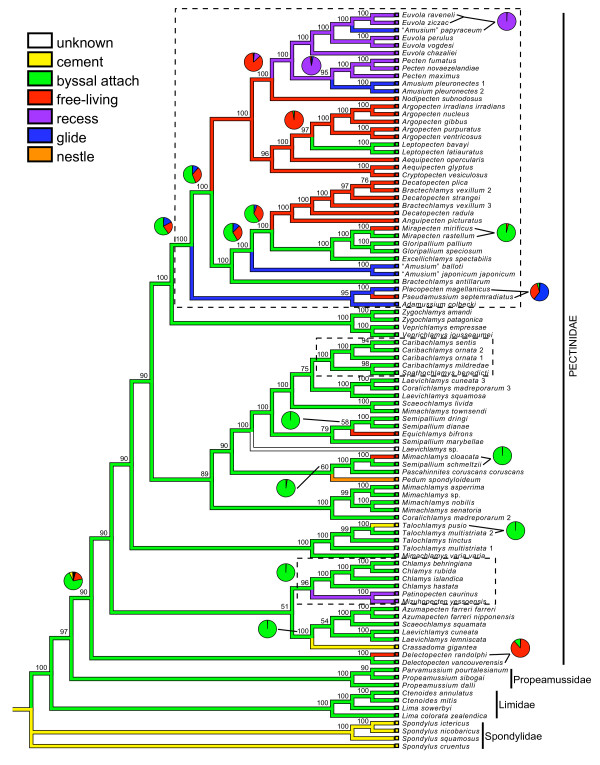
We employed a phylogenetic framework to identify patterns of life habit evolution in the marine bivalve family Pectinidae. Specifically, we examined the number of independent origins of each life habit and distinguished between convergent and parallel trajectories of life habit evolution using ancestral state estimation. We also investigated whether ancestral character states influence the frequency or type of evolutionary trajectories.
We determined that temporary attachment to substrata by byssal threads is the most likely ancestral condition for the Pectinidae, with subsequent transitions to the five remaining habit types. Nearly all transitions between life habit classes were repeated in our phylogeny and the majority of these transitions were the result of parallel evolution from byssate ancestors. Convergent evolution also occurred within the Pectinidae and produced two additional gliding clades and two recessing lineages. Furthermore, our analysis indicates that byssal attaching gave rise to significantly more of the transitions than any other life habit and that the cementing and nestling classes are only represented as evolutionary outcomes in our phylogeny, never as progenitor states.
Collectively, our results illustrate that both convergence and parallelism generated repeated life habit states in the scallops. Bias in the types of habit transitions observed may indicate constraints due to physical or ontogenetic limitations of particular phenotypes.
我们采用系统发育框架来识别海洋双壳贝类扇贝科生活习性进化的模式。具体来说,我们检查了每种生活习性的独立起源数量,并使用祖先状态估计来区分生活习性进化的趋同和并行轨迹。我们还研究了祖先性状是否会影响进化轨迹的频率或类型。
我们确定,通过足丝暂时附着在基质上是扇贝科最有可能的祖先状态,随后向其余五种生活习性类型转变。在我们的系统发育中,几乎所有生活习性类别的转变都被重复,其中大多数转变是由有足丝的祖先平行进化而来的。扇贝科内部也发生了趋同进化,产生了两个额外的滑行分支和两个退缩分支。此外,我们的分析表明,足丝附着产生的转变比任何其他生活习性都多,而且固着和营巢类仅作为进化结果出现在我们的系统发育中,从未作为祖先状态出现。
总的来说,我们的结果表明,趋同和并行都在扇贝中产生了重复的生活习性状态。观察到的生活习性转变类型的偏差可能表明受到特定表型的物理或个体发生限制的约束。