Lineberger Comprehensive Cancer Center, University of North Carolina at Chapel Hill, Chapel Hill, North Carolina, United States of America.
PLoS One. 2011;6(6):e20412. doi: 10.1371/journal.pone.0020412. Epub 2011 Jun 3.
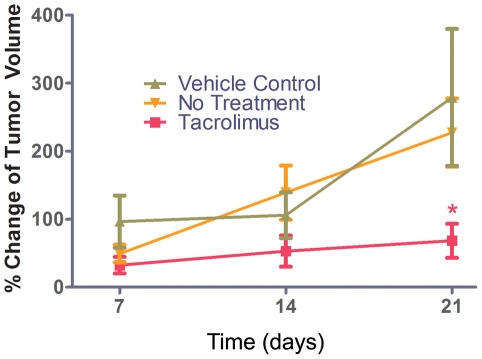
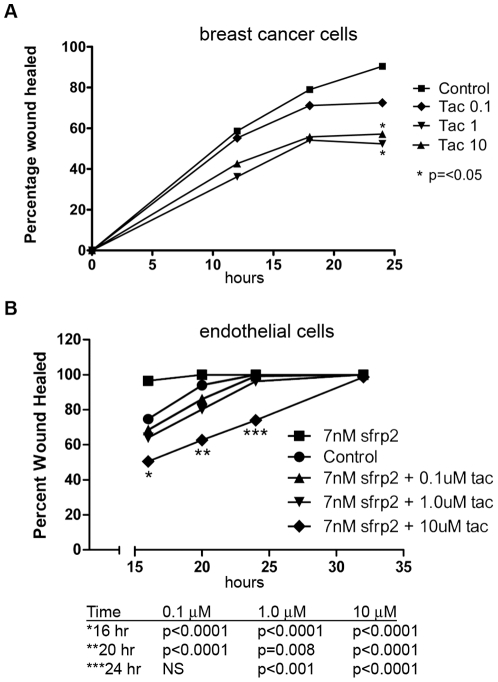
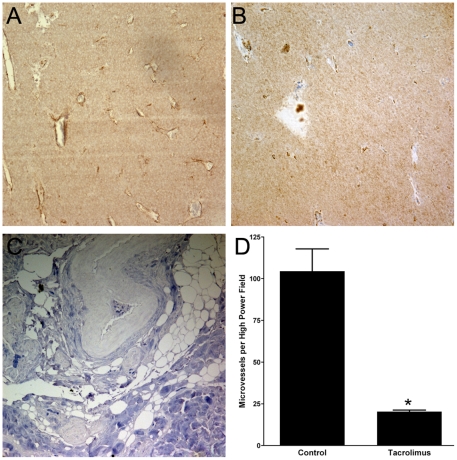
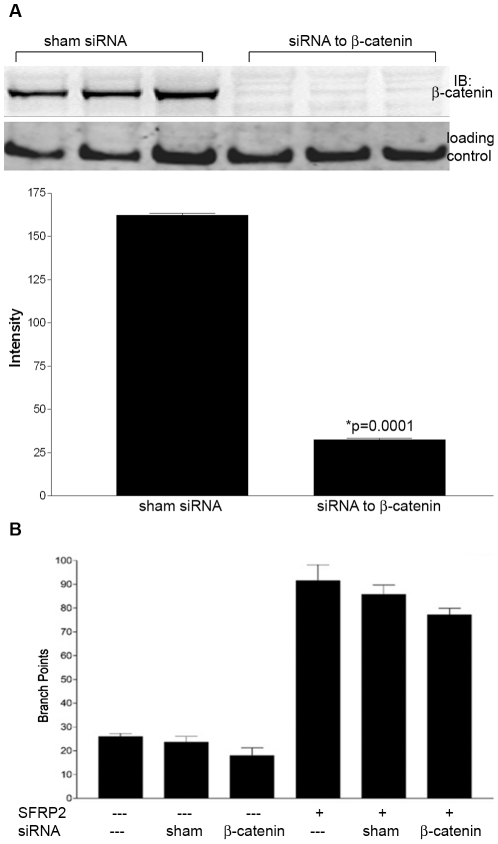
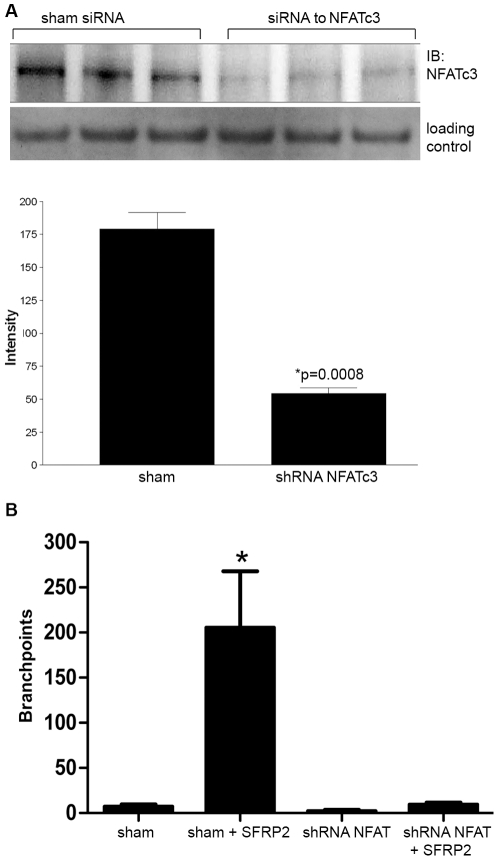
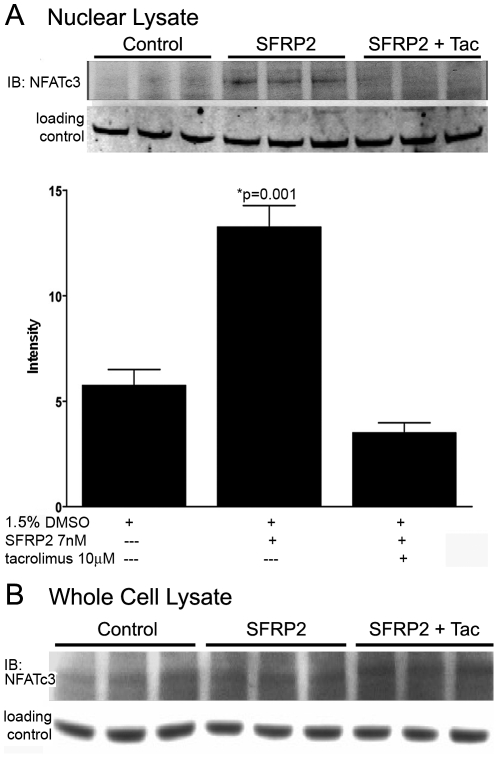
Tacrolimus (FK506) is an immunosuppressive drug that binds to the immunophilin FKBPB12. The FK506-FKBP12 complex associates with calcineurin and inhibits its phosphatase activity, resulting in inhibition of nuclear translocation of nuclear factor of activated T-cells (NFAT). There is increasing data supporting a critical role of NFAT in mediating angiogenic responses stimulated by both vascular endothelial growth factor (VEGF) and a novel angiogenesis factor, secreted frizzled-related protein 2 (SFRP2). Since both VEGF and SFRP2 are expressed in breast carcinomas, we hypothesized that tacrolimus would inhibit breast carcinoma growth. Using IHC (IHC) with antibodies to FKBP12 on breast carcinomas we found that FKBP12 localizes to breast tumor vasculature. Treatment of MMTV-neu transgenic mice with tacrolimus (3 mg/kg i.p. daily) (n = 19) resulted in a 73% reduction in the growth rate for tacrolimus treated mice compared to control (n = 15), p = 0.003; which was associated with an 82% reduction in tumor microvascular density (p<0.001) by IHC. Tacrolimus (1 µM) inhibited SFRP2 induced endothelial tube formation by 71% (p = 0.005) and inhibited VEGF induced endothelial tube formation by 67% (p = 0.004). To show that NFATc3 is required for SFRP2 stimulated angiogenesis, NFATc3 was silenced with shRNA in endothelial cells. Sham transfected cells responded to SFRP2 stimulation in a tube formation assay with an increase in the number of branch points (p<0.003), however, cells transfected with shRNA to NFATc3 showed no increase in tube formation in response to SFRP2. This demonstrates that NFATc3 is required for SFRP2 induced tube formation, and tacrolimus inhibits angiogenesis in vitro and breast carcinoma growth in vivo. This provides a rationale for examining the therapeutic potential of tacrolimus at inhibiting breast carcinoma growth in humans.
他克莫司(FK506)是一种免疫抑制剂,与免疫亲和素 FKBPB12 结合。FK506-FKBP12 复合物与钙调神经磷酸酶结合并抑制其磷酸酶活性,从而抑制活化 T 细胞核因子(NFAT)的核转位。越来越多的数据支持 NFAT 在介导血管内皮生长因子(VEGF)和一种新的血管生成因子——分泌卷曲相关蛋白 2(SFRP2)刺激的血管生成反应中起关键作用。由于 VEGF 和 SFRP2 均在乳腺癌中表达,我们假设他克莫司会抑制乳腺癌的生长。我们使用针对乳腺癌的 FKBP12 的免疫组化(IHC)抗体发现,FKBP12 定位于乳腺癌肿瘤血管。用他克莫司(3mg/kg 腹腔注射,每天一次)(n=19)治疗 MMTV-neu 转基因小鼠导致他克莫司治疗组小鼠的生长速度比对照组(n=15)降低了 73%,p=0.003;这与 IHC 检测到的肿瘤微血管密度降低 82%相关(p<0.001)。他克莫司(1µM)抑制 SFRP2 诱导的内皮管形成 71%(p=0.005),并抑制 VEGF 诱导的内皮管形成 67%(p=0.004)。为了表明 NFATc3 是 SFRP2 刺激的血管生成所必需的,我们用 shRNA 沉默内皮细胞中的 NFATc3。在管形成试验中,对照转染细胞对 SFRP2 刺激的反应表现为分支点数量增加(p<0.003),然而,转染 NFATc3 shRNA 的细胞对 SFRP2 刺激没有增加管形成。这表明 NFATc3 是 SFRP2 诱导的管形成所必需的,他克莫司抑制体外血管生成和体内乳腺癌生长。这为研究他克莫司抑制人类乳腺癌生长的治疗潜力提供了依据。