Department of Academic Haematology, The University of Nottingham, Clinical Sciences Building, Hucknall Road, Nottingham, NG5 1PB, UK.
BMC Cancer. 2011 Jun 16;11:254. doi: 10.1186/1471-2407-11-254.
Aurora kinases play an essential role in orchestrating chromosome alignment, segregation and cytokinesis during mitotic progression, with both aurora-A and B frequently over-expressed in a variety of human malignancies. Over-expression of the ABC drug transporter proteins P-glycoprotein (Pgp) and Breast cancer resistance protein (BCRP) is a major obstacle for chemotherapy in many tumour types with Pgp conferring particularly poor prognosis in acute myeloid leukaemia (AML). Barasertib-hQPA is a highly selective inhibitor of aurora-B kinase that has shown tumouricidal activity against a range tumour cell lines including those of leukaemic AML origin.
Effect of barasertib-hQPA on the pHH3 biomarker and cell viability was measured in a panel of leukaemic cell lines and 37 primary AML samples by flow cytometry. Pgp status was determined by flow cytometry and BCRP status by flow cytometry and real-time PCR.
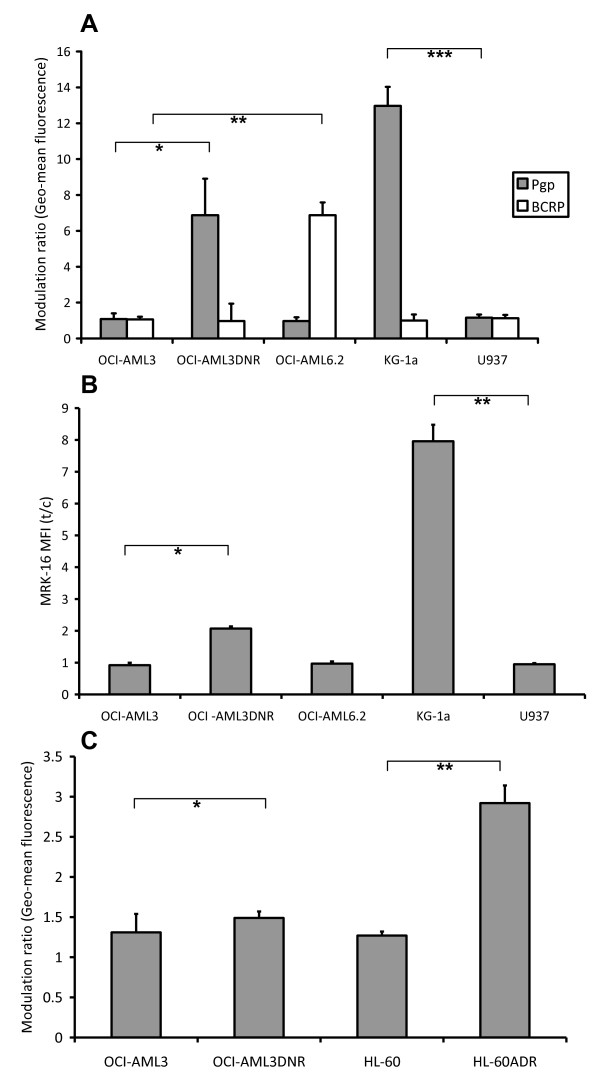
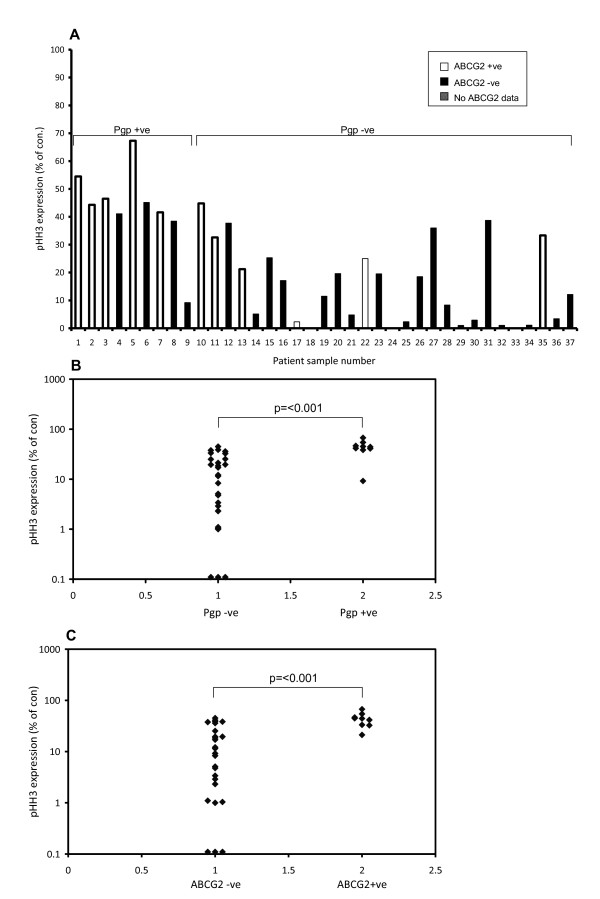
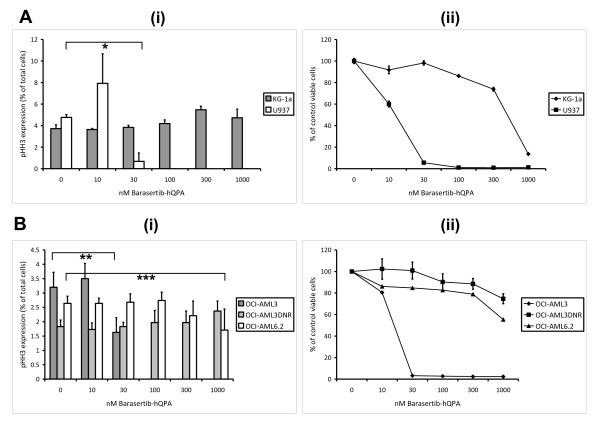
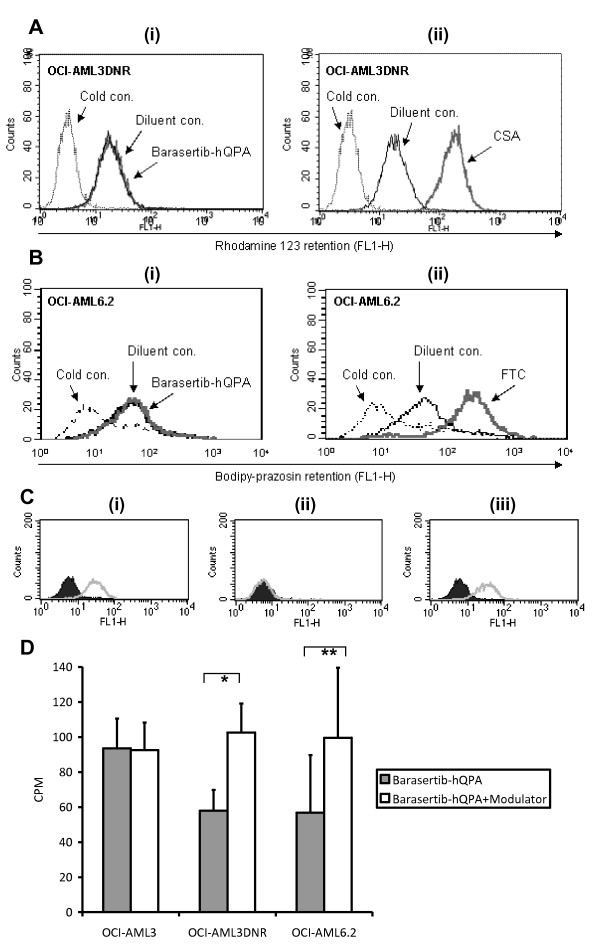
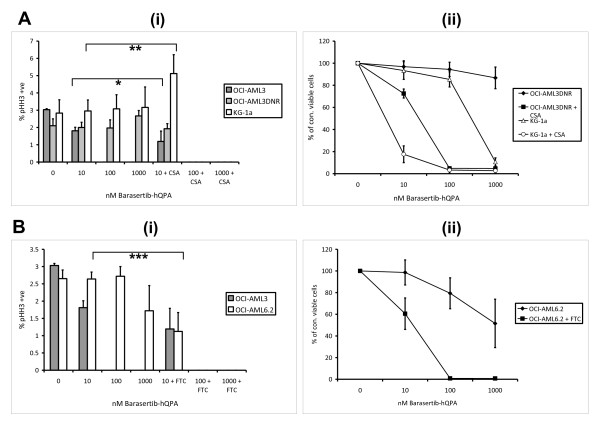
In this study we report the creation of the cell line OCI-AML3DNR, which over-expresses Pgp but not BCRP or multidrug resistance-associated protein (MRP), through prolonged treatment of OCI-AML3 cells with daunorubicin. We demonstrate that Pgp (OCI-AML3DNR and KG-1a) and BCRP (OCI-AML6.2) expressing AML cell lines are less sensitive to barasertib-hQPA induced pHH3 inhibition and subsequent loss of viability compared to transporter negative cell lines. We also show that barasertib-hQPA resistance in these cell lines can be reversed using known Pgp and BCRP inhibitors. We report that barasertib-hQPA is not an inhibitor of Pgp or BCRP, but by using 14[C]-barasertib-hQPA that it is effluxed by these transporters. Using phosphoHistone H3 (pHH3) as a biomarker of barasertib-hQPA responsiveness in primary AML blasts we determined that Pgp and BCRP positive primary samples were less sensitive to barasertib-hQPA induced pHH3 inhibition (p = <0.001) than samples without these transporters. However, we demonstrate that IC50 inhibition of pHH3 by barasertib-hQPA was achieved in 94.6% of these samples after 1 hour drug treatment, in contrast to the resistance of the cell lines.
We conclude that Pgp and BCRP status and pHH3 down-regulation in patients treated with barasertib should be monitored in order to establish whether transporter-mediated efflux is sufficient to adversely impact on the efficacy of the agent.
极光激酶在协调有丝分裂过程中的染色体排列、分离和胞质分裂中起着至关重要的作用,其中极光-A 和 B 在多种人类恶性肿瘤中经常过表达。ABC 药物转运蛋白 P-糖蛋白(Pgp)和乳腺癌耐药蛋白(BCRP)的过度表达是许多肿瘤类型化疗的主要障碍,其中 Pgp 在急性髓系白血病(AML)中尤其预示着不良预后。Barasertib-hQPA 是一种高度选择性的极光-B 激酶抑制剂,对一系列肿瘤细胞系具有杀伤活性,包括白血病 AML 起源的细胞系。
通过流式细胞术,在一组白血病细胞系和 37 个原发性 AML 样本中测量 barasertib-hQPA 对 pHH3 生物标志物和细胞活力的影响。通过流式细胞术确定 Pgp 状态,通过流式细胞术和实时 PCR 确定 BCRP 状态。
在这项研究中,我们报告了通过用柔红霉素长期处理 OCI-AML3 细胞,创建了过表达 Pgp 但不表达 BCRP 或多药耐药相关蛋白(MRP)的细胞系 OCI-AML3DNR。我们证明,与转运蛋白阴性细胞系相比,表达 Pgp(OCI-AML3DNR 和 KG-1a)和 BCRP(OCI-AML6.2)的 AML 细胞系对 barasertib-hQPA 诱导的 pHH3 抑制和随后的活力丧失的敏感性较低。我们还表明,这些细胞系中的 barasertib-hQPA 耐药可以通过已知的 Pgp 和 BCRP 抑制剂逆转。我们报告说,barasertib-hQPA 不是 Pgp 或 BCRP 的抑制剂,但使用 14[C]-barasertib-hQPA 时,它被这些转运蛋白外排。我们使用磷酸化组蛋白 H3(pHH3)作为原发性 AML 原始细胞中 barasertib-hQPA 反应性的生物标志物,确定 Pgp 和 BCRP 阳性的原发性样本对 barasertib-hQPA 诱导的 pHH3 抑制的敏感性低于没有这些转运蛋白的样本(p <0.001)。然而,我们证明,在用药物治疗 1 小时后,在 94.6%的这些样本中,barasertib-hQPA 对 pHH3 的 IC50 抑制得以实现,与细胞系的耐药性形成对比。
我们得出结论,在接受 barasertib 治疗的患者中,应监测 Pgp 和 BCRP 状态以及 pHH3 的下调,以确定转运蛋白介导的外排是否足以对药物的疗效产生不利影响。