Laboratory of Molecular Immunology, National Institute of Allergy and Infectious Diseases, National Institutes of Health, Bethesda, MD 20892, USA.
Circ Res. 2011 Aug 5;109(4):374-81. doi: 10.1161/CIRCRESAHA.111.242578. Epub 2011 Jun 16.
The chemokine receptor Ccr6 is a G-protein-coupled receptor expressed on various types of leukocytes identified in mouse atherosclerotic lesions. Recent evidence suggests that both CCR6 and its ligand CCL20 are also present in human atheroma; however, their functional roles in atherogenesis remain undefined.
Our objective was to delineate the role of Ccr6 in atherogenesis in the apolipoprotein E-deficient (ApoE(-/-)) mouse model of atherosclerosis.
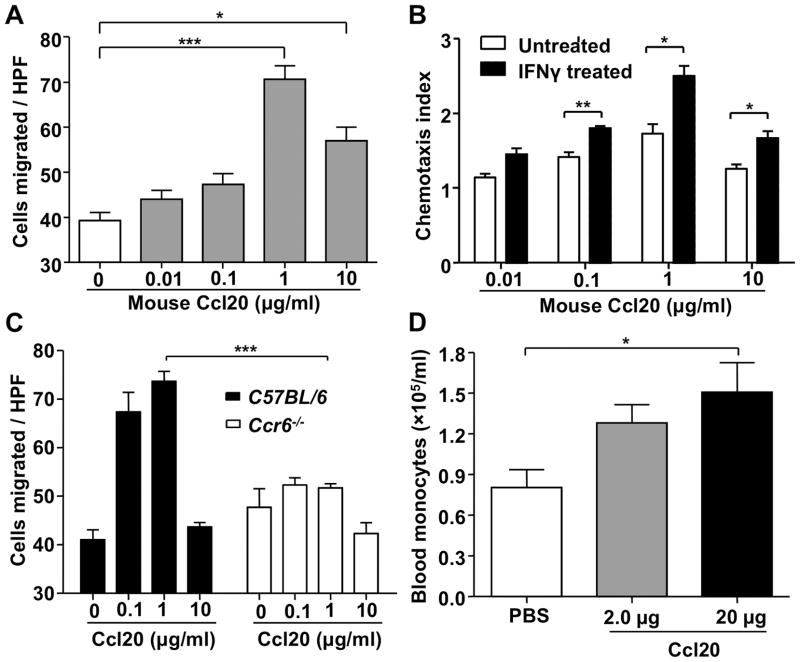
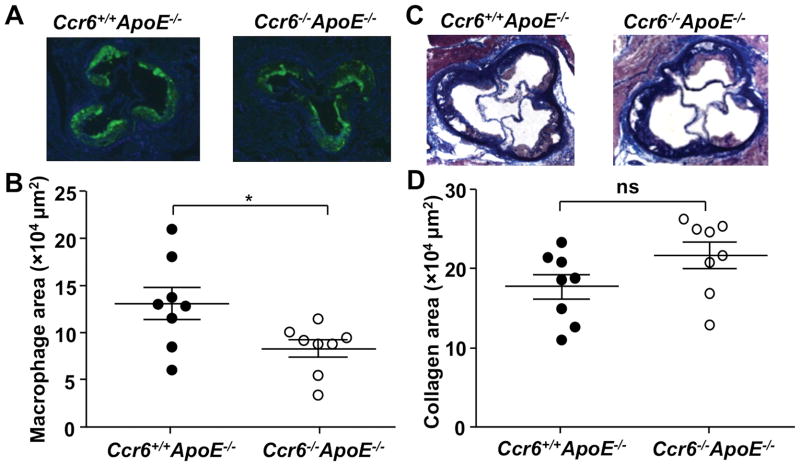
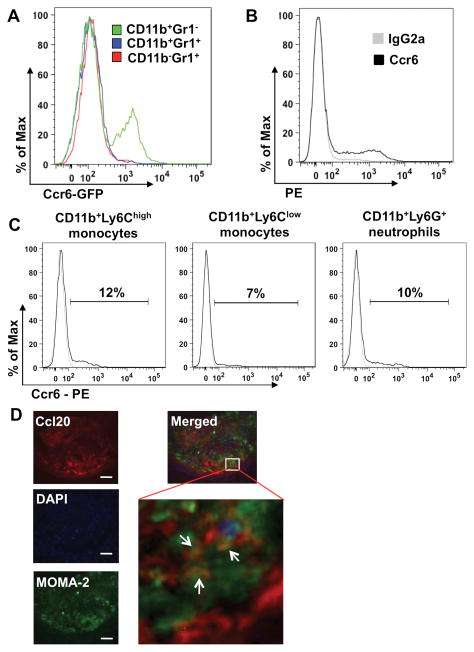
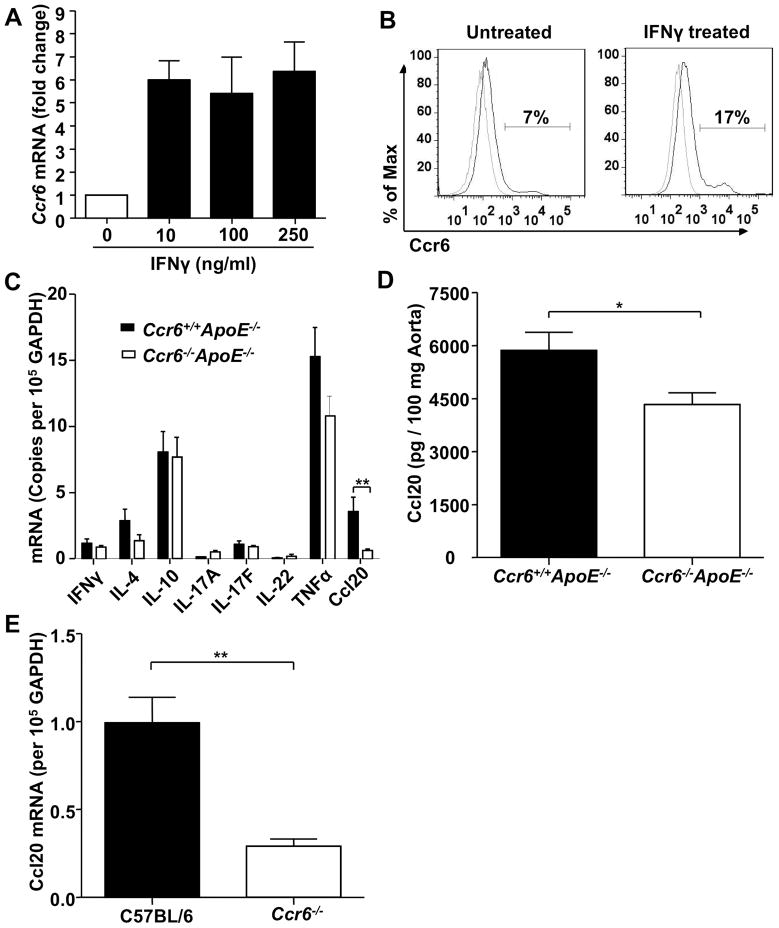
Both Ccr6 and Ccl20 are expressed in atherosclerotic aorta from ApoE(-/-) mice. Aortic lesion area in Ccr6(-/-)ApoE(-/-) mice was ∼40% and ∼30% smaller than in Ccr6(+/+)ApoE(-/-) mice at 16 and 24 weeks of age, respectively. Transplantation of bone marrow from Ccr6(-/-) mice into ApoE(-/-) mice resulted in ∼40% less atherosclerotic lesion area than for bone marrow from Ccr6(+/+) mice; lesions in Ccr6(-/-)ApoE(-/-) mice had 44% less macrophage content than lesions in Ccr6(+/+)ApoE(-/-) mice. Ccr6 was expressed on a subset of primary mouse monocytes. Accordingly, Ccl20 induced chemotaxis of primary monocytes from wild-type but not Ccr6(-/-) mice; moreover, Ccl20 induced monocytosis in ApoE(-/-) mice in vivo. Consistent with this, we observed 30% fewer monocytes in circulating blood of Ccr6(-/-)ApoE(-/-) mice, mainly because of fewer CD11b(+)Ly6C(high) inflammatory monocytes.
Ccr6 promotes atherosclerosis in ApoE-deficient mice, which may be due in part to Ccr6 support of normal monocyte levels in blood, as well as direct Ccr6-dependent monocyte migration.
趋化因子受体 Ccr6 是一种 G 蛋白偶联受体,存在于小鼠动脉粥样硬化病变中各种类型的白细胞上。最近的证据表明,CCR6 及其配体 CCL20 也存在于人类动脉粥样硬化斑块中;然而,其在动脉粥样硬化形成中的功能作用仍未确定。
本研究旨在描述趋化因子受体 Ccr6 在载脂蛋白 E 缺陷(ApoE(-/-))小鼠动脉粥样硬化模型中的动脉粥样硬化形成中的作用。
在 ApoE(-/-)小鼠的动脉粥样硬化主动脉中均表达 Ccr6 和 Ccl20。与 Ccr6(+/+)ApoE(-/-)小鼠相比,16 周和 24 周龄 Ccr6(-/-)ApoE(-/-)小鼠的主动脉病变面积分别减少约 40%和 30%。将 Ccr6(-/-)小鼠的骨髓移植到 ApoE(-/-)小鼠中,导致动脉粥样硬化病变面积比 Ccr6(+/+)骨髓移植减少约 40%;Ccr6(-/-)ApoE(-/-)小鼠的病变中巨噬细胞含量比 Ccr6(+/+)ApoE(-/-)小鼠的病变少 44%。Ccr6 在一组原代小鼠单核细胞上表达。因此,Ccl20 诱导来自野生型而非 Ccr6(-/-)小鼠的原代单核细胞趋化;此外,Ccl20 在体内诱导 ApoE(-/-)小鼠单核细胞增多症。与此一致,我们观察到 Ccr6(-/-)ApoE(-/-)小鼠循环血液中的单核细胞减少 30%,主要是由于 CD11b(+)Ly6C(high)炎症性单核细胞减少。
Ccr6 促进 ApoE 缺陷型小鼠的动脉粥样硬化形成,这可能部分归因于 Ccr6 对血液中正常单核细胞水平的支持,以及 Ccr6 依赖性单核细胞的直接迁移。