Department of Comparative Biosciences, University of Wisconsin, Madison, WI 53706-1102, USA.
Exp Neurol. 2011 Sep;231(1):97-103. doi: 10.1016/j.expneurol.2011.05.020. Epub 2011 Jun 13.
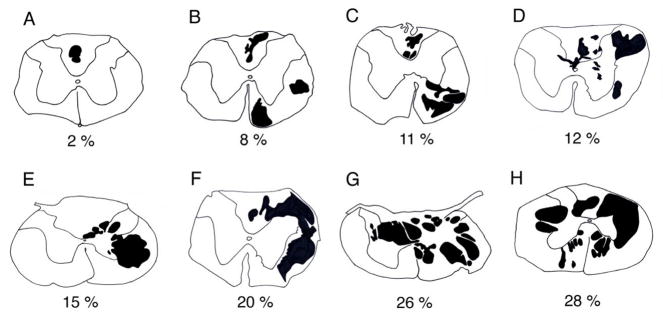
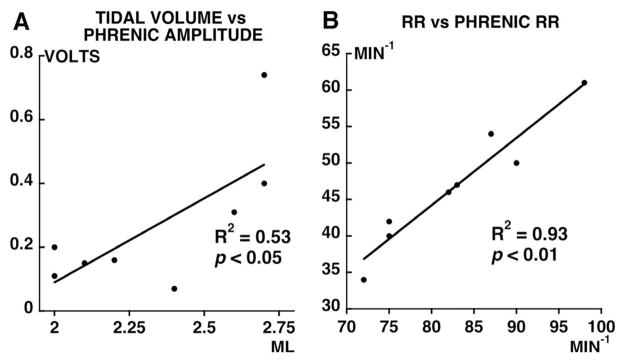
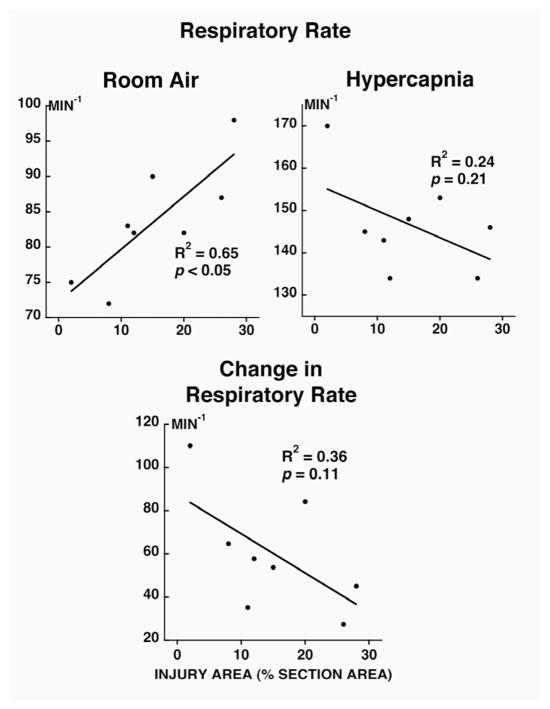
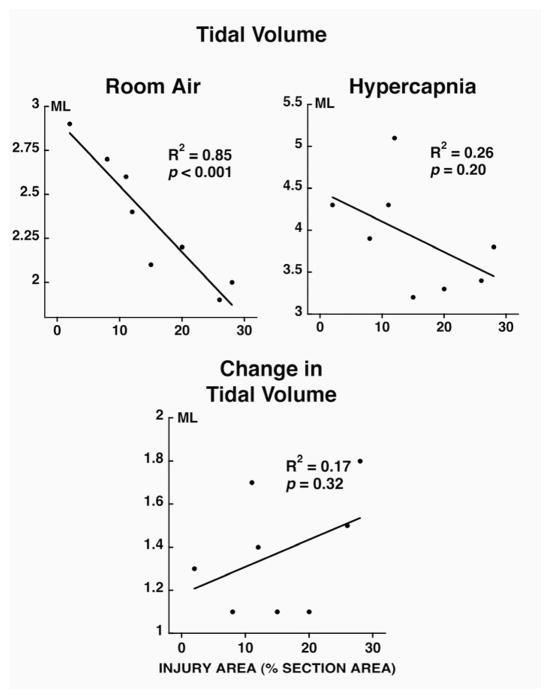
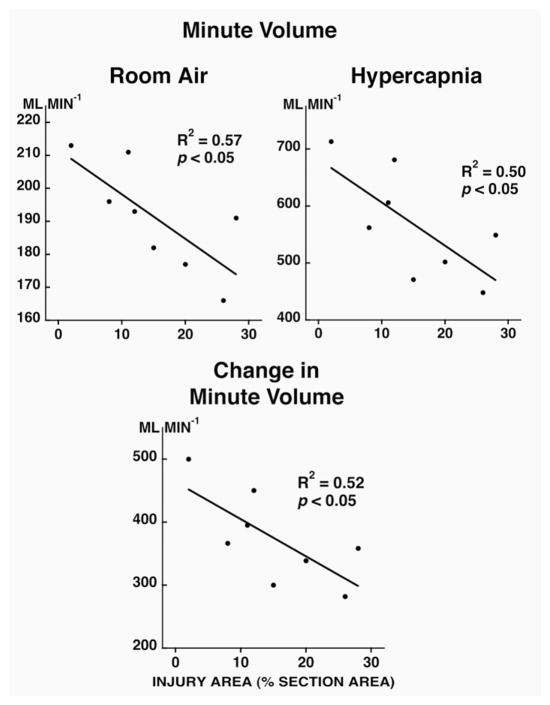
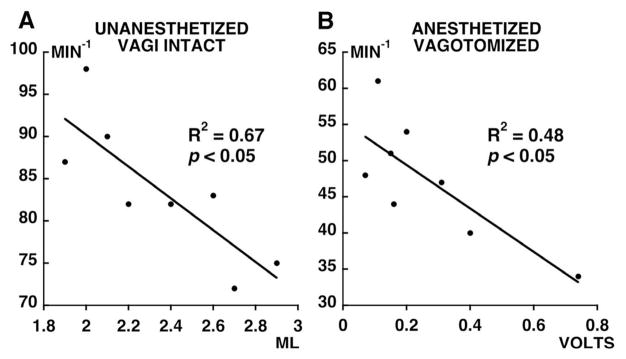
Respiratory failure is the leading cause of death after cervical spinal injury. We hypothesized that incomplete cervical spinal injuries would alter respiratory pattern and initiate plasticity in the neural control of breathing. Further, we hypothesized that the severity of cervical spinal contusion would correlate with changes in breathing pattern. Fourteen days after C4-C5 contusions, respiratory frequency and tidal volume were measured in unanesthetized Sprague Dawley rats in a whole body plethysmograph. Phrenic motor output was monitored in the same rats which were anesthetized, vagotomized, paralyzed and ventilated to eliminate and/or control sensory feedback that could alter breathing patterns. The extent of spinal injury was approximated histologically by measurements of the injury-induced cyst area in transverse sections; cysts ranged from 2 to 28% of spinal cross-sectional area, and had a unilateral bias. In unanesthetized rats, the severity of spinal injury correlated negatively with tidal volume (R(2)=0.85; p<0.001) and positively with breathing frequency (R(2)=0.65; p<0.05). Thus, the severity of C4-C5 spinal contusion dictates post-injury breathing pattern. In anesthetized rats, phrenic burst amplitude was decreased on the side of injury, and burst frequency correlated negatively with contusion size (R(2)=0.51; p<0.05). A strong correlation between unanesthetized breathing pattern and the pattern of phrenic bursts in anesthetized, vagotomized and ventilated rats suggests that changes in respiratory motor output after spinal injury reflect, at least in part, intrinsic neural mechanisms of CNS plasticity initiated by injury.
呼吸衰竭是颈椎损伤后导致死亡的主要原因。我们假设不完全性颈椎损伤会改变呼吸模式,并引发呼吸中枢控制的可塑性变化。此外,我们还假设颈椎挫伤的严重程度与呼吸模式的变化相关。在 C4-C5 挫伤后 14 天,在全身呼吸描记器中测量未麻醉的 Sprague Dawley 大鼠的呼吸频率和潮气量。在相同的大鼠中监测膈神经运动输出,这些大鼠被麻醉、迷走神经切断、麻痹和通气,以消除和/或控制可能改变呼吸模式的感觉反馈。通过测量横切面上损伤引起的囊肿面积来近似估计脊髓损伤的程度;囊肿范围为脊髓横截面积的 2%至 28%,并具有单侧偏倚。在未麻醉的大鼠中,脊髓损伤的严重程度与潮气量呈负相关(R2=0.85;p<0.001),与呼吸频率呈正相关(R2=0.65;p<0.05)。因此,C4-C5 脊髓挫伤的严重程度决定了损伤后的呼吸模式。在麻醉大鼠中,损伤侧膈神经爆发幅度降低,爆发频率与挫伤大小呈负相关(R2=0.51;p<0.05)。未麻醉大鼠的呼吸模式与麻醉、迷走神经切断和通气大鼠膈神经爆发模式之间存在很强的相关性,这表明脊髓损伤后呼吸运动输出的变化至少部分反映了中枢神经系统可塑性的内在神经机制。