Institute for Amphibian Biology, Graduate School of Science, Hiroshima University, Hiroshima, 739-8526, Japan.
BMC Evol Biol. 2011 Jun 21;11:175. doi: 10.1186/1471-2148-11-175.
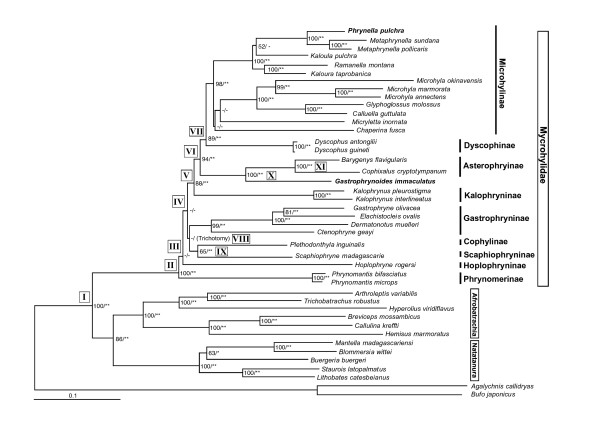
Microhylidae is a geographically widespread family of anurans. Although several extensive molecular analyses have attempted to elucidate their subfamilial relationships, and correlate these with Mesozoic and Cenozoic continental drifts, consensus has not been reached. Further, generic level relationships have not been well investigated in some microhylid subfamilies, and therefore subfamilial affiliations of some genera are still unclear. To elucidate the phylogenetic positions of two mysterious Asian genera, Gastrophrynoides and Phrynella, and to better understand the trans-continental distributions of microhylid taxa, we performed molecular phylogenetic and dating analyses using the largest molecular dataset applied to these taxa to date.
Six nuclear and two mitochondrial genes (approx. 8 kbp) were sequenced from 22 microhylid frog species representing eight subfamilies. The maximum likelihood and Bayesian analyses could not fully elucidate the subfamilial relationships, suggesting a rapid radiation of these taxa between 85 and 66 million years ago. In contrast, generic relationships of Asian microhylines were generally well resolved.
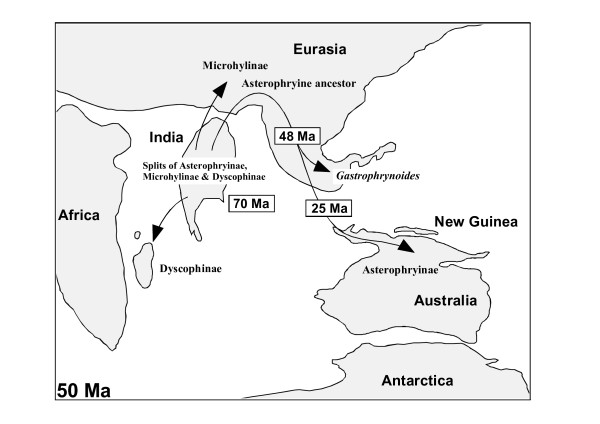
Our results clearly showed that one of two problematic Asian genera, Phrynella, was nested in the clade of the Asian subfamily Microhylinae. By contrast, Gastrophrynoides occupied the most basal position of the Australian-New Guinean subfamily Asterophryinae. The estimated divergence of Gastrophrynoides from other asterophryine was unexpectedly around 48 million years ago. Although a colonization scenario via Antarctica to the Australian-New Guinean landmass has been suggested for Asterophryinae, our finding suggested a novel colonization route via Indo-Eurasia.
细趾蟾科是分布广泛的蛙科。尽管有几项广泛的分子分析试图阐明其亚科关系,并将这些关系与中生代和新生代的大陆漂移联系起来,但尚未达成共识。此外,一些细趾蟾亚科的属级关系尚未得到很好的研究,因此一些属的亚科归属仍然不清楚。为了阐明两个神秘的亚洲属 Gastrophrynoides 和 Phrynella 的系统发育位置,并更好地了解细趾蟾类的跨大陆分布,我们使用迄今为止应用于这些类群的最大分子数据集进行了分子系统发育和年代测定分析。
从代表 8 个亚科的 22 种细趾蟾蛙种中测序了 6 个核基因和 2 个线粒体基因(约 8 kbp)。最大似然和贝叶斯分析未能完全阐明亚科关系,表明这些类群在 8500 万至 6600 万年前发生了快速辐射。相比之下,亚洲细趾蟾的属级关系通常得到了很好的解决。
我们的研究结果清楚地表明,两个有问题的亚洲属之一 Phrynella 嵌套在亚洲亚科 Microhylinae 的分支中。相比之下,Gastrophrynoides 占据了澳大利亚-新几内亚亚科 Asterophryinae 的最基部位置。Gastrophrynoides 与其他 Asterophryinae 的分化时间出人意料地在 4800 万年前左右。虽然有人提出 Asterophryinae 通过南极洲向澳大利亚-新几内亚大陆的迁移,但我们的发现表明了一种通过印度-欧亚大陆的新的迁移途径。