Department of Animal Sciences, University of Illinois at Urbana-Champaign, Urbana, Illinois, United States of America.
PLoS One. 2011;6(6):e20642. doi: 10.1371/journal.pone.0020642. Epub 2011 Jun 8.
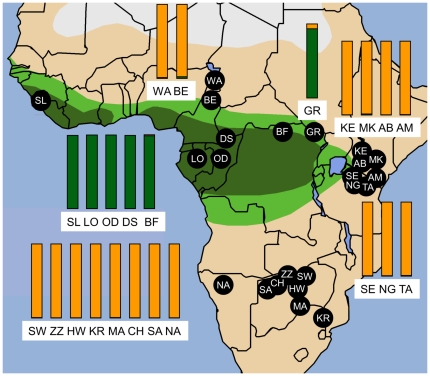
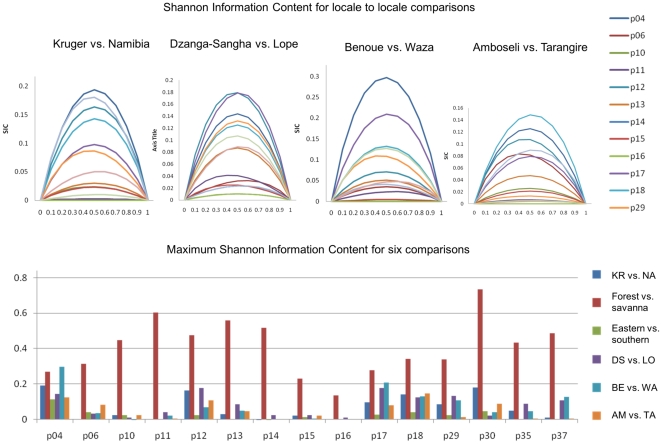
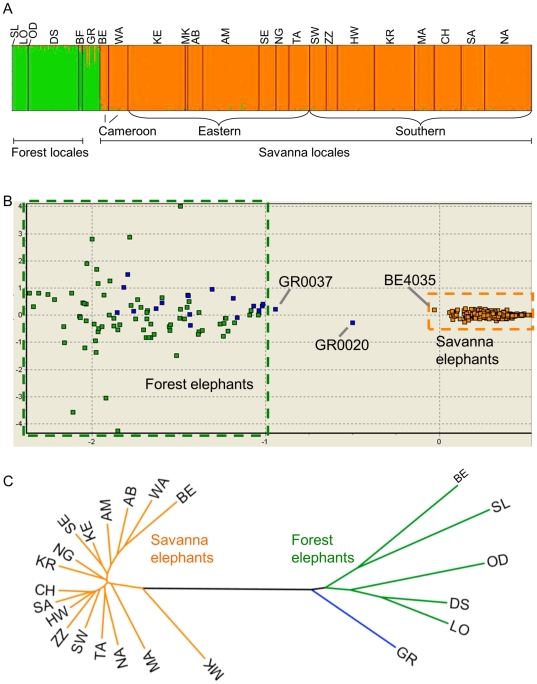
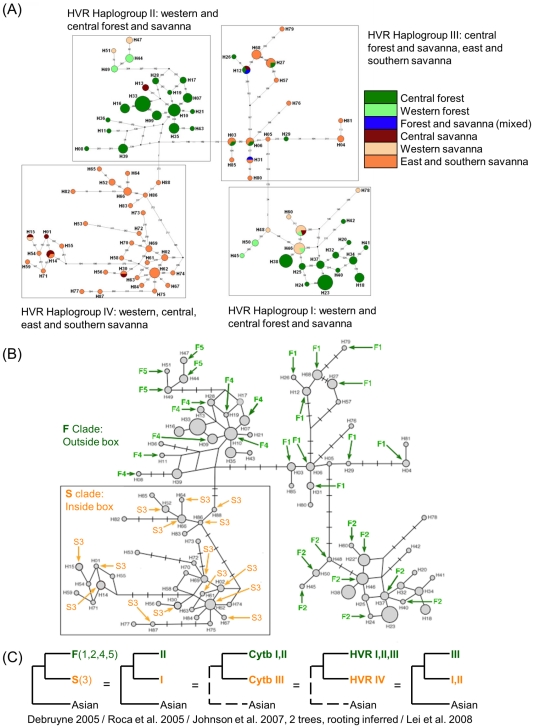
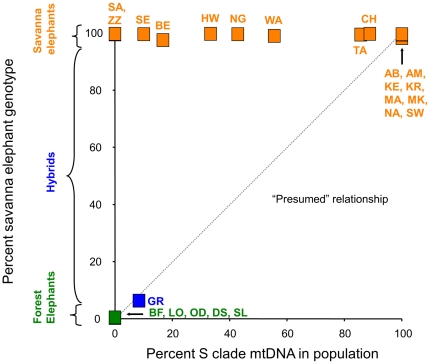
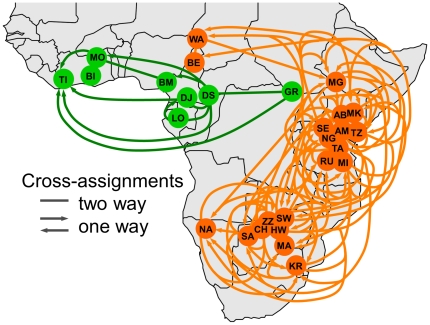
Conservation strategies for African elephants would be advanced by resolution of conflicting claims that they comprise one, two, three or four taxonomic groups, and by development of genetic markers that establish more incisively the provenance of confiscated ivory. We addressed these related issues by genotyping 555 elephants from across Africa with microsatellite markers, developing a method to identify those loci most effective at geographic assignment of elephants (or their ivory), and conducting novel analyses of continent-wide datasets of mitochondrial DNA. Results showed that nuclear genetic diversity was partitioned into two clusters, corresponding to African forest elephants (99.5% Cluster-1) and African savanna elephants (99.4% Cluster-2). Hybrid individuals were rare. In a comparison of basal forest "F" and savanna "S" mtDNA clade distributions to nuclear DNA partitions, forest elephant nuclear genotypes occurred only in populations in which S clade mtDNA was absent, suggesting that nuclear partitioning corresponds to the presence or absence of S clade mtDNA. We reanalyzed African elephant mtDNA sequences from 81 locales spanning the continent and discovered that S clade mtDNA was completely absent among elephants at all 30 sampled tropical forest locales. The distribution of savanna nuclear DNA and S clade mtDNA corresponded closely to range boundaries traditionally ascribed to the savanna elephant species based on habitat and morphology. Further, a reanalysis of nuclear genetic assignment results suggested that West African elephants do not comprise a distinct third species. Finally, we show that some DNA markers will be more useful than others for determining the geographic origins of illegal ivory. These findings resolve the apparent incongruence between mtDNA and nuclear genetic patterns that has confounded the taxonomy of African elephants, affirm the limitations of using mtDNA patterns to infer elephant systematics or population structure, and strongly support the existence of two elephant species in Africa.
保护非洲象的策略将通过解决其包含一个、两个、三个或四个分类群的相互冲突的主张得到推进,并通过开发确定没收象牙来源的更精确的遗传标记得到推进。我们通过使用微卫星标记对来自非洲各地的 555 头大象进行基因分型,开发了一种确定最有效的用于地理分配大象(或其象牙)的基因座的方法,并对线粒体 DNA 的全大陆数据集进行了新的分析,从而解决了这些相关问题。结果表明,核遗传多样性分为两个聚类,对应于非洲森林象(99.5%聚类 1)和非洲草原象(99.4%聚类 2)。杂种个体很少见。在将基础森林“F”和草原“S”线粒体 DNA 支系分布与核 DNA 分区进行比较时,森林象核基因型仅出现在不存在 S 支系 mtDNA 的种群中,这表明核分区与 S 支系 mtDNA 的存在或不存在相对应。我们重新分析了来自非洲大陆 81 个地点的非洲象 mtDNA 序列,发现 S 支系 mtDNA 在所有 30 个采样热带森林地点的大象中完全不存在。草原核 DNA 和 S 支系 mtDNA 的分布与传统上基于栖息地和形态学归因于草原象种的范围边界非常吻合。此外,对核遗传分配结果的重新分析表明,西非大象不构成一个独特的第三个物种。最后,我们表明,一些 DNA 标记将比其他标记更有助于确定非法象牙的地理来源。这些发现解决了 mtDNA 和核遗传模式之间明显不一致的问题,这种不一致一直困扰着非洲象的分类学,证实了使用 mtDNA 模式推断大象系统发育或种群结构的局限性,并强烈支持非洲存在两种大象物种。