INSERM, U973, (MTi Unit), Université Paris Diderot, Paris, France.
PLoS One. 2011;6(6):e21117. doi: 10.1371/journal.pone.0021117. Epub 2011 Jun 20.
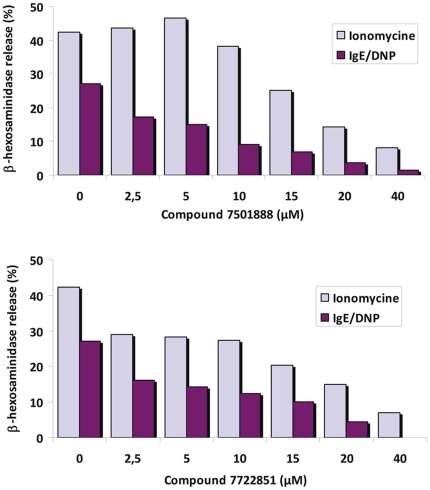
In the past decade, the spleen tyrosine kinase (Syk) has shown a high potential for the discovery of new treatments for inflammatory and autoimmune disorders. Pharmacological inhibitors of Syk catalytic site bearing therapeutic potential have been developed, with however limited specificity towards Syk. To address this topic, we opted for the design of drug-like compounds that could impede the interaction of Syk with its cellular partners while maintaining an active kinase protein. To achieve this challenging task, we used the powerful potential of intracellular antibodies for the modulation of cellular functions in vivo, combined to structure-based in silico screening. In our previous studies, we reported the anti-allergic properties of the intracellular antibody G4G11. With the aim of finding functional mimics of G4G11, we developed an Antibody Displacement Assay and we isolated the drug-like compound C-13, with promising in vivo anti-allergic activity. The likely binding cavity of this compound is located at the close vicinity of G4G11 epitope, far away from the catalytic site of Syk. Here we report the virtual screen of a collection of 500,000 molecules against this new cavity, which led to the isolation of 1000 compounds subsequently evaluated for their in vitro inhibitory effects using the Antibody Displacement Assay. Eighty five compounds were selected and evaluated for their ability to inhibit the liberation of allergic mediators from mast cells. Among them, 10 compounds inhibited degranulation with IC₅₀ values ≤ 10 µM. The most bioactive compounds combine biological activity, significant inhibition of antibody binding and strong affinity for Syk. Moreover, these molecules show a good potential for oral bioavailability and are not kinase catalytic site inhibitors. These bioactive compounds could be used as starting points for the development of new classes of non-enzymatic inhibitors of Syk and for drug discovery endeavour in the field of inflammation related disorders.
在过去的十年中,脾酪氨酸激酶(Syk)在发现治疗炎症和自身免疫性疾病的新疗法方面显示出巨大的潜力。已经开发出具有治疗潜力的Syk 催化位点的药理学抑制剂,但是对 Syk 的特异性有限。为了解决这个问题,我们选择设计可以阻止 Syk 与其细胞伙伴相互作用的药物样化合物,同时保持激酶蛋白的活性。为了完成这项具有挑战性的任务,我们利用细胞内抗体在体内调节细胞功能的强大潜力,结合基于结构的计算机筛选。在我们之前的研究中,我们报告了细胞内抗体 G4G11 的抗过敏特性。为了寻找 G4G11 的功能模拟物,我们开发了抗体置换测定法,并分离出具有有前途的体内抗过敏活性的药物样化合物 C-13。该化合物的可能结合腔位于 G4G11 表位的附近,远离 Syk 的催化位点。在这里,我们报告了针对该新腔的 50 万个分子的虚拟筛选,这导致分离出 1000 个随后用抗体置换测定法评估其体外抑制作用的化合物。选择了 85 个化合物,并评估它们抑制肥大细胞释放过敏介质的能力。其中,有 10 种化合物的脱颗粒抑制作用的 IC₅₀值≤10µM。最具生物活性的化合物结合了生物活性、显著抑制抗体结合和对 Syk 的强亲和力。此外,这些分子具有良好的口服生物利用度潜力,并且不是激酶催化位点抑制剂。这些生物活性化合物可作为开发新型非酶抑制剂 Syk 的起点,并为炎症相关疾病领域的药物发现努力提供参考。