Centre for Cognitive Neuroimaging, Institute of Neuroscience and Psychology, University of Glasgow, Glasgow G12 8QB, UK.
Curr Biol. 2011 Jul 26;21(14):1176-85. doi: 10.1016/j.cub.2011.05.049. Epub 2011 Jun 30.
Neuronal elements underlying perception, cognition, and action exhibit distinct oscillatory phenomena, measured in humans by electro- or magnetoencephalography (EEG/MEG). So far, the correlative or causal nature of the link between brain oscillations and functions has remained elusive. A compelling demonstration of causality would primarily generate oscillatory signatures that are known to correlate with particular cognitive functions and then assess the behavioral consequences. Here, we provide the first direct evidence for causal entrainment of brain oscillations by transcranial magnetic stimulation (TMS) using concurrent EEG.
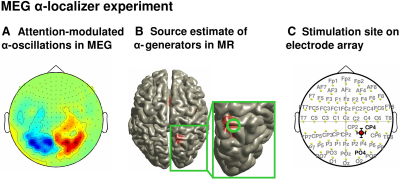
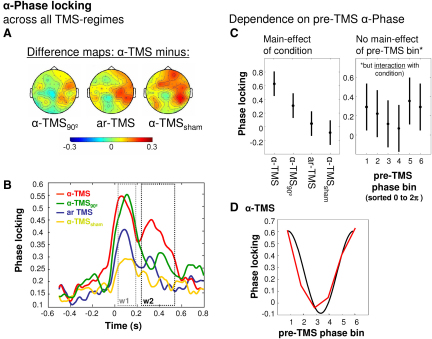
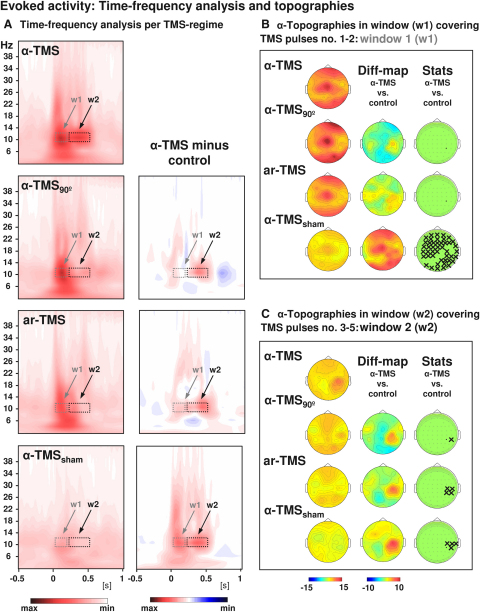
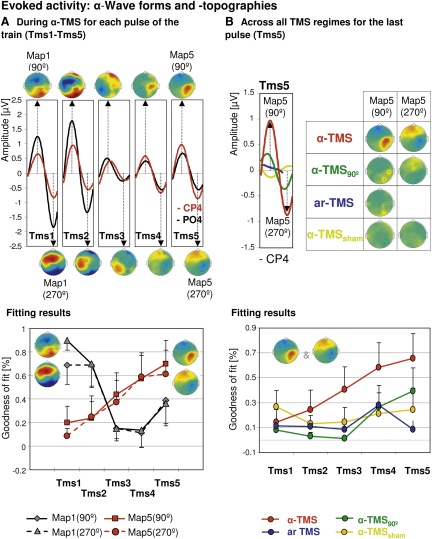
We used rhythmic TMS bursts to directly interact with an MEG-identified parietal α-oscillator, activated by attention and linked to perception. With TMS bursts tuned to its preferred α-frequency (α-TMS), we confirmed the three main predictions of entrainment of a natural oscillator: (1) that α-oscillations are induced during α-TMS (reproducing an oscillatory signature of the stimulated parietal cortex), (2) that there is progressive enhancement of this α-activity (synchronizing the targeted, α-generator to the α-TMS train), and (3) that this depends on the pre-TMS phase of the background α-rhythm (entrainment of natural, ongoing α-oscillations). Control conditions testing different TMS burst profiles and TMS-EEG in a phantom head confirmed specificity of α-boosting to the case of synchronization between TMS train and neural oscillator.
The periodic electromagnetic force that is generated during rhythmic TMS can cause local entrainment of natural brain oscillations, emulating oscillatory signatures activated by cognitive tasks. This reveals a new mechanism of online TMS action on brain activity and can account for frequency-specific behavioral TMS effects at the level of biologically relevant rhythms.
感知、认知和行为的神经元件表现出独特的振荡现象,可以通过脑电图(EEG)或脑磁图(MEG)在人体中测量到。到目前为止,脑振荡与功能之间的关联的相关性或因果关系仍然难以捉摸。因果关系的有力证明主要会产生已知与特定认知功能相关的振荡特征,然后评估行为后果。在这里,我们使用同时进行的 EEG 提供了经颅磁刺激(TMS)对大脑振荡进行因果同步的第一个直接证据。
我们使用节奏性 TMS 爆发直接与由注意力激活并与感知相关的 MEG 识别的顶叶 α-振荡相互作用。通过将 TMS 爆发调谐到其首选的 α-频率(α-TMS),我们证实了自然振荡器同步的三个主要预测:(1)α-TMS 期间诱导 α-振荡(再现受刺激顶叶皮层的振荡特征);(2)这种α-活动逐渐增强(将目标、α-发生器与α-TMS 训练同步);(3)这取决于背景α节律的预-TMS 相位(自然进行中的α-振荡的同步)。在幻影头中测试不同 TMS 爆发模式和 TMS-EEG 的控制条件证实了α-增强的特异性,即 TMS 训练与神经振荡器之间的同步。
在节奏性 TMS 期间产生的周期性电磁场力可以引起自然大脑振荡的局部同步,模拟认知任务激活的振荡特征。这揭示了 TMS 对大脑活动的在线作用的新机制,并可以解释在生物相关节律水平上具有特定频率的行为 TMS 效应。