Arthritis Research UK Primary Care Centre, Primary Care Sciences, Keele University, Keele ST5 5 BG, UK.
Rheumatology (Oxford). 2011 Oct;50(10):1869-78. doi: 10.1093/rheumatology/ker179. Epub 2011 Jul 6.
To describe primary care management of knee pain, in relation to National Institute for Health and Clinical Excellence (NICE) OA guidelines, and examine variation in management by patient characteristics.
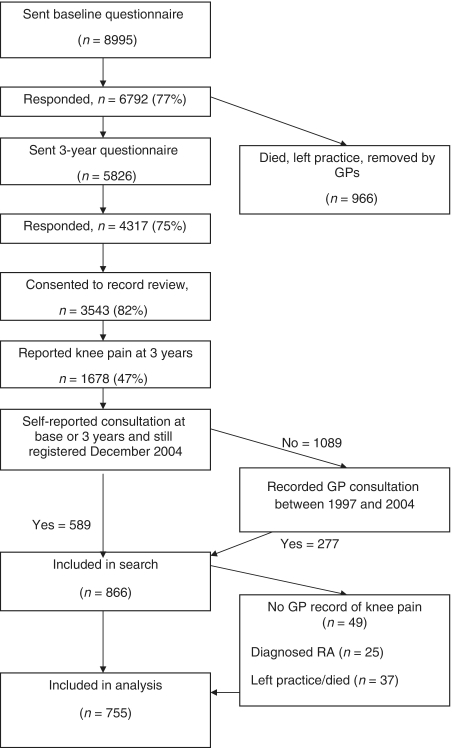
Subjects were 755 adults aged ≥50 years who responded to baseline and 3-year surveys and had consulted primary care for knee pain. Medical records (1997-2006) were searched. Associations of having interventions from the outer circle (adjunctive treatments or Step 3) of the NICE guidelines with self-reported socio-demographic and knee-specific factors were determined.
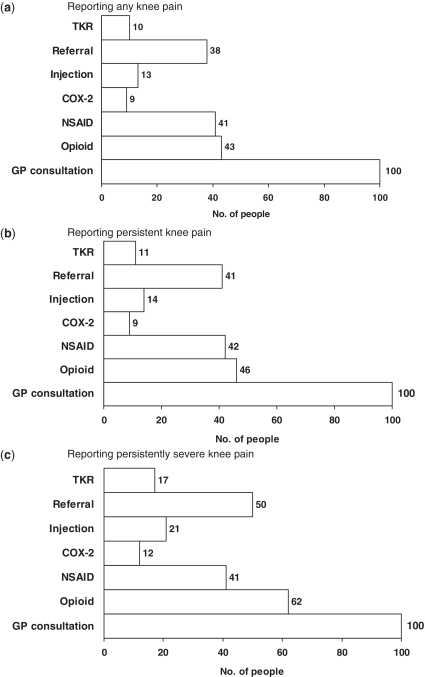
Eighty per cent had received a Step 3 intervention. Thirty-eight per cent had been referred to secondary care, and 10% had received a knee replacement. Forty-three per cent had been prescribed an opioid and 41% an NSAID. Severe knee pain or disability at baseline and follow-up was the main association with receiving a Step 3 intervention [adjusted odds ratio (OR) 2.26; 95% CI 1.38, 3.70] and with referral (OR 2.57; 95% CI 1.72, 3.83). Older patients were less likely to be referred. Although non-significant, those of higher social class, in more affluent areas, older age or overweight or obese, appeared more likely to receive a knee replacement. Fifty per cent of those reporting severe knee pain or disability in both surveys had not been referred to secondary care.
Most of the older adults who consult primary care with knee pain receive at least one Step 3 intervention from the OA guidelines. Inequalities in the management and referral of knee problems in primary care were generally not observed, although there were some trends towards differences in likelihood of total knee replacement.
描述初级保健对膝关节疼痛的管理,以符合国家卫生与临床优化研究所(NICE)骨关节炎指南,并检查患者特征对管理的影响。
本研究对象为 755 名年龄≥50 岁的成年人,他们参加了基线和 3 年的调查,并因膝关节疼痛就诊于初级保健。搜索了他们的医疗记录(1997-2006 年)。确定了接受 NICE 指南外圆(辅助治疗或第 3 步)干预与自我报告的社会人口统计学和膝关节特定因素之间的关联。
80%的患者接受了第 3 步干预。38%的患者被转诊到二级保健,10%的患者接受了膝关节置换。43%的患者被开了阿片类药物,41%的患者开了非甾体抗炎药。基线和随访时严重的膝关节疼痛或残疾是接受第 3 步干预的主要关联因素[调整后的优势比(OR)2.26;95%置信区间(CI)1.38, 3.70]和转诊的关联因素(OR 2.57;95% CI 1.72, 3.83)。年龄较大的患者更不可能被转诊。尽管没有统计学意义,但社会阶层较高、较富裕地区、年龄较大或超重或肥胖的患者,似乎更有可能接受膝关节置换。在两次调查中都报告严重膝关节疼痛或残疾的患者中,有 50%未被转诊至二级保健。
大多数因膝关节疼痛就诊于初级保健的老年人至少接受了一次来自骨关节炎指南的第 3 步干预。在初级保健中,膝关节问题的管理和转诊方面的不平等普遍没有观察到,尽管存在一些差异趋势,即全膝关节置换的可能性存在差异。