Department of Anesthesia, University of Iowa Hospitals and Clinics, Iowa City, Iowa, USA.
J Neuroinflammation. 2011 Jul 7;8:80. doi: 10.1186/1742-2094-8-80.
In our previous study, we demonstrated that local injection of complement C5a and C3a produce mechanical and heat hyperalgesia, and that C5a and C3a activate and sensitize cutaneous nociceptors in normal skin, suggesting a contribution of complement fragments to acute pain. Other studies also have shown that the complement system can be activated by surgical incision, and the systemic blockade of C5a receptor (C5aR) reduces incision-induced pain and inflammation. In this study, we further examined the possible contribution of wound area C5a to incisional pain.
Using of a hind paw incisional model, the effects of a selective C5aR antagonist, PMX53, on nociceptive behaviors were measured after incision in vivo. mRNA levels of C5 and C5aR in skin, dorsal root ganglia (DRG) and spinal cord, and C5a protein levels in the skin were quantified after incision. The responses of nociceptors to C5a were also evaluated using the in vitro skin-nerve preparation.
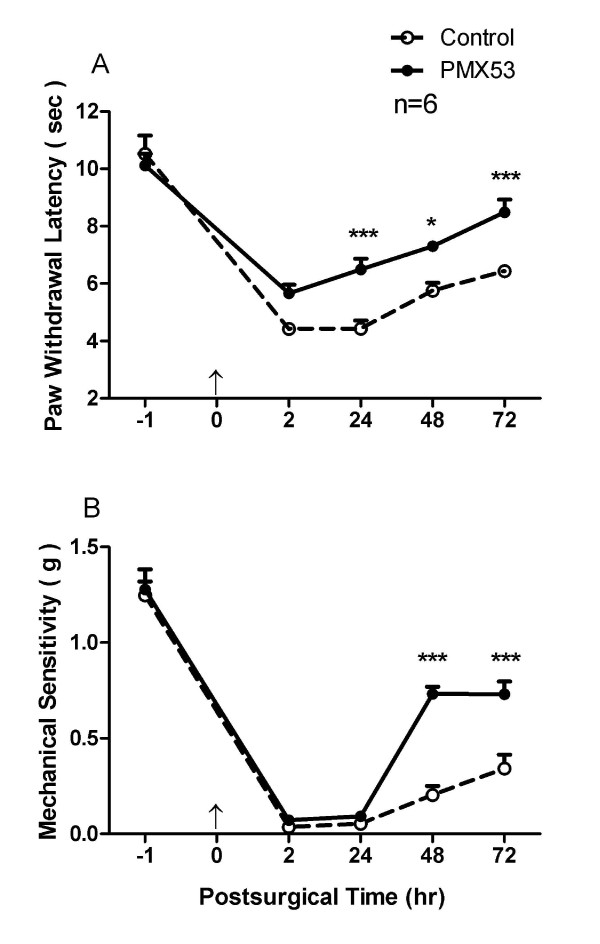
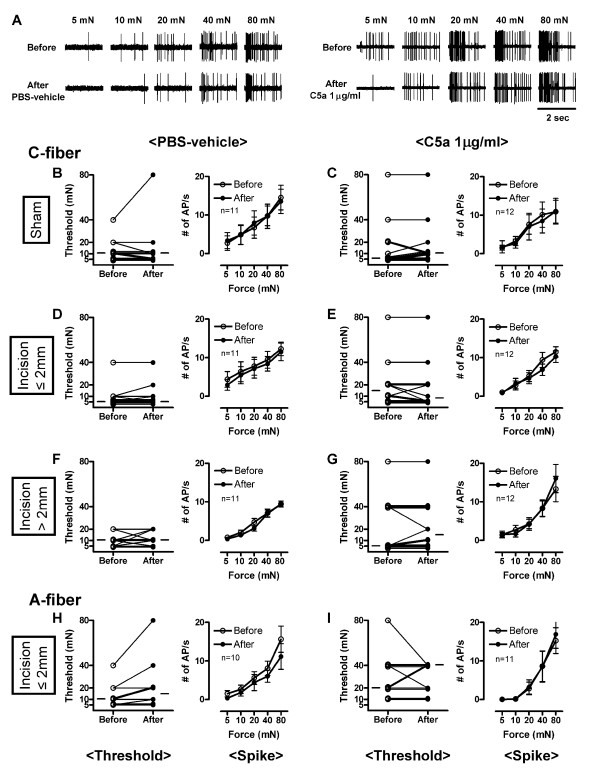
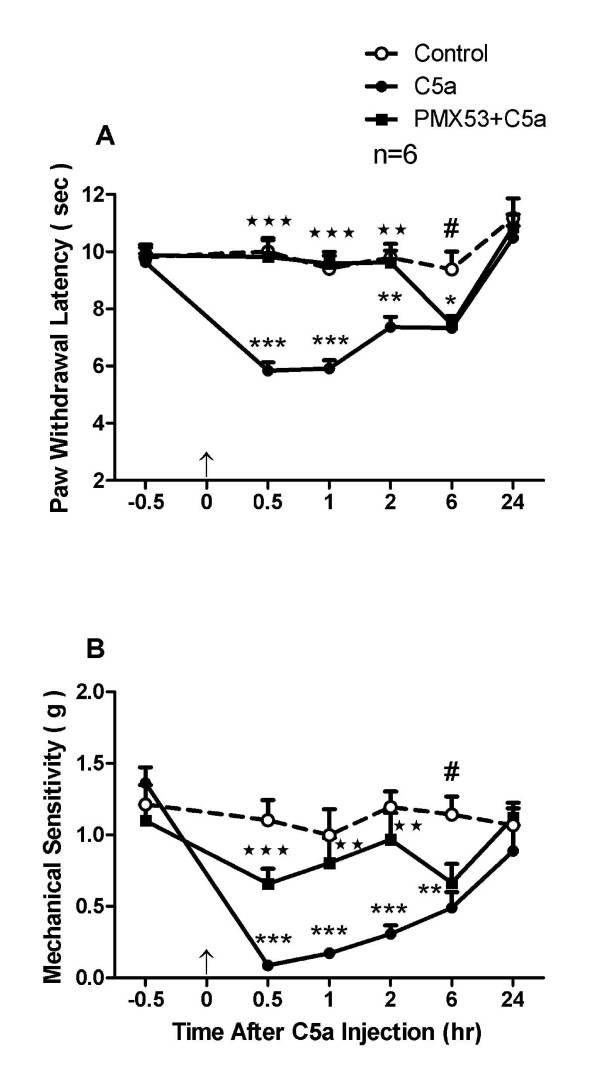
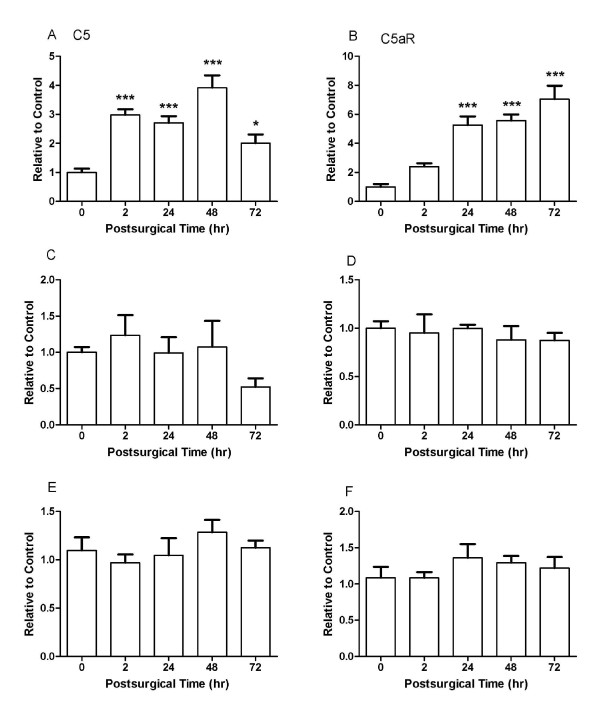
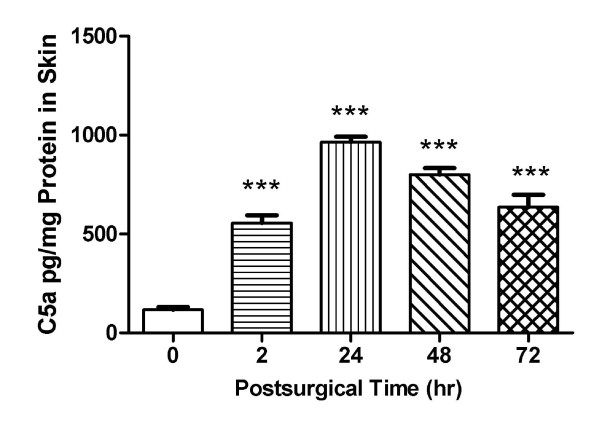
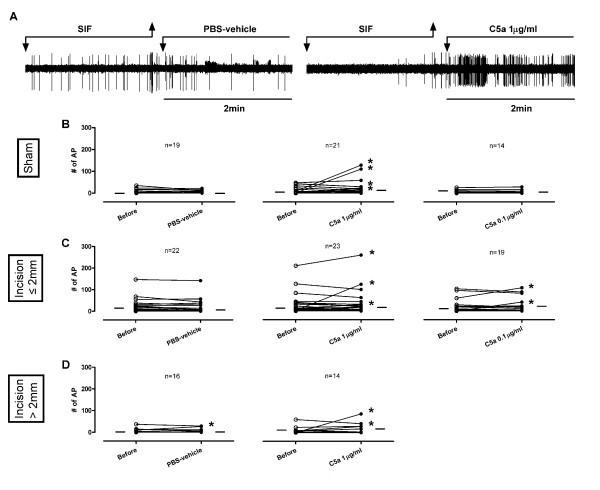
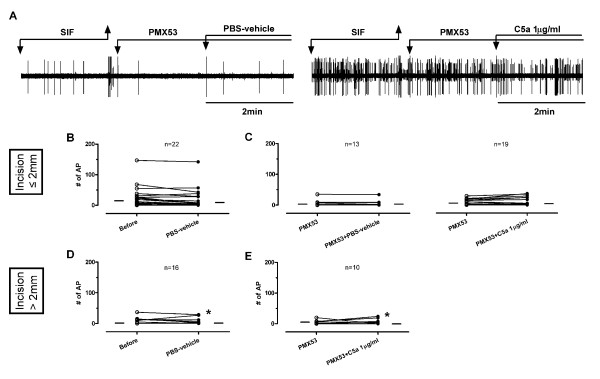
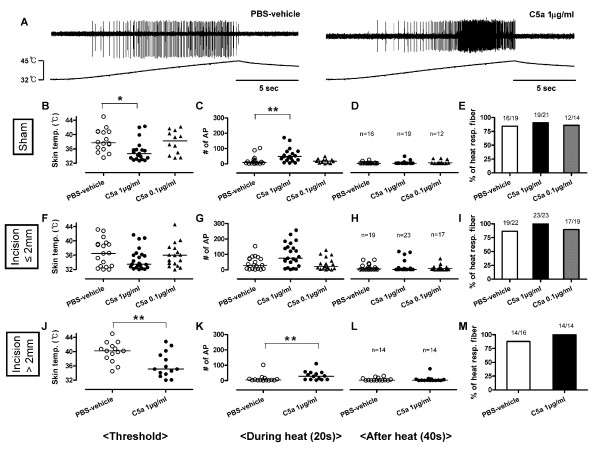
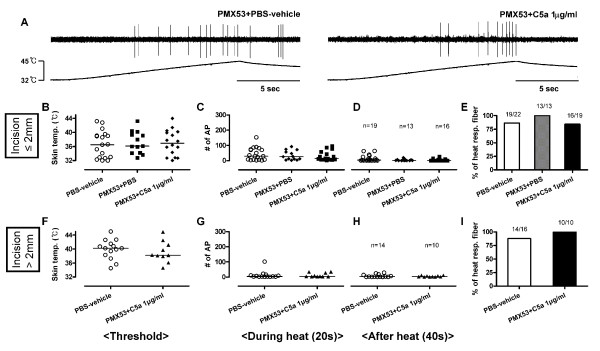
Local administration of PMX53 suppressed heat hyperalgesia and mechanical allodynia induced by C5a injection or after hind paw incision in vivo. mRNA levels of C5 and C5aR in the skin, but not DRG and spinal cord, were dramatically increased after incision. C5a protein in the skin was also increased after incision. In vitro C5a did not increase the prevalence of fibers with ongoing activity in afferents from incised versus control, unincised skin. C5a sensitized C-fiber afferent responses to heat; however, this was less evident in afferents adjacent to the incision. PMX53 blocked sensitization of C-fiber afferents to heat by C5a but did not by itself influence ongoing activity or heat sensitivity in afferents innervating control or incised skin. The magnitude of mechanical responses was also not affected by C5a in any nociceptive fibers innervating incised or unincised skin.
This study demonstrates that high locally generated C5a levels are present in wounds for at least 72 hours after incision. In skin, C5a contributes to hypersensitivity after incision, but increased responsiveness of cutaneous nociceptors to C5a was not evident in incised skin. Thus, high local concentrations of C5a produced in wounds likely contribute to postoperative pain.
在我们之前的研究中,我们证明了局部注射补体 C5a 和 C3a 会引起机械性和热痛觉过敏,并且 C5a 和 C3a 会激活和敏化正常皮肤中的皮肤伤害感受器,这表明补体片段对急性疼痛有一定的贡献。其他研究也表明,手术切口可以激活补体系统,而全身性阻断 C5a 受体(C5aR)可以减轻切口引起的疼痛和炎症。在这项研究中,我们进一步研究了伤口处 C5a 对切口疼痛的可能贡献。
使用后爪切口模型,在体内测量选择性 C5aR 拮抗剂 PMX53 对伤害性行为的影响。在切口后,定量检测皮肤、背根神经节(DRG)和脊髓中的 C5 和 C5aR 的 mRNA 水平,以及皮肤中的 C5a 蛋白水平。还使用体外皮肤-神经制备物评估伤害感受器对 C5a 的反应。
局部给予 PMX53 可抑制 C5a 注射或体内后爪切口引起的热痛觉过敏和机械性痛觉过敏。皮肤中的 C5 和 C5aR 的 mRNA 水平在切口后显著增加,但 DRG 和脊髓中的 C5 和 C5aR 的 mRNA 水平没有增加。皮肤中的 C5a 蛋白在切口后也增加。体外 C5a 不会增加来自切口与对照(未切口)皮肤的传入纤维中持续活动纤维的发生率。C5a 敏化 C 纤维传入对热的反应;然而,在切口附近的传入纤维中,这种情况不太明显。PMX53 阻断 C5a 对热的 C 纤维传入的敏化作用,但本身不会影响支配对照或切口皮肤的传入纤维的持续活动或热敏感性。机械反应的幅度也不受 C5a 影响,无论传入纤维是否支配切口或未切口皮肤。
本研究表明,切口后至少 72 小时,伤口中存在高水平的局部产生的 C5a。在皮肤中,C5a 导致切口后过敏,但在切口皮肤中未发现皮肤伤害感受器对 C5a 的反应性增加。因此,伤口中产生的高浓度局部 C5a 可能导致术后疼痛。