Zinovyev Evgeniy
Institute of Ecology of Plants and Animals, Ural' Branch of the RAS, Ekaterinburg, Russia.
Zookeys. 2011(100):149-69. doi: 10.3897/zookeys.100.1524. Epub 2011 May 20.
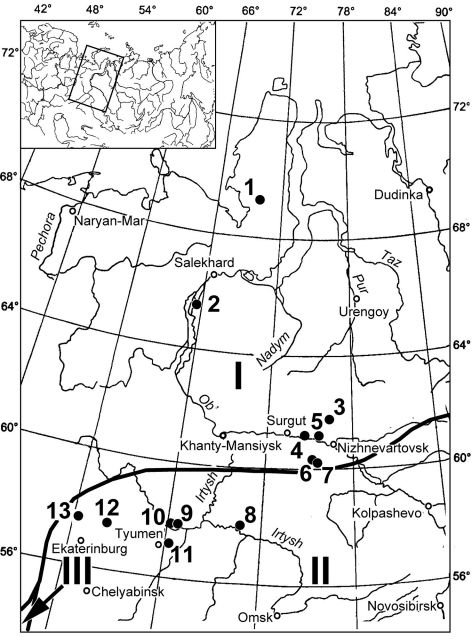
The distribution of beetles at the end of the Middle Pleninglacial (=terminal Quaternary) was examined based on sub-fossil material from the Ural Mountains and Western Siberia, Russia. All relevant localities of fossil insects have similar radiocarbon dates, ranging between 33,000 and 22,000 C14 years ago. Being situated across the vast territory from the southern Ural Mountains in the South to the middle Yamal Peninsula in the North, they allow latitudinal changes in beetle assemblages of that time to be traced. These beetles lived simultaneously with mammals of the so-called "mammoth fauna" with mammoth, bison, and wooly rhinoceros, the often co-occurring mega-mammalian bones at some of the sites being evidence of this. The beetle assemblages found between 59° and 57°N appear to be the most interesting. Their bulk is referred to as a "mixed" type, one which includes a characteristic combination of arcto-boreal, boreal, steppe and polyzonal species showing no analogues among recent insect complexes. These peculiar faunas seem to have represented a particular zonal type, which disappeared since the end of the Last Glaciation to arrive here with the extinction of the mammoth biota. In contrast, on the sites lying north of 60°N, the beetle communities were similar to modern sub-arctic and arctic faunas, yet with the participation of some sub-boreal steppe components, such as Poecilus ravus Lutshnik and Carabus sibiricus Fischer-Waldheim. This information, when compared with our knowledge of synchronous insect faunas from other regions of northern Eurasia, suggests that the former distribution of beetles in this region could be accounted for both by palaeo-environmental conditions and the impact of grazing by large ruminant mammals across the so-called "mammoth savannas".
基于俄罗斯乌拉尔山脉和西西伯利亚的亚化石材料,对中普列宁冰期晚期(即第四纪末期)甲虫的分布情况进行了研究。所有化石昆虫的相关地点都有相似的放射性碳年代测定结果,范围在距今33000至22000个碳-14年之间。这些地点从南部的乌拉尔山脉一直延伸到北部的亚马尔半岛中部,跨越广阔地域,使得当时甲虫群落的纬度变化得以追溯。这些甲虫与所谓“猛犸象动物群”的哺乳动物同时存在,猛犸象、野牛和披毛犀就是其中的代表,一些地点经常同时出现的大型哺乳动物骨骼就是证据。在北纬59°至57°之间发现的甲虫群落似乎最为有趣。它们的主体被归为“混合”类型,其中包括北极-北方、北方、草原和多地带物种的独特组合,在现代昆虫群落中没有类似物。这些独特的动物群似乎代表了一种特殊的地带类型,自末次冰期结束后随着猛犸象生物群的灭绝而消失。相比之下,在北纬60°以北的地点,甲虫群落与现代亚北极和北极动物群相似,但也有一些亚北方草原成分的参与,如拉夫斯步甲(Poecilus ravus Lutshnik)和西伯利亚步甲(Carabus sibiricus Fischer-Waldheim)。将这些信息与我们对欧亚大陆北部其他地区同步昆虫动物群的了解相比较,表明该地区甲虫的先前分布可能是由古环境条件以及大型反刍哺乳动物在所谓“猛犸象稀树草原”上的放牧影响共同造成的。