Department of Entomology, Max Planck Institute for Chemical Ecology, Jena, Germany.
BMC Genomics. 2011 Jul 8;12:357. doi: 10.1186/1471-2164-12-357.
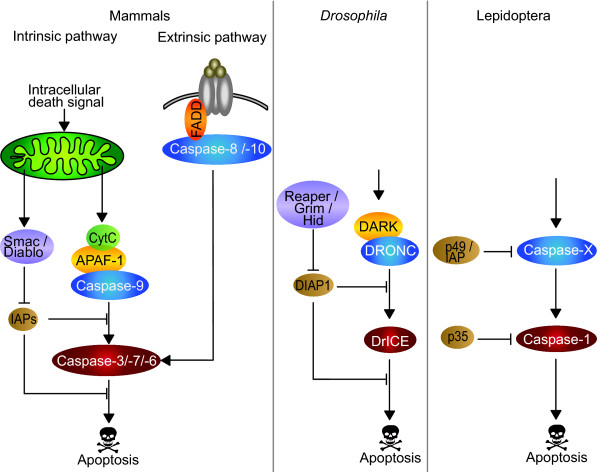
The cell suicide pathway of apoptosis is a necessary event in the life of multicellular organisms. It is involved in many biological processes ranging from development to the immune response. Evolutionarily conserved proteases, called caspases, play a central role in regulating apoptosis. Reception of death stimuli triggers the activation of initiator caspases, which in turn activate the effector caspases. In Lepidoptera, apoptosis is crucial in processes such as metamorphosis or defending against baculovirus infection. The discovery of p35, a baculovirus protein inhibiting caspase activity, has led to the characterization of the first lepidopteran caspase, Sf-Caspase-1. Studies on Sf-Caspase-1 mode of activation suggested that apoptosis in Lepidoptera requires a cascade of caspase activation, as demonstrated in many other species.
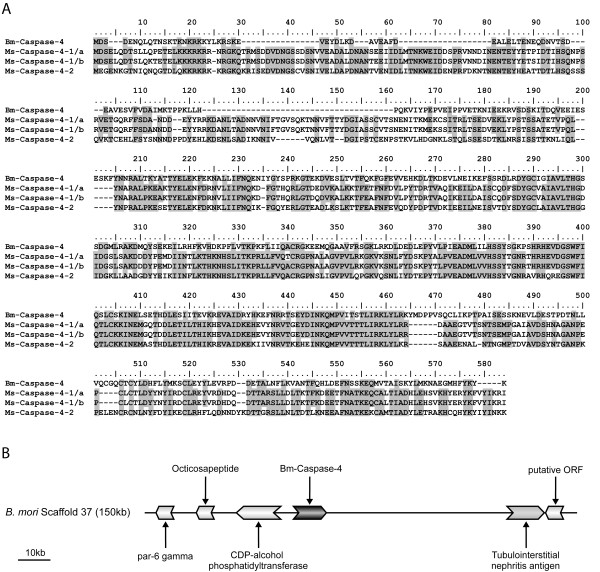
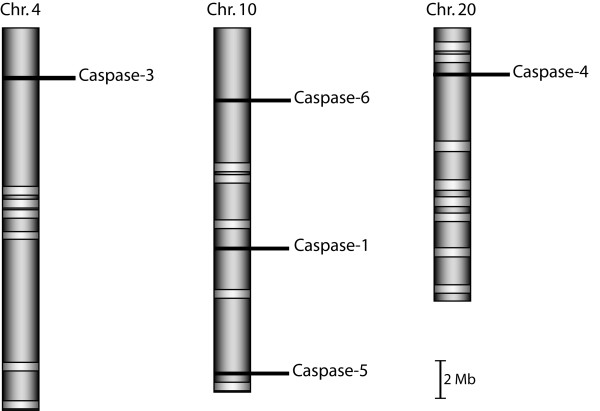
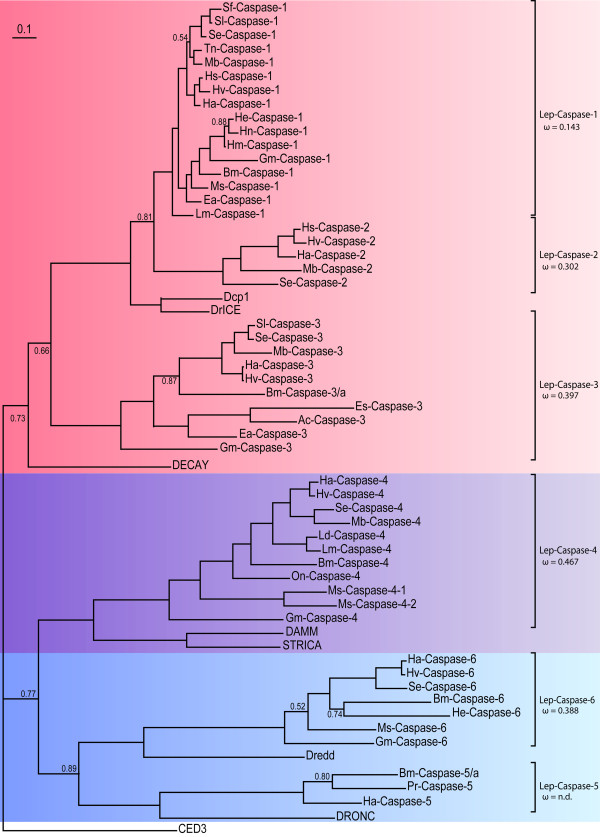
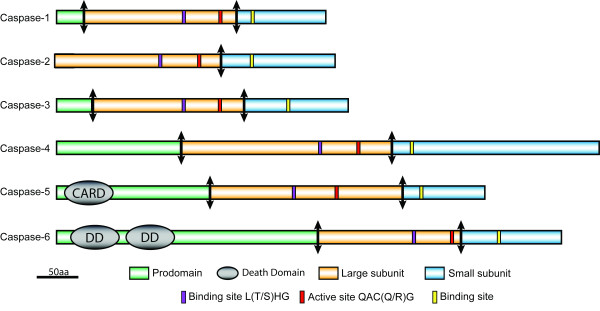
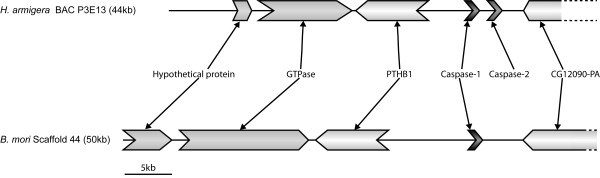
In order to get insights into this gene family in Lepidoptera, we performed an extensive survey of lepidopteran-derived EST datasets. We identified 66 sequences distributed among 27 species encoding putative caspases. Phylogenetic analyses showed that Lepidoptera possess at least 5 caspases, for which we propose a unified nomenclature. According to homology to their Drosophila counterparts and their primary structure, we determined that Lep-Caspase-1, -2 and -3 are putative effector caspases, whereas Lep-Caspase-5 and -6 are putative initiators. The likely function of Lep-Caspase-4 remains unclear. Lep-Caspase-2 is absent from the silkworm genome and appears to be noctuid-specific, and to have arisen from a tandem duplication of the Caspase-1 gene. In the tobacco hawkmoth, 3 distinct transcripts encoding putative Caspase-4 were identified, suggesting at least 2 duplication events in this species.
The basic repertoire of five major types of caspases shared among Lepidoptera seems to be smaller than for most other groups studied to date, but gene duplication still plays a role in lineage-specific increases in diversity, just as in Diptera and mammals.
细胞凋亡的自杀途径是多细胞生物生命中必不可少的事件。它涉及到从发育到免疫反应等许多生物学过程。进化上保守的蛋白酶,称为半胱天冬酶,在调节细胞凋亡中起着核心作用。死亡刺激的接收触发起始半胱天冬酶的激活,反过来又激活效应半胱天冬酶。在鳞翅目昆虫中,细胞凋亡在变态或抵御杆状病毒感染等过程中至关重要。杆状病毒蛋白 p35 的发现抑制了半胱天冬酶的活性,从而导致了第一个鳞翅目半胱天冬酶 Sf-Caspase-1 的特征描述。对 Sf-Caspase-1 激活模式的研究表明,细胞凋亡在鳞翅目昆虫中需要半胱天冬酶激活级联反应,正如在许多其他物种中所证明的那样。
为了深入了解鳞翅目昆虫中的这个基因家族,我们对广泛的鳞翅目衍生 EST 数据集进行了调查。我们鉴定了 66 个分布在 27 个物种中的序列,编码假定的半胱天冬酶。系统发育分析表明,鳞翅目至少有 5 种半胱天冬酶,我们为此提出了统一的命名法。根据与它们的果蝇对应物的同源性和它们的一级结构,我们确定 Lep-Caspase-1、-2 和 -3 是假定的效应半胱天冬酶,而 Lep-Caspase-5 和 -6 是假定的起始半胱天冬酶。Lep-Caspase-4 的可能功能仍不清楚。Lep-Caspase-2 缺失于家蚕基因组中,似乎是夜蛾科特异性的,并且是由 Caspase-1 基因的串联重复产生的。在烟草天蛾中,鉴定出 3 种不同的转录本编码假定的 Caspase-4,表明该物种中至少发生了 2 次重复事件。
与迄今为止研究的大多数其他组相比,鳞翅目昆虫中共享的五种主要类型半胱天冬酶的基本库似乎更小,但基因复制仍然在谱系特异性的多样性增加中发挥作用,就像在双翅目和哺乳动物中一样。