
发作期而非发作间期的癫痫放电激活星形胶质细胞终足并引起大脑小动脉反应。
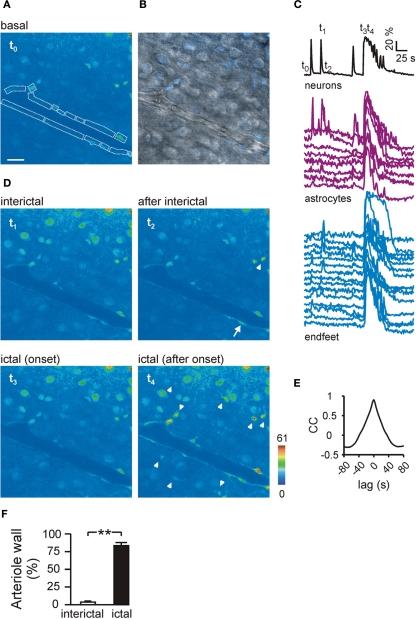
Ictal but not interictal epileptic discharges activate astrocyte endfeet and elicit cerebral arteriole responses.
机构信息
Institute of Neuroscience, National Research Council Padova, Italy.
出版信息
Front Cell Neurosci. 2011 Jun 17;5:8. doi: 10.3389/fncel.2011.00008. eCollection 2011.
Activation of astrocytes by neuronal signals plays a central role in the control of neuronal activity-dependent blood flow changes in the normal brain. The cellular pathways that mediate neurovascular coupling in the epileptic brain remain, however, poorly defined. In a cortical slice model of epilepsy, we found that the ictal, seizure-like discharge, and only to a minor extent the interictal discharge, evokes both a Ca(2+) increase in astrocyte endfeet and a vasomotor response. We also observed that rapid ictal discharge-induced arteriole responses were regularly preceded by Ca(2+) elevations in endfeet and were abolished by pharmacological inhibition of Ca(2+) signals in these astrocyte processes. Under these latter conditions, arterioles exhibited after the ictal discharge only slowly developing vasodilations. The poor efficacy of interictal discharges, compared with ictal discharges, to activate endfeet was confirmed also in the intact in vitro isolated guinea pig brain. Although the possibility of a direct contribution of neurons, in particular in the late response of cerebral blood vessels to epileptic discharges, should be taken into account, our study supports the view that astrocytes are central for neurovascular coupling also in the epileptic brain. The massive endfeet Ca(2+) elevations evoked by ictal discharges and the poor response to interictal events represent new information potentially relevant to interpret data from diagnostic brain imaging techniques, such as functional magnetic resonance, utilized in the clinic to localize neural activity and to optimize neurosurgery of untreatable epilepsies.
神经元信号激活星形胶质细胞在控制正常大脑中神经元活动依赖性血流变化中起着核心作用。然而,癫痫大脑中介导神经血管耦联的细胞途径仍未得到很好的定义。在癫痫皮质片模型中,我们发现发作样放电(ictal),即癫痫发作样放电,而仅仅是发作间期放电的一小部分,会引起星形胶质细胞终足中的 Ca(2+)增加和血管运动反应。我们还观察到,快速发作诱导的小动脉反应通常先于终足中的 Ca(2+)升高,并被这些星形胶质细胞过程中 Ca(2+)信号的药理学抑制所消除。在这些后者的条件下,小动脉在发作后仅表现出缓慢发展的血管扩张。与发作相比,发作间期放电激活终足的效果较差,这在完整的体外分离豚鼠脑中也得到了证实。尽管应该考虑神经元的直接贡献的可能性,特别是在脑血管对癫痫放电的后期反应中,但我们的研究支持了这样一种观点,即星形胶质细胞在癫痫大脑中也是神经血管耦联的核心。发作引起的大量终足 Ca(2+)升高以及对发作间期事件的反应不佳,代表了可能与从功能磁共振等诊断性脑成像技术获得的数据进行解释相关的新信息,这些技术在临床上用于定位神经活动和优化无法治疗的癫痫的神经外科手术。




 Zotero 插件