Park Sang Hyuk, Chi Hyun-Sook, Min Sook-Kyung, Cho Young-Uk, Jang Seongsoo, Park Chan-Jeoung, Lee Jung-Hee, Lee Je-Hwan, Lee Kyoo-Hyung, Im Ho-Joon, Seo Jong-Jin
Department of Laboratory Medicine, University of Ulsan College of Medicine and Asan Medical Center, Seoul, Korea.
Korean J Hematol. 2011 Jun;46(2):88-95. doi: 10.5045/kjh.2011.46.2.88. Epub 2011 Jun 21.
Fms-like tyrosine kinase 3 internal tandem duplication (FLT3 ITD) mutation is related to poor prognosis in normal-karyotype acute myeloid leukemia (AML). However, the prognostic significance of the mutation at relapse has not been adequately investigated. We investigated the prognostic significance of the FLT3 ITD mutation at relapse in normal-karyotype AML patients.
We analyzed 69 normal-karyotype AML patients, in whom paired bone marrow samples taken at initial diagnosis and subsequent relapse were analyzed for the FLT3 ITD mutation at the Asan Medical Center between 1995 and 2009.
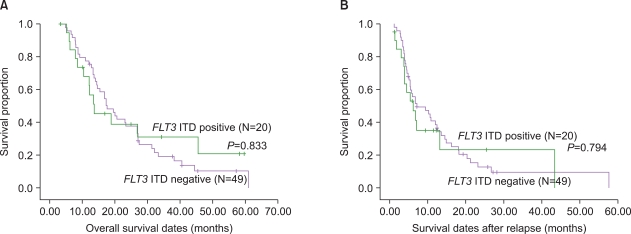
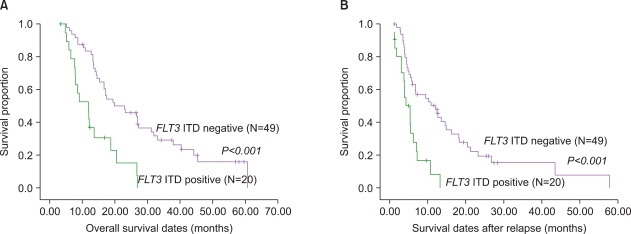
Forty patients showed a persistent wild-type genotype, 11 showed the FLT3 ITD mutation at diagnosis and relapse, and 9 lost and another 9 acquired the mutation at relapse. The mutation status at relapse affected the overall survival (OS), with the mutation group showing shorter OS and survival after relapse than the wild-type group did (P<0.001 and P<0.001, respectively), despite having received more frequent stem cell transplantation after relapse than the wild-type group did. However, no difference was detected in the OS and survival after relapse with regard to the mutation status at diagnosis.
The patients with FLT3 ITD mutation at relapse showed poorer prognoses than those without the mutation. However, mutation status at diagnosis did not affect the outcome. These results suggest that, in normal-karyotype AML patients with relapse, the prognostic significance of FLT3 ITD mutation at relapse is greater than that of the mutation status at diagnosis.
Fms样酪氨酸激酶3内部串联重复(FLT3 ITD)突变与正常核型急性髓系白血病(AML)的不良预后相关。然而,该突变在复发时的预后意义尚未得到充分研究。我们调查了正常核型AML患者复发时FLT3 ITD突变的预后意义。
我们分析了69例正常核型AML患者,这些患者于1995年至2009年在峨山医学中心接受治疗,对其初诊时和随后复发时采集的配对骨髓样本进行FLT3 ITD突变分析。
40例患者显示持续野生型基因型,11例在诊断和复发时均显示FLT3 ITD突变,9例在复发时丢失该突变,另有9例在复发时获得该突变。复发时的突变状态影响总生存期(OS),突变组的OS和复发后的生存期均短于野生型组(分别为P<0.001和P<0.001),尽管复发后接受干细胞移植的频率高于野生型组。然而,诊断时的突变状态在OS和复发后的生存期方面未检测到差异。
复发时存在FLT3 ITD突变的患者预后比无突变患者差。然而,诊断时的突变状态不影响预后。这些结果表明,在复发的正常核型AML患者中,复发时FLT3 ITD突变的预后意义大于诊断时的突变状态。