Laboratory of Pharmacokinetic/Pharmacogenomic, Regina Elena National Cancer Institute, Rome, Italy.
BMC Cancer. 2011 Jul 12;11:291. doi: 10.1186/1471-2407-11-291.
To evaluate the association between polymorphisms involved in DNA repair and oxidative stress genes and mean dose to whole breast on acute skin reactions (erythema) in breast cancer (BC) patients following single shot partial breast irradiation (SSPBI) after breast conservative surgery.
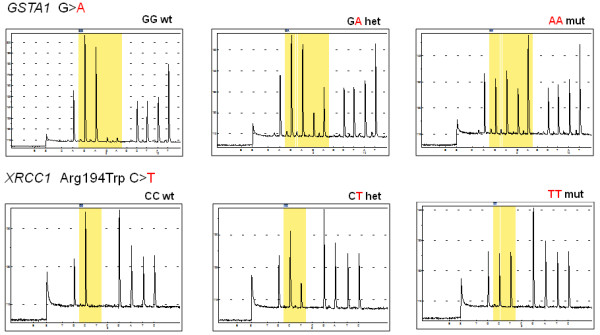
Acute toxicity was assessed using vers.3 criteria. single nucleotides polymorphisms(SNPs) in genes: XRCC1(Arg399Gln/Arg194Trp), XRCC3 (A4541G-5'UTR/Thr241Met), GSTP1(Ile105Val), GSTA1 and RAD51(untranslated region). SNPs were determined in 57 BC patients by the Pyrosequencing analysis. Univariate(ORs and 95% CI) and logistic multivariate analyses (MVA) were performed to correlate polymorphic genes with the risk of developing acute skin reactions to radiotherapy.
After SSPBI on the tumour bed following conservative surgery, grade 1 or 2 acute erythema was observed in 19 pts(33%). Univariate analysis indicated a higher significant risk of developing erythema in patients with polymorphic variant wt XRCC1Arg194Trp, mut/het XRCC3Thr241Met, wt/het XRCC3A4541G-5'UTR. Similarly a higher erythema rate was also found in the presence of mut/het of XRCC1Arg194Trp or wt of GSTA1. Whereas, a lower erythema rate was observed in patients with mut/het of XRCC1Arg194Trp or wt of XRCC1Arg399Gln. The mean dose to whole breast(p = 0.002), the presence of either mut/het XRCC1Arg194Trp or wt XRCC3Thr241Met (p = 0.006) and the presence of either mut/het XRCC1Arg194Trp or wt GSTA1(p = 0.031) were confirmed as predictors of radiotherapy-induced erythema by MVA.
The Whole breast mean dose together with the presence of some polymorphic genes involved in DNA repair or oxidative stress could explain the erythema observed after SSPBI, but further studies are needed to confirm these results in a larger cohort.
评估与 DNA 修复和氧化应激基因相关的多态性与乳腺癌(BC)患者保乳手术后单次部分乳腺照射(SSPBI)后急性皮肤反应(红斑)全乳平均剂量之间的关系。
使用 vers.3 标准评估急性毒性。单核苷酸多态性(SNPs)在基因中:XRCC1(Arg399Gln/Arg194Trp)、XRCC3(A4541G-5'UTR/Thr241Met)、GSTP1(Ile105Val)、GSTA1 和 RAD51(非翻译区)。通过焦磷酸测序分析在 57 名 BC 患者中确定 SNPs。采用单变量(ORs 和 95%CI)和逻辑多元分析(MVA)来分析多态性基因与放疗后急性皮肤反应风险的相关性。
在保乳手术后肿瘤床进行 SSPBI 后,19 例患者(33%)出现 1 级或 2 级急性红斑。单变量分析表明,携带 XRCC1Arg194Trp 多态性野生型、XRCC3Thr241Met 突变/杂合型、XRCC3A4541G-5'UTR 野生型/杂合型的患者发生红斑的风险显著增加。同样,XRCC1Arg194Trp 突变/杂合型或 GSTA1 野生型患者也发现红斑发生率较高。而 XRCC1Arg194Trp 突变/杂合型或 XRCC1Arg399Gln 野生型患者红斑发生率较低。全乳平均剂量(p=0.002)、存在 XRCC1Arg194Trp 突变/杂合型或 XRCC3Thr241Met 野生型(p=0.006)和存在 XRCC1Arg194Trp 突变/杂合型或 GSTA1 野生型(p=0.031)是 MVA 确定的放疗诱导红斑的预测因子。
全乳平均剂量与参与 DNA 修复或氧化应激的一些多态性基因的存在可以解释 SSPBI 后观察到的红斑,但需要进一步的研究来在更大的队列中证实这些结果。