Prazeres Hugo, Torres Joana, Rodrigues Fernando, Couto Joana P, Vinagre João, Sobrinho-Simões Manuel, Soares Paula
Cancer Biology Group, Institute of Molecular Pathology and Immunology of the University of Porto (IPATIMUP), Rua Dr. Roberto Frias, s/n, 4200-465 Porto, Portugal.
J Thyroid Res. 2011;2011:678357. doi: 10.4061/2011/678357. Epub 2011 Jun 23.
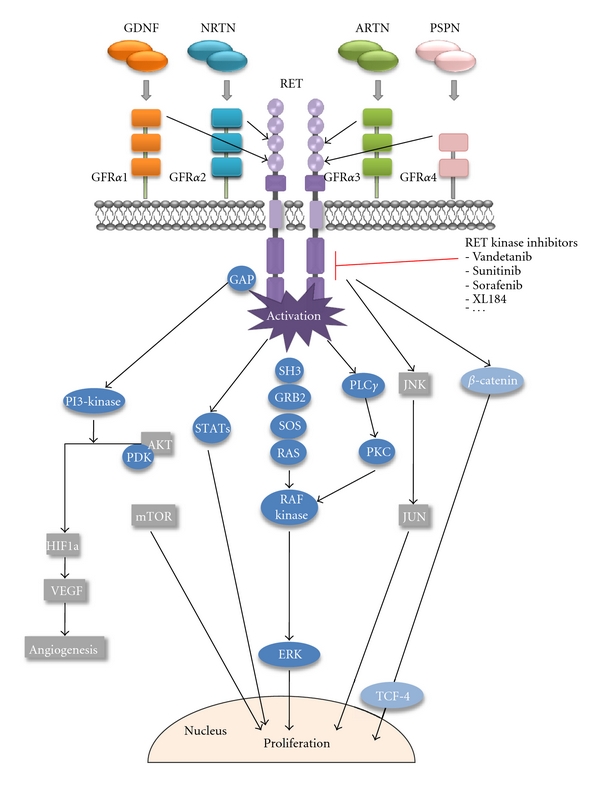
The significance of RET in thyroid cancer comes from solid evidence that, when inherited, an RET activating mutation primes C-cells to transform into medullary carcinomas. Moreover, environmental exposure to radiation also induces rearranged transforming RET "isoforms" that are found in papillary thyroid cancer. The RET gene codes for a tyrosine kinase receptor that targets a diverse set of intracellular signaling pathways. The nature of RET point mutations predicts differences in the mechanisms by which the receptor becomes activated and correlates with different forms of clinical presentation, age of onset, and biological aggressiveness. A number of RET-targeting Tyrosine Kinase Inhibitors (TKIs) are currently undergoing clinical trials to evaluate their effectiveness in the treatment of thyroid cancer, and it is conceivable that the RET genotype may also influence response to these compounds. The question that now emerges is whether, in the future, the rational for treatment of refractory thyroid cancer will be based on the management of an abnormal RET signal. In this paper we address the RET-targeting TKIs and review studies about the signaling properties of distinct RET mutants as a means to predict response and design combinatorial therapies for the soon to be available TKIs.
RET在甲状腺癌中的重要性源于确凿证据,即当RET激活突变遗传时,会促使C细胞转化为髓样癌。此外,环境辐射暴露也会诱导在甲状腺乳头状癌中发现的重排转化RET“异构体”。RET基因编码一种靶向多种细胞内信号通路的酪氨酸激酶受体。RET点突变的性质预示着受体激活机制的差异,并与不同形式的临床表现、发病年龄和生物学侵袭性相关。目前,一些靶向RET的酪氨酸激酶抑制剂(TKIs)正在进行临床试验,以评估其在治疗甲状腺癌方面的有效性,并且可以想象,RET基因型也可能影响对这些化合物的反应。现在出现的问题是,未来难治性甲状腺癌的治疗依据是否将基于对异常RET信号的处理。在本文中,我们探讨了靶向RET的TKIs,并综述了关于不同RET突变体信号特性的研究,以此作为预测反应和为即将上市的TKIs设计联合疗法的一种手段。