Lainscak Mitja, von Haehling Stephan, Doehner Wolfram, Sarc Irena, Jeric Tina, Ziherl Kristina, Kosnik Mitja, Anker Stefan D, Suskovic Stanislav
J Cachexia Sarcopenia Muscle. 2011 Jun;2(2):81-86. doi: 10.1007/s13539-011-0023-9. Epub 2011 Mar 1.
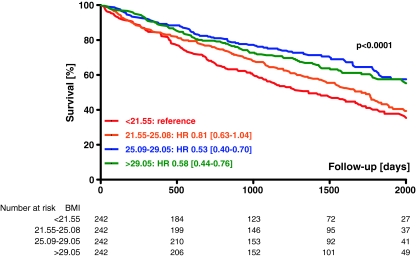
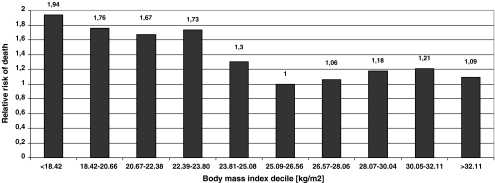
Nutritional status, weight loss and cachexia have important prognostic implications in patients with chronic obstructive pulmonary disease (COPD). Body mass index (BMI) has been implicated in COPD risk assessment, but information is mostly limited to composite scores or to patients with stable disease. We aimed to analyse the association between BMI and mortality in acute exacerbation of COPD. METHODS: This retrospective survey included 968 patients hospitalized due to acute exacerbation of COPD at the University Clinic Golnik from February 2002 to June 2007. Vital status was ascertained with Central Population Registry, and database was censored on November 1, 2008. RESULTS: Median BMI was 25.08 kg/m(2) (interquartile range, 21.55-29.05 kg/m(2)) and 210 patients (22%) had BMI < 21 kg/m(2). During median follow-up of 3.26 years (1.79-4.76 years), 430 patients (44%) died. Lowest mortality was found for BMI 25.09-29.05 kg/m(2). When divided per BMI decile, mortality was lowest for BMI 25.09-26.56 kg/m(2) (33%). In univariate analysis, BMI per quartile and BMI per unit increase were predictive for all-cause mortality. In an adjusted model, BMI per 1 kg/m(2) unit increase was associated with 5% less chance of death (hazard ratio 0.95, 95% confidence interval 0.93-0.97). CONCLUSIONS: Low BMI < 21 kg/m(2) is frequent in patients hospitalized due to acute exacerbation of COPD. Higher BMI was independently predictive of better long-term survival. A better outcome in obese patients compared to normal weight is in contrast to primary prevention data but concurs with observations of an obesity paradox in other cardiovascular diseases.
营养状况、体重减轻和恶病质对慢性阻塞性肺疾病(COPD)患者具有重要的预后意义。体重指数(BMI)已被用于COPD风险评估,但相关信息大多局限于综合评分或病情稳定的患者。我们旨在分析BMI与COPD急性加重期患者死亡率之间的关联。
这项回顾性调查纳入了2002年2月至2007年6月在戈尔尼克大学诊所因COPD急性加重而住院的968例患者。通过中央人口登记处确定生命状态,数据库于2008年11月1日进行审查。
BMI中位数为25.08kg/m²(四分位间距为21.55 - 29.05kg/m²),210例患者(22%)的BMI < 21kg/m²。在中位随访3.26年(1.79 - 4.76年)期间,430例患者(44%)死亡。BMI为25.09 - 29.05kg/m²时死亡率最低。按BMI十分位数划分时,BMI为25.09 - 26.56kg/m²时死亡率最低(33%)。在单因素分析中,BMI每四分位数和BMI每增加一个单位均对全因死亡率具有预测性。在调整模型中,BMI每增加1kg/m²单位与死亡几率降低5%相关(风险比0.95,95%置信区间0.93 - 0.97)。
因COPD急性加重而住院的患者中,BMI < 21kg/m²的情况很常见。较高的BMI是长期生存更好的独立预测因素。与正常体重患者相比,肥胖患者的预后更好,这与一级预防数据相反,但与其他心血管疾病中肥胖悖论的观察结果一致。