Department of Cardiology, Thorax Center, University Medical Center Groningen, University of Groningen, Hanzeplein 1, PO Box 30001, 9700 RB, Groningen, The Netherlands.
Clin Res Cardiol. 2011 Dec;100(12):1069-76. doi: 10.1007/s00392-011-0343-y. Epub 2011 Jul 16.
Early detection of acute myocardial infarction (AMI) using cardiac biomarkers of myocardial necrosis remains limited since these biomarkers do not rise within the first hours from onset of AMI. We aimed to compare the temporal release pattern of the C-terminal portion of provasopressin (copeptin) with conventional cardiac biomarkers, including creatine kinase isoenzyme (CK-MB), cardiac troponin T (cTnT), and high-sensitivity cTnT (hs-cTnT), in patients with ST-elevation AMI.
We included 145 patients undergoing successful primary percutaneous coronary intervention (PCI) for a first ST-elevation AMI presenting within 12 h of symptom onset. Blood samples were taken on admission and at four time points within the first 24 h after PCI.
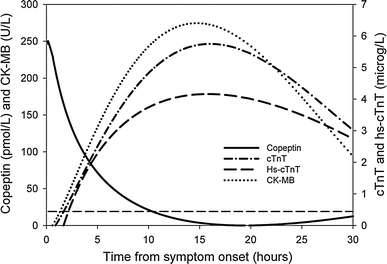
In contrast to all other markers, copeptin levels were already elevated on admission and were higher with a shorter time from symptom onset to reperfusion and lower systolic blood pressure. Copeptin levels peaked immediately after symptom onset at a maximum of 249 pmol/L and normalized within 10 h. In contrast, CK-MB, cTnT, and hs-cTnT peaked after 14 h from symptom onset at a maximum of 275 U/L, 5.75 μg/L, and 4.16 μg/L, respectively, and decreased more gradually.
Copeptin has a distinct release pattern in patients with ST-elevation AMI, peaking within the first hour after symptom onset before conventional cardiac biomarkers and falling to normal ranges within the first day. Further studies are required to determine the exact role of copeptin in AMI suspects presenting within the first hours after symptom onset.
由于心肌坏死的心脏生物标志物在急性心肌梗死(AMI)发作后的最初几小时内并未升高,因此早期检测 AMI 仍受到限制。我们旨在比较血管加压素 C 端片段( copeptin )与传统心脏生物标志物(包括肌酸激酶同工酶(CK-MB)、心肌肌钙蛋白 T(cTnT)和高敏肌钙蛋白 T(hs-cTnT))在 ST 段抬高型 AMI 患者中的时间释放模式。
我们纳入了 145 例在症状发作后 12 小时内接受成功的初次经皮冠状动脉介入治疗(PCI)的首发 ST 段抬高 AMI 患者。在入院时和 PCI 后 24 小时内的四个时间点采集血样。
与所有其他标志物相比,copeptin 水平在入院时即已升高,且与症状发作至再灌注时间较短和收缩压较低相关。copeptin 水平在症状发作后即刻达到峰值(最高 249 pmol/L),并在 10 小时内恢复正常。相比之下,CK-MB、cTnT 和 hs-cTnT 在症状发作后 14 小时达到峰值(分别为 275 U/L、5.75 μg/L 和 4.16 μg/L),下降更缓慢。
ST 段抬高型 AMI 患者的 copeptin 释放模式独特,在症状发作后 1 小时内达到峰值,早于传统心脏生物标志物,且在第 1 天内降至正常范围。需要进一步研究以确定 copeptin 在症状发作后最初几小时内的 AMI 疑似患者中的确切作用。