Division of Molecular Neurobiology, National Institute for Basic Biology, The Graduate University for Advanced Studies, Okazaki, Aichi, Japan.
PLoS One. 2011;6(7):e22246. doi: 10.1371/journal.pone.0022246. Epub 2011 Jul 14.
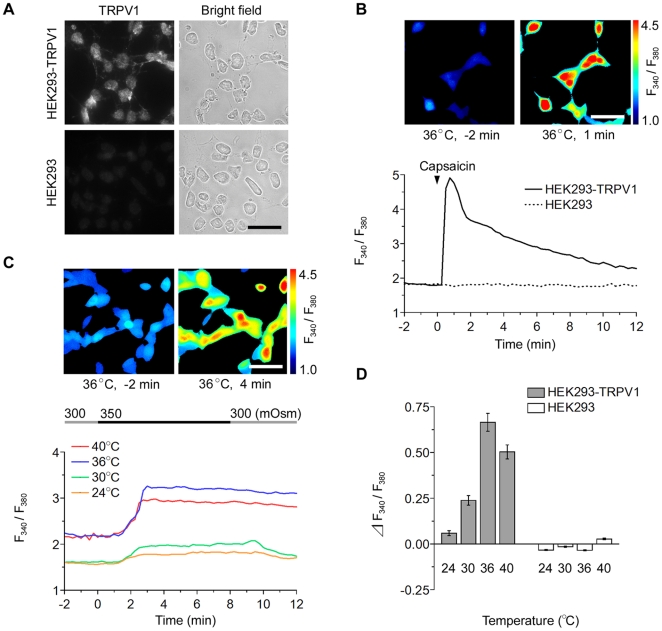
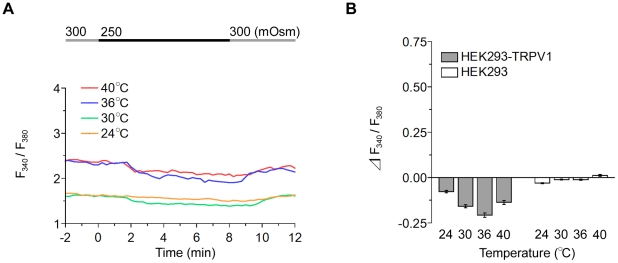
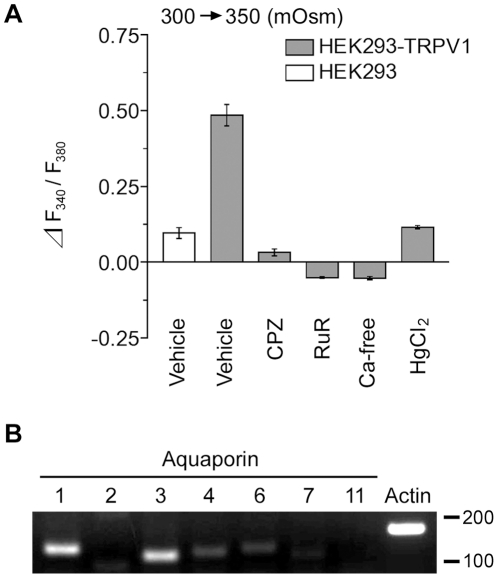
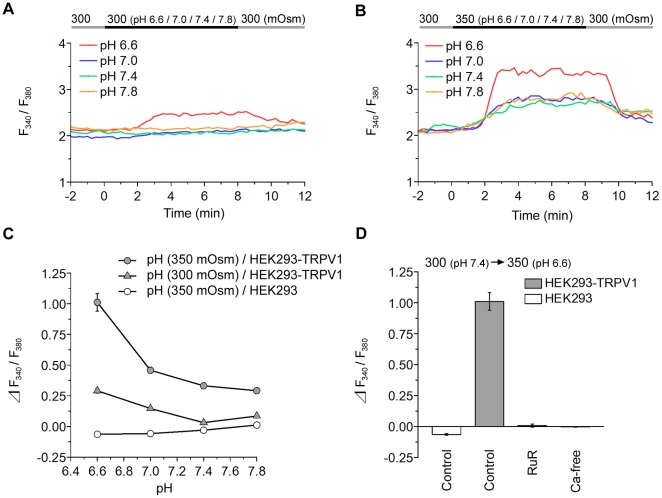
In animals, body-fluid osmolality is continuously monitored to keep it within a narrow range around a set point (∼300 mOsm/kg). Transient receptor potential vanilloid 1 (TRPV1), a cation channel, has been implicated in body-fluid homeostasis in vivo based on studies with the TRPV1-knockout mouse. However, the response of TRPV1 to hypertonic stimuli has not been demonstrated with heterologous expression systems so far, despite intense efforts by several groups. Thus, the molecular entity of the hypertonic sensor in vivo still remains controversial. Here we found that the full-length form of TRPV1 is sensitive to an osmotic increase exclusively at around body temperature using HEK293 cells stably expressing rat TRPV1. At an ambient temperature of 24°C, a slight increase in the intracellular calcium concentration (Ca(2+)) was rarely observed in response to hypertonic stimuli. However, the magnitude of the osmosensitive response markedly increased with temperature, peaking at around 36°C. Importantly, the response at 36°C showed a robust increase over a hypertonic range, but a small decrease over a hypotonic range. A TRPV1 antagonist, capsazepine, and a nonspecific TRP channel inhibitor, ruthenium red, completely blocked the increase in Ca(2+). These results endorse the view that the full-length form of TRPV1 is able to function as a sensor of hypertonic stimuli in vivo. Furthermore, we found that protons and capsaicin likewise synergistically potentiated the response of TRPV1 to hypertonic stimuli. Of note, HgCl(2), which blocks aquaporins and inhibits cell-volume changes, significantly reduced the osmosensitive response. Our findings thus indicate that TRPV1 integrates multiple different types of activating stimuli, and that TRPV1 is sensitive to hypertonic stimuli under physiologically relevant conditions.
在动物体内,体液渗透压持续受到监控,以使其保持在设定点(约 300 mOsm/kg)附近的狭窄范围内。瞬时受体电位香草酸 1(TRPV1)是一种阳离子通道,基于 TRPV1 基因敲除小鼠的研究,其被认为与体内体液稳态有关。然而,尽管有几个研究小组进行了大量努力,迄今为止,还没有在异源表达系统中证明 TRPV1 对高渗刺激的反应。因此,体内高渗传感器的分子实体仍然存在争议。在这里,我们发现使用稳定表达大鼠 TRPV1 的 HEK293 细胞,全长形式的 TRPV1 仅对接近体温的渗透压增加敏感。在环境温度为 24°C 时,很少观察到对高渗刺激的细胞内钙离子浓度([Ca2+]i)的轻微增加。然而,渗透压敏感反应的幅度随着温度的升高而显著增加,在约 36°C 时达到峰值。重要的是,在 36°C 时的反应在高渗范围内表现出强烈的增加,而在低渗范围内则略有减少。TRPV1 拮抗剂辣椒素和非特异性 TRP 通道抑制剂钌红完全阻断了[Ca2+]i 的增加。这些结果支持全长形式的 TRPV1 能够作为体内高渗刺激传感器的观点。此外,我们发现质子和辣椒素同样协同增强 TRPV1 对高渗刺激的反应。值得注意的是,HgCl2,它阻断水通道并抑制细胞体积变化,显著降低了渗透压敏感反应。因此,我们的研究结果表明 TRPV1 整合了多种不同类型的激活刺激,并且 TRPV1 在生理相关条件下对高渗刺激敏感。