Almeida G F G, Castro G, Snitcovsky I M L, Siqueira S A, Akaishi E H, Camargo O P, Oliveira C R G C M, Federico M H H
Servico de Oncologia Clinica, Instituto de Radiologia, Hospital das Clinicas, Faculdade de Medicina, Universidade de Sao Paulo, 05403-900 Sao Paulo, SP, Brazil.
Sarcoma. 2011;2011:984340. doi: 10.1155/2011/984340. Epub 2011 Jun 30.
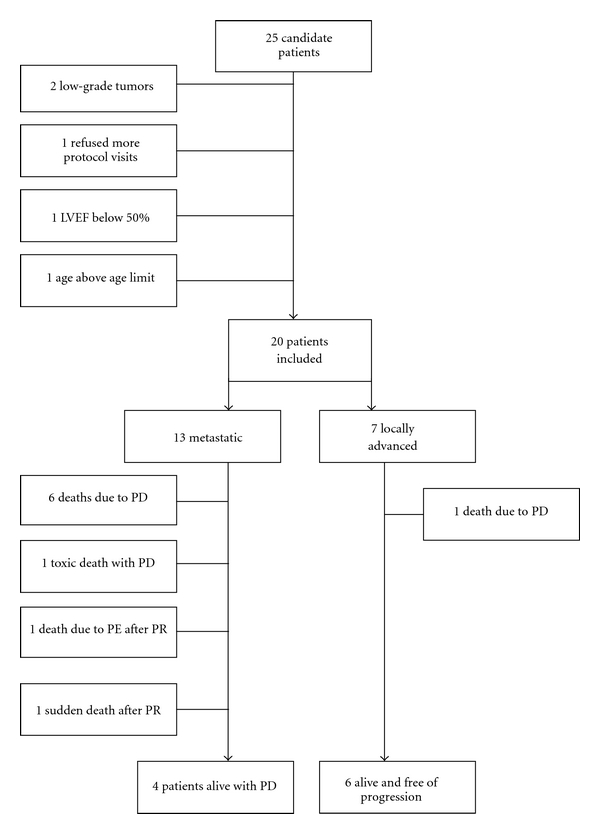
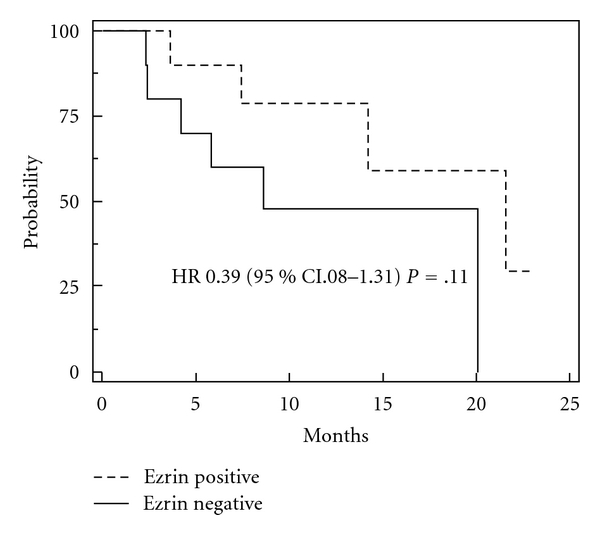
Aims. This phase II study explored activity/safety of front-line dose-dense chemotherapy in high-grade STS (soft tissue sarcoma) patients and tested ezrin as prognostic factor. Patients and Methods. The protocol consisted of three cycles of doxorubicin (DOXO) 30 mg/m(2) on days 1-3 every 2 weeks, followed by three cycles of ifosfamide (IFO) 2.5 g/m(2) two hours a day on days 1-5 every 3 weeks, with GCSF support. Ezrin was assessed immunohistochemically. Results. Twenty patients, 13 metastatic and 7 locally advanced, were enrolled. Median age was 39 years (25-60). Median dose intensities were 42 mg/m(2)/week and 3.6 g/m(2)/week for DOXO and IFO, respectively. Grade 3/4 toxicities occurred in 18 patients. Response rate was 15% (3 of 20) by RECIST. Patients younger than 45 years with locally advanced disease and synovial histology presented longer survival. A trend towards longer survival was observed among ezrin-positive patients. Conclusions. This dose-dense schedule should not be routinely used due to its high frequency of toxic events; however, a sequential strategy with DOXO and IFO may benefit selected patients and should be further explored with lower doses. The role of ezrin as a prognostic marker should be confirmed in a larger group of patients.
目的。本II期研究探讨了一线剂量密集化疗在高级别软组织肉瘤(STS)患者中的活性/安全性,并将埃兹蛋白作为预后因素进行检测。患者与方法。方案包括每2周第1 - 3天给予多柔比星(DOXO)30mg/m²共三个周期,随后每3周第1 - 5天每天2小时给予异环磷酰胺(IFO)2.5g/m²共三个周期,并给予粒细胞集落刺激因子(GCSF)支持。通过免疫组织化学评估埃兹蛋白。结果。入组20例患者,其中13例为转移性,7例为局部晚期。中位年龄为39岁(25 - 60岁)。DOXO和IFO的中位剂量强度分别为42mg/m²/周和3.6g/m²/周。18例患者发生3/4级毒性反应。根据实体瘤疗效评价标准(RECIST),缓解率为15%(20例中的3例)。年龄小于45岁、局部晚期疾病且组织学为滑膜型的患者生存期较长。埃兹蛋白阳性患者中观察到生存期延长的趋势。结论。由于其毒性事件发生率高,这种剂量密集方案不应常规使用;然而,DOXO和IFO的序贯策略可能使部分患者获益,应使用更低剂量进一步探索。埃兹蛋白作为预后标志物的作用应在更大规模的患者群体中得到证实。