Department of Cancer Research and Molecular Medicine, Norwegian University of Science and Technology, Trondheim.
Environ Mol Mutagen. 2011 Oct;52(8):623-35. doi: 10.1002/em.20663. Epub 2011 Jul 22.
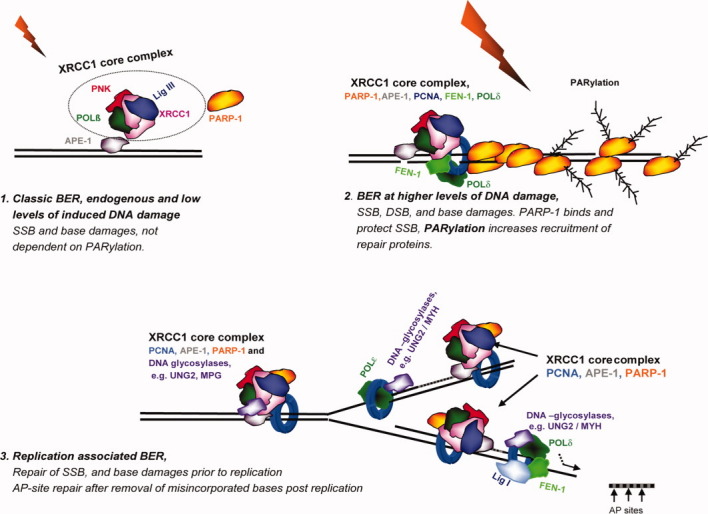
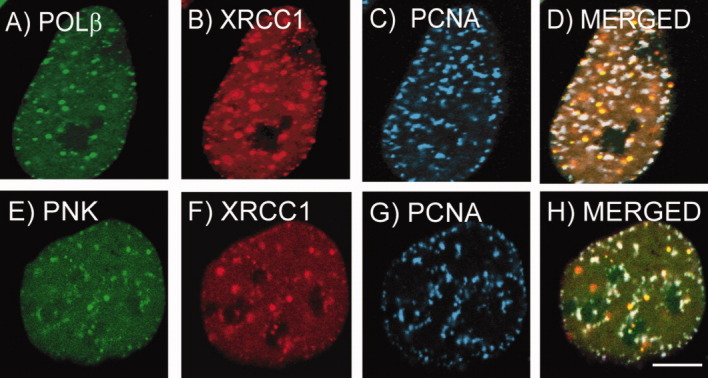
XRCC1 is a scaffold protein capable of interacting with several DNA repair proteins. Here we provide evidence for the presence of XRCC1 in different complexes of sizes from 200 to 1500 kDa, and we show that immunoprecipitates using XRCC1 as bait are capable of complete repair of AP sites via both short patch (SP) and long patch (LP) base excision repair (BER). We show that POLβ and PNK colocalize with XRCC1 in replication foci and that POLβ and PNK, but not PCNA, colocalize with constitutively present XRCC1-foci as well as damage-induced foci when low doses of a DNA-damaging agent are applied. We demonstrate that the laser dose used for introducing DNA damage determines the repertoire of DNA repair proteins recruited. Furthermore, we demonstrate that recruitment of POLβ and PNK to regions irradiated with low laser dose requires XRCC1 and that inhibition of PARylation by PARP-inhibitors only slightly reduces the recruitment of XRCC1, PNK, or POLβ to sites of DNA damage. Recruitment of PCNA and FEN-1 requires higher doses of irradiation and is enhanced by XRCC1, as well as by accumulation of PARP-1 at the site of DNA damage. These data improve our understanding of recruitment of BER proteins to sites of DNA damage and provide evidence for a role of XRCC1 in the organization of BER into multiprotein complexes of different sizes.
X 射线修复交叉互补蛋白 1(XRCC1)是一种支架蛋白,能够与几种 DNA 修复蛋白相互作用。在这里,我们提供了证据表明 XRCC1 存在于大小从 200 到 1500 kDa 的不同复合物中,并且我们表明,使用 XRCC1 作为诱饵进行免疫沉淀能够通过短补丁(SP)和长补丁(LP)碱基切除修复(BER)完全修复 AP 位点。我们表明,POLβ 和 PNK 与 XRCC1 在复制焦点中共定位,并且 POLβ 和 PNK,但不是 PCNA,与组成性存在的 XRCC1 焦点以及应用低剂量 DNA 损伤剂时诱导的焦点共定位。我们证明,用于引入 DNA 损伤的激光剂量决定了募集的 DNA 修复蛋白的种类。此外,我们证明,POLβ 和 PNK 向低激光剂量照射区域的募集需要 XRCC1,并且 PARP 抑制剂抑制 PAR 化仅略微减少 XRCC1、PNK 或 POLβ 向 DNA 损伤部位的募集。PCNA 和 FEN-1 的募集需要更高剂量的照射,并且 XRCC1 以及 PARP-1 在 DNA 损伤部位的积累增强了募集。这些数据提高了我们对 BER 蛋白向 DNA 损伤部位募集的理解,并提供了 XRCC1 在将 BER 组织成不同大小的多蛋白复合物中的作用的证据。