Department of Bioengineering, University of Illinois at Chicago, Illinois, United States of America.
PLoS One. 2011;6(7):e22274. doi: 10.1371/journal.pone.0022274. Epub 2011 Jul 15.
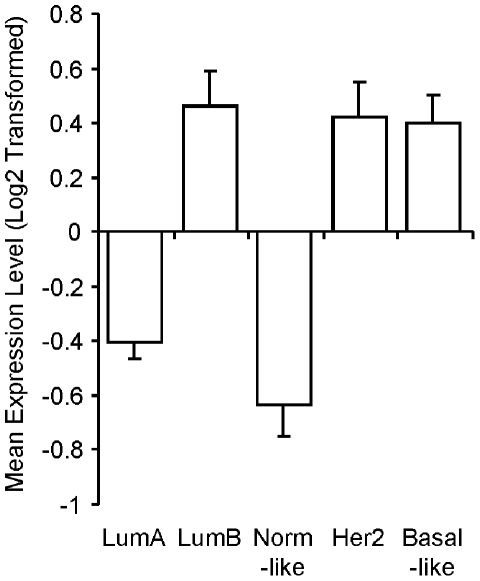
Approximately half of estrogen receptor (ER) positive breast tumors will fail to respond to endocrine therapy. Here we used an integrative bioinformatics approach to analyze three gene expression profiling data sets from breast tumors in an attempt to uncover underlying mechanisms contributing to the development of resistance and potential therapeutic strategies to counteract these mechanisms. Genes that are differentially expressed in tamoxifen resistant vs. sensitive breast tumors were identified from three different publically available microarray datasets. These differentially expressed (DE) genes were analyzed using gene function and gene set enrichment and examined in intrinsic subtypes of breast tumors. The Connectivity Map analysis was utilized to link gene expression profiles of tamoxifen resistant tumors to small molecules and validation studies were carried out in a tamoxifen resistant cell line. Despite little overlap in genes that are differentially expressed in tamoxifen resistant vs. sensitive tumors, a high degree of functional similarity was observed among the three datasets. Tamoxifen resistant tumors displayed enriched expression of genes related to cell cycle and proliferation, as well as elevated activity of E2F transcription factors, and were highly correlated with a Luminal intrinsic subtype. A number of small molecules, including phenothiazines, were found that induced a gene signature in breast cancer cell lines opposite to that found in tamoxifen resistant vs. sensitive tumors and the ability of phenothiazines to down-regulate cyclin E2 and inhibit proliferation of tamoxifen resistant breast cancer cells was validated. Our findings demonstrate that an integrated bioinformatics approach to analyze gene expression profiles from multiple breast tumor datasets can identify important biological pathways and potentially novel therapeutic options for tamoxifen-resistant breast cancers.
大约有一半的雌激素受体 (ER) 阳性乳腺癌肿瘤对内分泌治疗无反应。在这里,我们使用综合生物信息学方法分析了来自乳腺癌肿瘤的三个基因表达谱数据集,试图揭示导致耐药性的潜在机制和潜在的治疗策略来对抗这些机制。从三个不同的公共微阵列数据集鉴定出在他莫昔芬耐药与敏感乳腺癌肿瘤中差异表达的基因。使用基因功能和基因集富集分析这些差异表达 (DE) 基因,并在乳腺癌肿瘤的固有亚型中进行检查。连接映射分析用于将他莫昔芬耐药肿瘤的基因表达谱与小分子相关联,并在他莫昔芬耐药细胞系中进行验证研究。尽管在他莫昔芬耐药与敏感肿瘤中差异表达的基因之间几乎没有重叠,但在三个数据集之间观察到高度相似的功能。他莫昔芬耐药肿瘤显示与细胞周期和增殖相关的基因表达丰富,以及 E2F 转录因子的活性升高,并且与 Luminal 固有亚型高度相关。发现了一些小分子,包括吩噻嗪类药物,它们在乳腺癌细胞系中诱导了与他莫昔芬耐药与敏感肿瘤相反的基因特征,并且吩噻嗪类药物下调 cyclin E2 并抑制他莫昔芬耐药乳腺癌细胞增殖的能力得到了验证。我们的研究结果表明,综合生物信息学方法分析来自多个乳腺癌肿瘤数据集的基因表达谱可以识别重要的生物学途径,并为他莫昔芬耐药乳腺癌提供潜在的新治疗选择。