Univ. de Bordeaux, Bordeaux, France.
BMC Cardiovasc Disord. 2011 Jul 26;11:46. doi: 10.1186/1471-2261-11-46.
While the factors for poor adherence for treatment with statins have been highlighted, the impact of their combination on adherence is not clear.
To estimate adherence for statins and whether it differs according to the number of cardiovascular risk factors.
A cohort study was conducted using data from the main French national health insurance system reimbursement database. Newly treated patients with statins between September 1 and December 31, 2004 were included. Patients were followed up 15 months. The cohort was split into three groups according to their number of additional cardiovascular risk factors that included age and gender, diabetes mellitus and cardiovascular disease (using co-medications as a proxy). Adherence was assessed for each group by using four parameters: (i) proportion of days covered by statins, (ii) regularity of the treatment over time, (iii) persistence, and (iv) the refill delay.
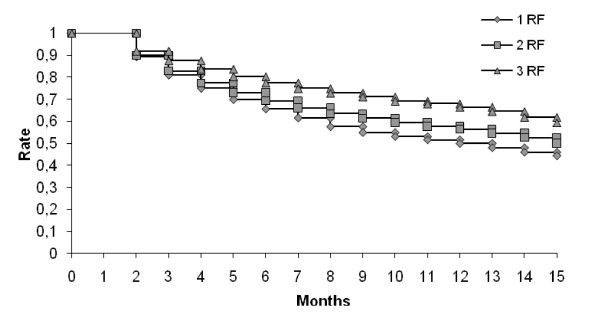
16,397 newly treated patients were identified. Of these statin users, 21.7% did not have additional cardiovascular risk factors. Thirty-one percent had two cardiovascular risk factors and 47% had at least three risk factors. All the parameters showed a sub-optimal adherence whatever the group: days covered ranged from 56% to 72%, regularity ranged from 23% to 33% and persistence ranged from 44% to 59%, but adherence was better for those with a higher number of cardiovascular risk factors.
The results confirm that long-term drug treatments are a difficult challenge, particularly in patients at lower risk and invite to the development of therapeutic education.
尽管已经强调了他汀类药物治疗依从性差的因素,但它们联合使用对依从性的影响尚不清楚。
评估他汀类药物的依从性,以及它是否因心血管危险因素的数量而异。
采用法国主要国家健康保险系统报销数据库中的数据进行队列研究。纳入 2004 年 9 月 1 日至 12 月 31 日期间新接受他汀类药物治疗的患者。患者随访 15 个月。该队列根据其附加心血管危险因素的数量分为三组,包括年龄和性别、糖尿病和心血管疾病(使用合并用药作为替代指标)。通过使用以下四个参数评估每个组的依从性:(i)他汀类药物覆盖的天数比例,(ii)随着时间的推移治疗的规律性,(iii)持久性,以及(iv)补充延迟。
共确定了 16397 名新接受他汀类药物治疗的患者。在这些他汀类药物使用者中,21.7%没有其他心血管危险因素。31%有两个心血管危险因素,47%有至少三个危险因素。无论组内情况如何,所有参数均显示出次优的依从性:覆盖天数从 56%到 72%不等,规律性从 23%到 33%不等,持久性从 44%到 59%不等,但在心血管危险因素数量较高的患者中,依从性更好。
研究结果证实,长期药物治疗是一项艰巨的挑战,特别是对风险较低的患者,这需要开展治疗教育。